
Highlights
- China Rare Earth Group and Nankai University signed a strategic cooperation agreement in Tianjin on June 8, covering emerging tech sectors from medical devices to cybersecurity.
- The partnership targets advanced applications including interventional brain-computer interfaces, stent-based drug delivery, turbojet low-altitude aircraft, and digital infrastructure.
- Nankai's Medical School, School of Computer Science, and School of Cryptography all participated, signaling a broad multidisciplinary approach beyond traditional materials science.
- No specific funding, patents, or commercialization timelines were disclosed, but the agreement reflects China's coordinated strategy to link rare earth supply chains with next-generation technology development.
- Western analysts should note China's accelerating push to move beyond supplying critical materials and toward owning the industries that consume them.
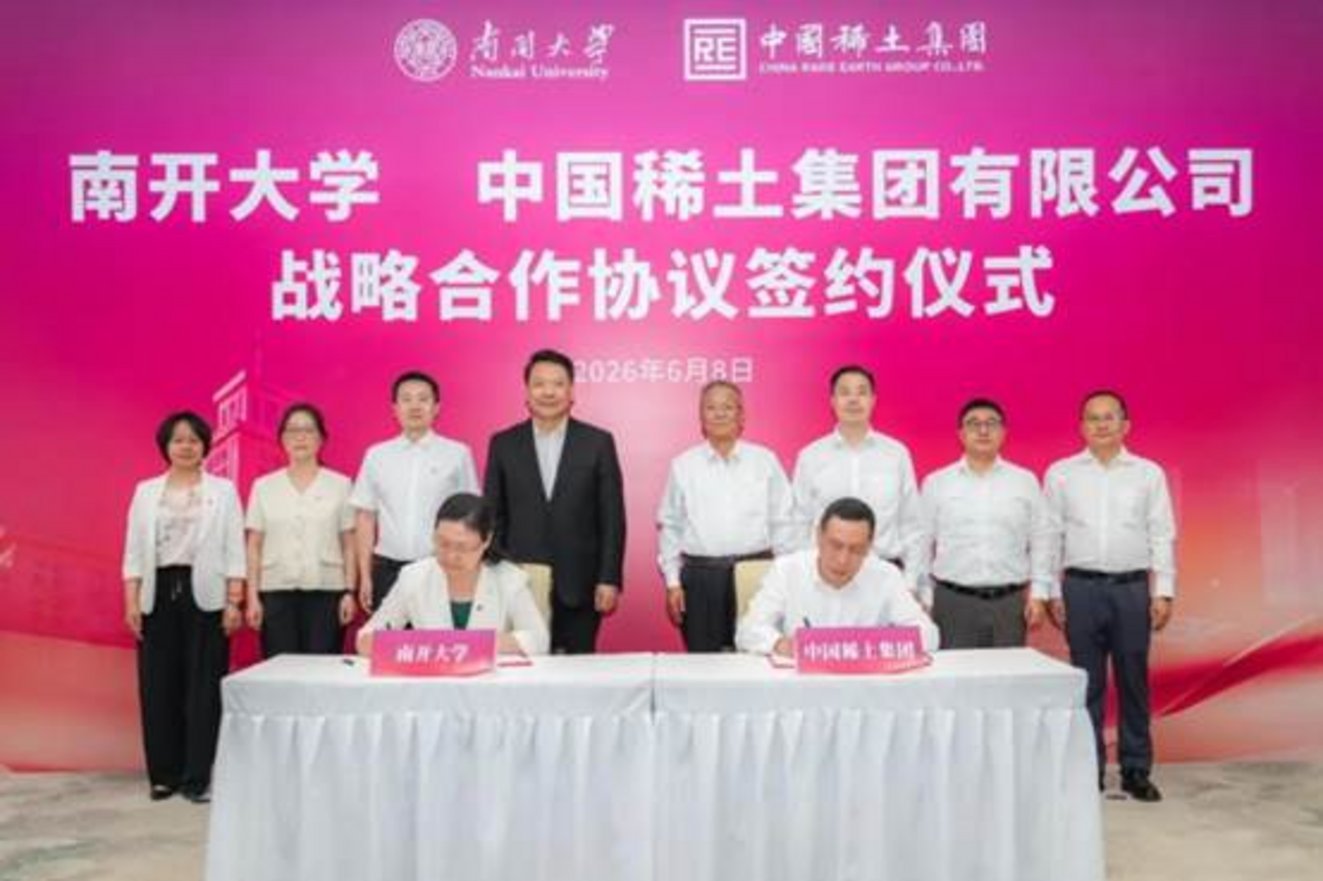
The relentless move by China’s rare earth players to move up the value chain. One of China's largest state-owned rare earth enterprises is signaling an ambition that extends well beyond mining, separation, refining, and permanent magnets. That is because on June 8, China Rare Earth Group (CREG) and Nankai University signed a strategic cooperation agreement in Tianjin aimed at accelerating research, technology commercialization, and talent development across a range of emerging technology sectors. The agreement was witnessed by Liu Leiyun, Party Secretary and Chairman of China Rare Earth Group, and Chen Yulu, President of Nankai University.
While the announcement contains no immediate commercial project or technical breakthrough, it provides a revealing look into how China is attempting to connect strategic materials, university research, and future industrial applications into a single innovation ecosystem.
Rare Earths Meet Medicine, Aerospace, and Computing
According to the announcement, both sides will explore cooperation in several emerging application areas, including:
- Interventional brain-computer interface technologies
- Stent-based targeted drug delivery systems
- Turbojet-powered low-altitude aircraft
- Advanced medical technologies
- Digital technologies and cybersecurity-related fields
The agreement also covers basic research, scientific breakthroughs, technology transfer and commercialization, talent cultivation, and collaborative innovation programs. Particularly noteworthy was the participation of officials from Nankai University's Medical School, School of Computer Science, and School of Cryptography and Cyberspace Security, indicating that the initiative is intended to be multidisciplinary rather than confined to traditional materials science.
No Breakthrough Announced—But a Strategic Signal
The announcement does not disclose specific technologies, patents, funding commitments, commercialization timelines, joint ventures, or research budgets. Nor does it identify which rare earth materials might be used in the proposed application areas. Instead, the agreement establishes a framework for future collaboration between one of China's most strategically important materials companies and one of its leading research universities.
This approach mirrors a broader Chinese industrial strategy that seeks to integrate industry, academia, research institutions, and commercialization pathways under coordinated national development goals.
Why Western Readers Should Pay Attention
For American and European audiences, the significance lies less in what was announced than in who is collaborating. China Rare Earth Group sits at the center of China's rare earth strategy, particularly in medium and heavy rare earth supply chains. Nankai University is among China's premier research institutions, with strengths spanning chemistry, materials science, medicine, computing, engineering, and applied research.
The partnership suggests China is increasingly focused on developing higher-value rare earth applications where advanced materials intersect with biotechnology, aerospace systems, artificial intelligence, medical devices, and digital infrastructure.
In other words, China appears to be looking beyond simply supplying critical materials and toward creating the next generation of technologies that consume them.
Organization and Contacts List
China Rare Earth Group (CREG)
China Rare Earth Group is China's flagship state-owned rare earth enterprise, formed through the consolidation of major rare earth assets under Beijing's strategic resource policy. The company plays a central role in the production, separation, processing, and commercialization of rare earth materials, particularly medium and heavy rare earth elements.
Key Executive:
- Liu Leiyun — Party Secretary and Chairman
Nankai University
Founded in 1919 and located in Tianjin, Nankai University is one of China's leading research universities. It is particularly recognized for chemistry, materials science, economics, medicine, computer science, and advanced engineering research.
Key Executive:
- Chen Yulu — President
Participating Academic Units Mentioned in the Announcement:
- Medical School Construction Office
- Medical School
- School of Computer Science
- School of Cryptography and Cyberspace Security
Additional Participants
China Rare Earth Group
- Xie Zhihong — Party Committee Member and Vice President
Nankai University
- Zhao Meirong — Executive Deputy Secretary of the Party Committee
- Yu Hai — Assistant President and host of the signing ceremony
REEx Assessment: China Is Building the Entire Innovation Stack
Another agreement reinforces a theme Rare Earth Exchanges® has chronicled repeatedly: China is leveraging its rare earth supply chain dominance not merely to control critical materials, but to position itself at the forefront of future industries. While Western policymakers often focus on mining, separation, refining, and magnet production, China continues building deeper connections among strategic materials, university research, technology commercialization, and emerging sectors.
The partnership's focus on brain-computer interfaces, targeted drug delivery systems, and low-altitude aerospace platforms suggests an effort to cultivate entirely new sources of demand for advanced materials, including rare earth-enabled technologies. No breakthrough was announced, but the broader signal is significant. China relentlessly pursues a coordinated "mine-to-application" strategy that integrates resource extraction, scientific research, talent development, manufacturing, and innovation ecosystems. The agreement itself changes little today, but it offers another glimpse into how China intends to compete for technological leadership tomorrow. Much like the nation has done to dominate certain industries, such as electric vehicles, green energy, and the like.
Source Disclosure: This report originates from China Rare Earth Group, a state-owned enterprise operating within China's strategic rare earth sector. The information should be independently verified where possible. The announcement describes a strategic cooperation framework and research partnership rather than a confirmed technological breakthrough, commercial product launch, funded development program, or binding investment commitment.


0 Comments
No replies yet
Loading new replies...
Moderator
Join the full discussion at the Rare Earth Exchanges Forum →