
Highlights
- China's 2024 Rare Earth Management Regulations and 2025 export controls formalize rare earths as dual-use military-civil strategic assets under unified state control.
- State-owned giants like China Rare Earth Group, China Minmetals, and China Northern Rare Earth form a vertically integrated ecosystem spanning mining to advanced magnet manufacturing.
- The PLA benefits not from direct supplier contracts but from a national strategic materials architecture that accelerates military innovation from lab to production.
- U.S. defense systems including the F-35, Virginia-class submarines, and directed-energy weapons depend on rare earth processing overwhelmingly concentrated in China.
- The Trump administration is mobilizing investments in MP Materials, USA Rare Earth, Lynas, and others, but a fully integrated domestic supply chain is unlikely before 2030.
China's rare earth system is not merely a mining business. Chinese government documents, company disclosures, industrial plans, and policy statements reveal a party-state-directed, vertically integrated supply chain stretching from mining and separation to metals, magnets, motors, advanced materials, and high-end manufacturing. The 2024 Rare Earth Management Regulations place mining, smelting, metal production, circulation, and trade under unified state supervision to safeguard "national resource security" and "industrial security." Meanwhile, the Ministry of Industry and Information Technology's (MIIT) 14th Five-Year Plan for Raw Materials identifies rare earths as a strategic sector essential to strengthening industrial-chain security and advancing high-end materials capabilities.
That matters because Beijing increasingly treats rare earths as explicitly dual-use assets. In 2025, China's Ministry of Commerce and Customs expanded export controls covering medium and heavy rare earth products, including samarium-cobalt magnets and materials involving dysprosium, terbium, yttrium, and scandium. Commentary distributed through official Chinese channels emphasized that rare earth products possess clear military-civil dual-use characteristics and play indispensable roles in advanced defense systems. A beneficiary—the People’s Liberation Army (opens in a new tab) (PLA).
PLA Navy Bases
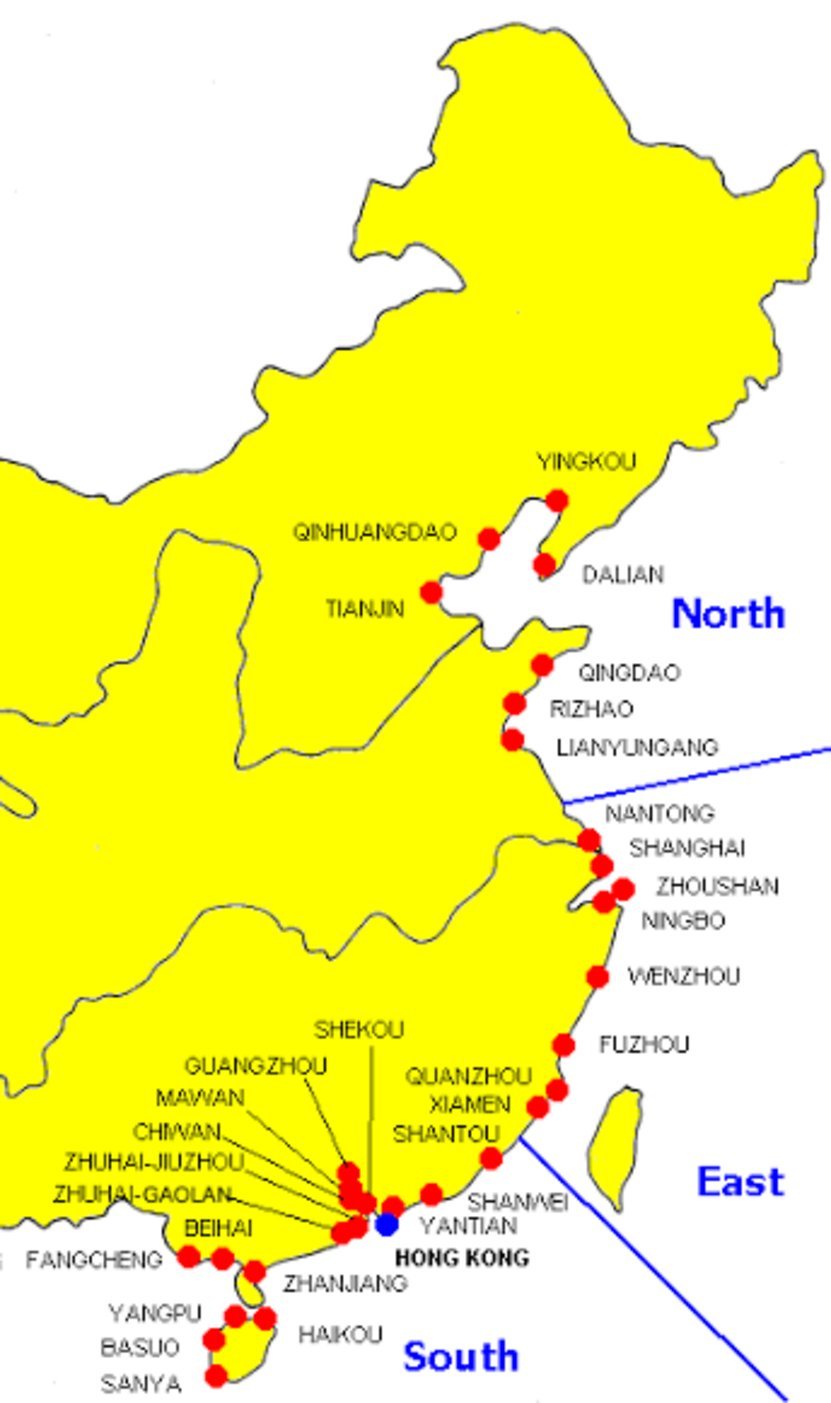
Source: Global Security.org
The Companies That Matter
China Rare Earth Group represents perhaps the clearest manifestation of Beijing's strategy. Established under State Council supervision through the consolidation of rare earth assets from Chinalco, China Minmetals, and Ganzhou Rare Earth, the company also absorbed major state-backed research institutions, creating a national champion spanning the full value chain. Company materials describe an organization dedicated to protecting strategic rare earth security, maintaining supply-chain stability, and advancing functional materials development through nationally coordinated innovation platforms.
China Minmetals remains a foundational pillar of this system. Official materials describe the company as a centrally managed state-owned enterprise tasked with advancing technological innovation, industrial control, and national security support. Its rare earth operations span mining, separation, deep processing, research and development, and global trade, illustrating Beijing's preference for integrated industrial platforms rather than isolated commodity producers.
China Northern Rare Earth (part of Baogang Group), anchored in Baotou and supported by the world-class Bayan Obo deposit, remains one of the country's most important rare earth enterprises. The company's operations extend from oxides and metals to magnets, hydrogen-storage materials, polishing compounds, and permanent-magnet motors. Extensive investments in research and development reinforce its role as both a producer and technology developer.
Shenghe Resources operates with a more commercially visible profile but remains deeply connected to China's broader state-directed resource strategy. The company has pursued international feedstock opportunities while emphasizing the strategic importance of rare earths to aerospace, defense, and advanced manufacturing sectors.
The PLA Link and the Blind Spot
The strongest publicly available evidence does not point to a simple list of suppliers selling directly to the People's Liberation Army. Rather, it points to a strategic materials architecture from which the PLA can draw.
Central state-owned enterprises, military-civil fusion initiatives, coordinated innovation platforms, party-led governance structures, and dual-use export controls collectively create a system designed to ensure that critical materials capabilities remain aligned with national priorities. Chinese regional development plans increasingly describe industrial chains that progress from rare earth oxides to metals, magnetic materials, permanent-magnet motors, and ultimately high-end equipment manufacturing. The result is a national ecosystem rather than a collection of independent firms.
Why Monopoly Fuels Military Innovation
China's greatest advantage may not be control of ore deposits but control of learning. Permanent magnets remain the crown jewel of the rare earth value chain. Rare earth oxides possess limited strategic value until they are transformed into metals, alloys, and ultimately high-performance NdFeB and samarium-cobalt magnets. China controls the overwhelming majority of global rare earth magnet manufacturing capacity, enabling it to capture both the economic value and technological know-how generated downstream.
China's rare earth dominance gives the PLA advantages that extend far beyond access to raw materials. By controlling much of the world's refining, metallization, magnet manufacturing, and advanced rare-earth materials production, China has created an industrial ecosystem that allows military-relevant innovations to move rapidly from laboratory research into production. Rare earth elements are critical components in precision-guided munitions, advanced radar systems, electronic warfare equipment, fighter aircraft, naval propulsion systems, drones, satellites, directed-energy weapons, and secure communications technologies.
Chinese state-backed firms, research institutes, and military-civil fusion programs operate within a tightly coordinated framework that compresses the distance between mine, factory, and defense laboratory. This integrated structure enables faster experimentation with next-generation permanent magnets, laser crystals, high-temperature alloys, sensors, and electric-drive systems while reducing dependence on foreign suppliers. The strategic advantage is therefore not simply resource control—it is China's ability to translate rare earth supply-chain dominance into accelerated military innovation, manufacturing resilience, and technological self-sufficiency.
Dependence on a Strategic Competitor & Potential Adversary
The United States faces a significant strategic disadvantage because many of its most advanced defense systems—including the F-35 fighter, Virginia-class submarines, precision-guided munitions, radar systems, satellites, drones, and emerging directed-energy weapons—depend on rare earth elements and other critical minerals whose processing and manufacturing remain heavily concentrated in China. Beijing's dominance extends far beyond mining into refining, metallization, magnet production, battery materials, and advanced functional materials, giving China the ability to influence supply availability and pricing at critical points across the defense industrial base.
In a prolonged geopolitical crisis, America will find itself competing for access to essential inputs that underpin weapons production, maintenance, and technological innovation. As Rare Earth Exchanges® has continued to publicize, the vulnerability is magnified by the years required to build alternative mine-to-magnet supply chains, making dependence on Chinese-controlled critical mineral ecosystems one of the most consequential industrial and national security risks facing the United States and its allies.
Race to Resilience
Recognizing this vulnerability, the Trump administration has accelerated what amounts to one of the largest U.S. industrial mobilization efforts in decades focused on mine-to-magnet resilience. The effort began with the Department of Defense's landmark investment in MP Materials (MP) and has expanded through support for USA Rare Earth (USAR), financing initiatives involving ReElement Technologies and Vulcan Elements, and significant commitments to Phoenix Tailings and Energy Fuels (UUUU). The Office of Strategic Capital (opens in a new tab) led by Dr. Jason Rathj has emerged as one of the federal government's most important financing vehicles for critical mineral supply chains, working alongside the Departments of Defense, Energy, Commerce, and State. The Pentagon has also inked a deal with the leading “ex-China” rare earth company Lynas Rare Earths (LYSCF).

Importantly, many of these investments target the true chokepoints in the Western supply chain—separation, refining, metallization, magnet manufacturing, and advanced materials production—rather than mining alone. Policymakers increasingly recognize that strategic vulnerability resides downstream, where China maintains its greatest advantages.
Yet time unfortunately remains America's greatest adversary. While many projects publicly target commissioning by 2028, Rare Earth Exchanges' assessment suggests that meaningful commercial-scale production across a fully integrated domestic mine-to-magnet ecosystem is more likely to emerge closer to 2030, and even beyond. The consequence is a strategic vulnerability window extending through much of the decade. Even under optimistic assumptions, China will likely retain substantial advantages in separation, metallization, magnet manufacturing, and advanced rare earth materials through at least 2030.
The strategic lesson is becoming increasingly clear to anyone with their eyes open in the West. The contest is no longer about who owns the most rare earth ore. It is about who controls the industrial ecosystem that transforms those materials into economic power, technological leadership, and military capability. On that battlefield, China has spent decades building an integrated advantage that the West is only beginning to challenge.
China brings to this contest a culture of long-term, comprehensive, and patient strategic planning that spans decades rather than election cycles. By contrast, Western democracies—and particularly the highly financialized Anglo-American economies—often struggle with short-term political horizons, quarterly earnings pressures, and shifting policy priorities. This asymmetry matters.
The United States is not merely racing to catch China; it is competing in what Rare Earth Exchanges calls Great Powers Era 2.0 against multiple nations seeking critical mineral security, advanced manufacturing capacity, and supply-chain resilience. Building a mine-to-magnet ecosystem is not simply a matter of capital investment (and investor get-rich-fast programs)—it is a generational industrial undertaking. China has spent more than three decades constructing its strategic advantage. The West is attempting to compress that timeline into a handful of years. This means we are in the early innings of a long game.
Did you know Rare Earth Exchanges® is developing REEx Connect? Meaning the world’s rare earth and critical mineral deal makers are going into a global database. Register today: REEx Marketplace™ (opens in a new tab)


0 Comments
No replies yet
Loading new replies...
Moderator
Join the full discussion at the Rare Earth Exchanges Forum →