
Highlights
- The CREIA Rare Earth Price Index rose 2.29% to 267.9 on June 24, continuing a broader uptrend well above 2024 levels.
- Heavy rare earths and magnet materials led gains, with terbium oxide, dysprosium oxide, holmium, gadolinium, and NdPr products all reported higher.
- China's rare earth prices reflect a state-managed market with production quotas, export licensing, and strategic stockpiling rather than free-market discovery.
- Ex-China price transparency remains limited, with most transactions conducted through bilateral agreements, offtake contracts, and opaque broker networks.
- Western diversification efforts are advancing, but meaningful ex-China supply depth and transparent price discovery remain incomplete.
The China Rare Earth Industry Association reported that its Rare Earth Price Index rose to 267.9 on June 24, up from 261.9 on June 23, representing a 2.29% daily increase. The index uses 2010 transaction data as its base year (100) and is calculated using transaction information reported by domestic Chinese rare earth enterprises.
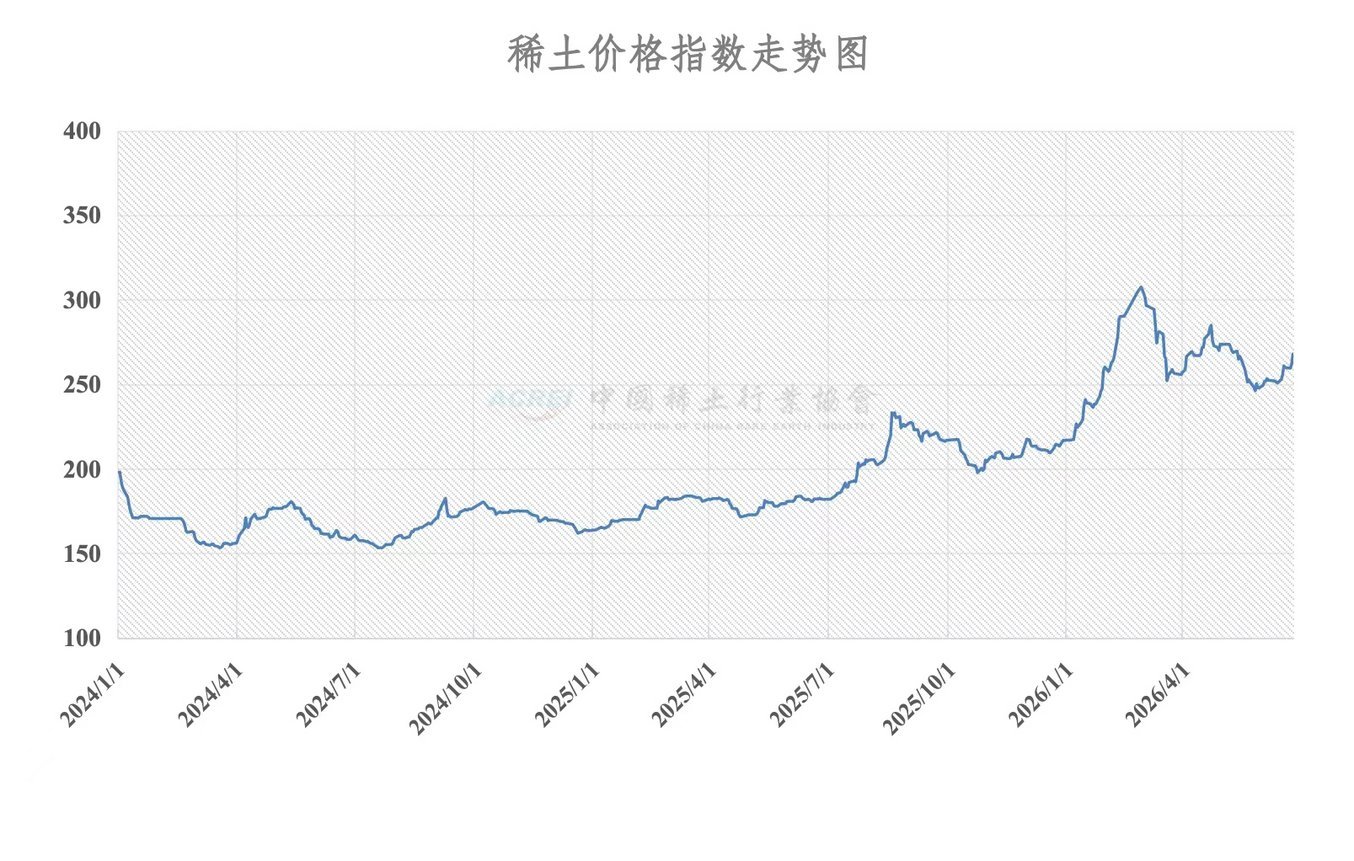
The accompanying chart indicates the index remains substantially above 2024 levels and continues a broader uptrend that accelerated during late 2025 and early 2026. While prices remain below the spring 2026 peak near 300, recent momentum suggests continued firmness in strategic rare earth materials.
Magnet Materials and Heavy Rare Earths Lead the Move
The most significant development in today's report is continued strength across both the heavy rare earth segment and portions of the magnet rare earth supply chain.
Key Strategic Rare Earth Prices—China Index
| Product | Price (Yuan/kg) | Price (USD/kg) |
|---|---|---|
| Terbium Oxide (≥99.9%) | ¥6,425–6,485 | $944–953 |
| Dysprosium Oxide (≥99%) | ¥1,395–1,435 | $205–211 |
| NdPr Oxide (75% Nd₂O₃) | ¥740–760 | $108.8–111.7 |
| NdPr Alloy (75% Nd) | ¥903.3–923.3 | $132.8–135.7 |
| Medium-Yttrium, Europium-Rich Ore (TREO ≥92%) | ¥239–249 | $35.1–36.6 |
Products Reported Higher
CREIA reported price increases in:
- Gadolinium oxide
- Gadolinium-iron alloy
- Terbium oxide
- Dysprosium oxide
- Holmium oxide
- Holmium-iron alloy
- Erbium oxide
- NdPr oxide
- NdPr alloy
- Medium-yttrium, europium-rich ore concentrate
Most light rare earth products, including cerium and lanthanum compounds, were reported as unchanged.
What Matters for Western Investors?
The key takeaway is not movement in abundant light rare earths. Rather, it is the continued firmness of materials critical to high-performance permanent magnets used in:
- Defense systems
- Electric vehicles
- Robotics
- Aerospace
- Wind turbines
- Advanced industrial automation
The continued rise in dysprosium, terbium, holmium, and NdPr products suggests strategic supply remains tight despite global efforts to diversify supply chains away from China.
China's Prices Are Not Traditional Market Prices
Investors should recognize that Chinese rare earth prices are not equivalent to prices formed through purely competitive commodity markets.
China's rare earth sector operates through a hybrid model that combines:
- State-directed industrial policy
- Production quotas
- Export licensing
- Strategic stockpiling
- Industry consolidation
- National security considerations
As a result, Chinese domestic prices should be viewed as signals emerging from a managed market environment rather than pure market discovery.
The Ex-China Pricing Challenge
Ironically, determining "real" rare earth pricing outside China can be even more difficult.
Approximately 10–15% of global rare earth separation capacity currently exists outside China (about 98% of heavies), leaving most ex-China transactions negotiated through:
- Bilateral supply agreements
- Long-term offtake contracts
- Strategic partnerships
- Confidential commercial arrangements
Transparent spot-market activity remains limited and is conducted via a shadowy network of traders and brokers. Some of these traders specialize in finding obscure sources, nearly always China-based. Ever more stringent China rules make it more difficult for these traders to access product.
Price reporting agencies often rely on trader submissions, broker indications, and selective market surveys. Consequently, published ex-China prices frequently represent only partial snapshots of a fragmented and largely opaque marketplace. While there is some value, these price points may be deceiving as well.
The announced (July 2025) U.S. government support package for MP Materials effectively establishes an NdPr revenue floor near $110/kg for qualifying production volumes. Whether that benchmark ultimately influences broader commercial contracting remains uncertain.
Bottom Line
The June 24 CREIA report points to continued strength in strategic rare earth materials, particularly across the heavy rare earth and magnet-material segments. The rise of the Rare Earth Price Index to 267.9, coupled with gains in terbium, dysprosium, holmium, gadolinium, and NdPr products, suggests ongoing tightness in some of the world's most strategically important mineral supply chains.
For Western governments, manufacturers, and investors, the message remains clear: diversification efforts are advancing, but meaningful ex-China supply depth and transparent price discovery remain works in progress.
Source: China Rare Earth Industry Association (CREIA), June 24, 2026. Information provided for reference only and should be independently verified. Rare Earth Exchanges analysis and commentary.
Important Disclaimer: This information originates from the China Rare Earth Industry Association, an industry body operating within China's state-directed rare earth sector. The underlying data should be independently verified. China's rare earth market operates within a framework of state planning, production quotas, export controls, strategic stockpiling, and industrial policy that differs significantly from traditional free-market commodity systems.
Register today: REEx Marketplace™ (opens in a new tab)


0 Comments
No replies yet
Loading new replies...
Moderator
Join the full discussion at the Rare Earth Exchanges Forum →