
Highlights
- China domestic reference prices show NdPr oxide near US$110–113/kg and terbium oxide near US$964–973/kg, but these reflect state-shaped markets, not true global discovery prices.
- Ex-China strategic deals reveal stark premiums: Serra Verde–USA Rare Earth floor prices sit at roughly US$575/kg for dysprosium and US$2,050/kg for terbium, multiples above China's domestic reference.
- NdPr oxide may be emerging as the first credible ex-China benchmark, with Western long-term agreements aligning near the US$110/kg level seen in China's domestic market.
- Heavy rare earths increasingly trade as strategic security assets rather than commodities, where geopolitical risk, export licensing, and traceability drive prices far above Chinese reference levels.
- Transparent price discovery in rare earths remains a work in progress globally, with both China and ex-China pricing incomplete, politicized, and difficult to independently verify.
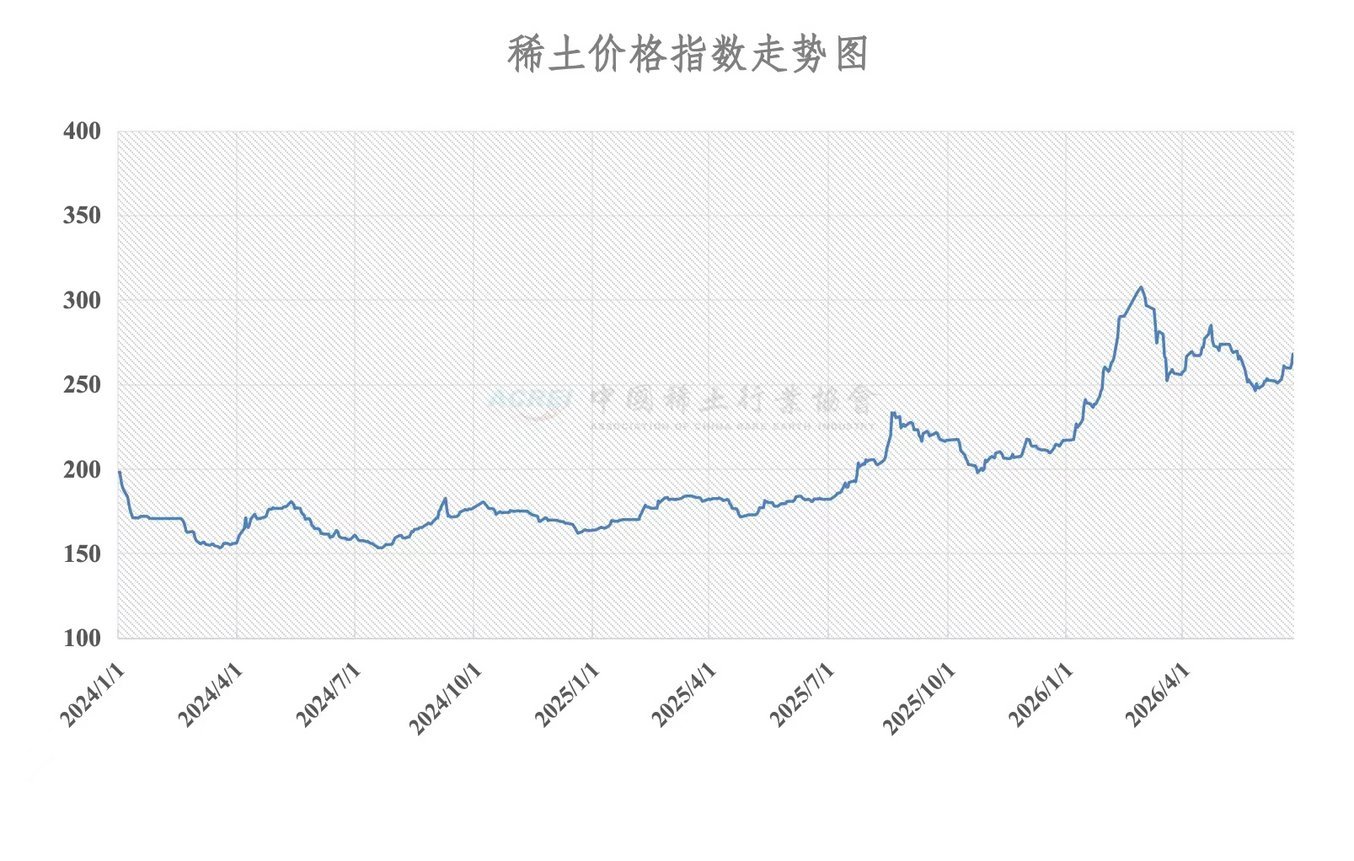
The China Rare Earth Industry Association reported a June 25, 2026 rare earth price index of 266.4, with 2010 as the base year of 100. CREIA says the index is calculated from domestic transaction data reported by Chinese rare earth enterprises and is provided for reference only, not investment advice.
China’s Reference Sheet
Using ¥1 = US$0.15, key June 25 China domestic reference prices include: NdPr oxide at ¥734–754/kg, or US$110.10–113.10/kg; NdPr alloy at ¥901–921/kg, or US$135.15–138.15/kg; dysprosium oxide at ¥1,395–1,435/kg, or US$209.25–215.25/kg; and terbium oxide at ¥6,425–6,485/kg, or US$963.75–972.75/kg. Holmium oxide was listed at ¥554.5–574.5/kg, or US$83.18–86.18/kg, while medium-yttrium, europium-rich ore was ¥239–249/kg, or US$35.85–37.35/kg.
The reported data shows gadolinium products rising, while zirconium oxide, scandium oxide, and NdPr-related mixed products declined. Most other listed products were flat.
Why This Matters
The index remains elevated, underscoring that rare earths are no longer merely industrial inputs. They are strategic materials. NdPr sits near the increasingly important US$110/kg level, while dysprosium and terbium remain pressure points for permanent magnets, defense systems, EVs, wind turbines, robotics, drones, and advanced electronics.
Buyer Beware: China Price Is Not World Price
These are China domestic reference prices, not true global market-discovery prices. China’s rare earth market is shaped by state intervention, production quotas, export controls, industrial policy, stockpiling, consolidation, and national security objectives. It operates as part of a hybrid socialist-capitalist state-control mechanism. The ex-China market is also far from transparent.
With only a small minority of rare earth refining outside China, pricing is mostly over-the-counter, bilateral, confidential, and highly bespoke. Contract terms can reflect origin, purity, delivery point, qualification status, urgency, financing, traceability, and geopolitical risk. Pricing agencies often rely on trader snapshots, which may capture only a narrow slice of the market. Corporate buyers can easily overpay. Buyer beware.
The Western Signal
No breakthrough is reported in this CREIA update. The real signal is market structure. The West is not only trying to rebuild mines, refineries, metals, alloys, and magnets. It is trying to build credible price discovery in a market where both China pricing and ex-China pricing remain incomplete, politicized, and difficult to verify.
The contrast between China's domestic pricing and ex-China transactions has become increasingly pronounced, particularly for heavy rare earths. China's June 25 reference sheet lists dysprosium oxide at approximately US$209–215/kg and terbium oxide at approximately US$964–973/kg (using ¥1 = US$0.15). By comparison, recent strategic transactions outside China illustrate a very different market. The Serra Verde–USA Rare Earth agreement established long-term floor prices of roughly US$575/kg for dysprosium and US$2,050/kg for terbium—not as spot prices, but as financing and supply-security benchmarks. NdPr oxide presents a different picture.
China's domestic reference of approximately US$110–113/kg closely aligns with the US$110/kg floor appearing in several long-term Western agreements, suggesting NdPr may be emerging as the first meaningful ex-China benchmark.
Heavy rare earths, however, increasingly trade in what is best described as a strategic security market rather than a commodity market, where scarcity, export licensing, traceability, and geopolitical risk can drive transaction values to multiples of China's domestic reference prices. Investors should therefore view both China reference prices and reported ex-China prices as context—not definitive market-clearing values—in a global rare earth market where transparent price discovery remains a work in progress.
Disclaimer: This news item originates from the China Rare Earth Industry Association, a state-linked industry source. The information should be independently verified before commercial, investment, or policy use.
Register today: REEx Marketplace™ (opens in a new tab)


0 Comments
No replies yet
Loading new replies...
Moderator
Join the full discussion at the Rare Earth Exchanges Forum →