
Highlights
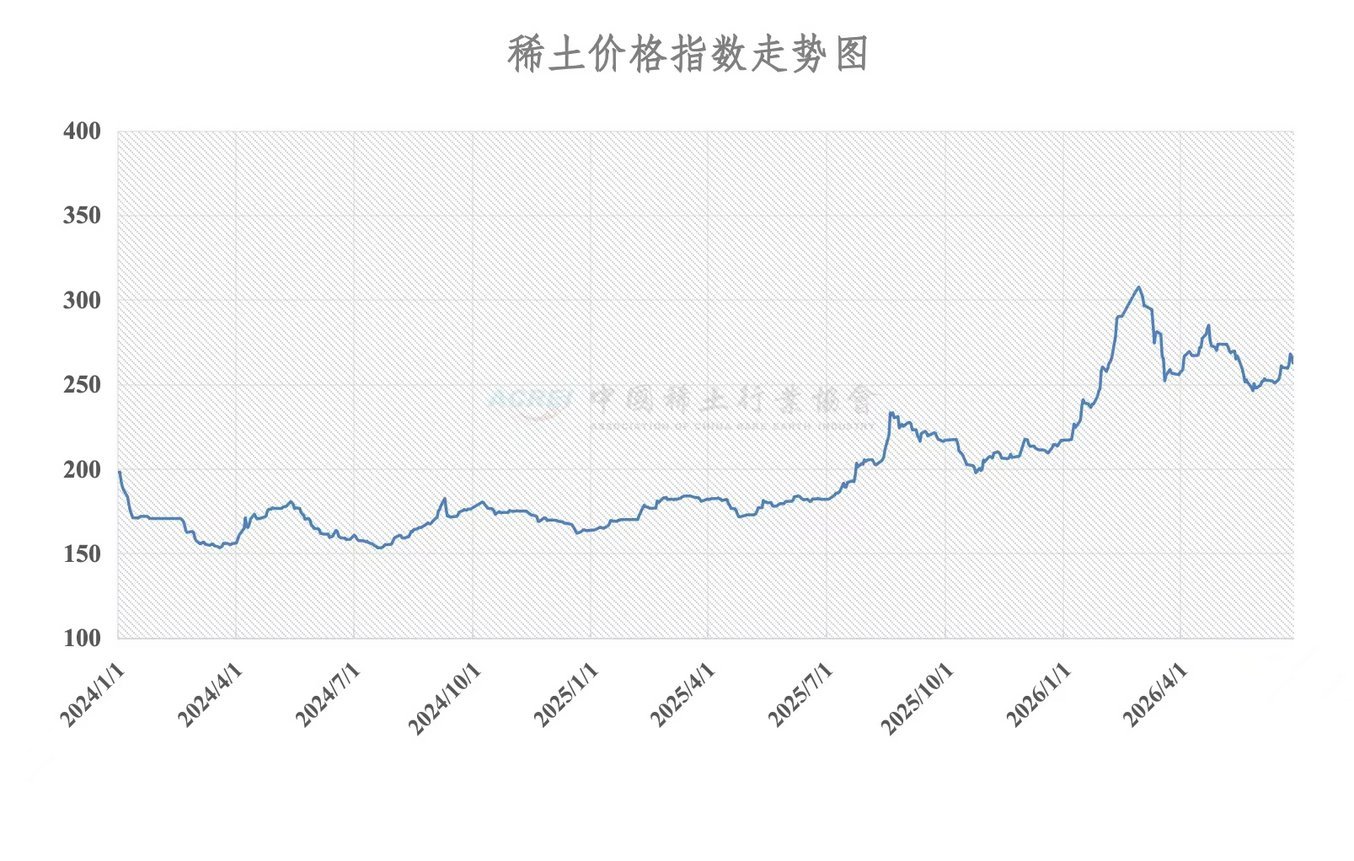
- CREIA's June 26 Rare Earth Price Index hit 262.6, with NdPr oxide at US$108–111/kg and terbium metal reaching US$1,198–1,213/kg.
- China's rare earth prices reflect production quotas, export licensing, and state policy—not simple supply and demand dynamics.
- Heavy rare earths like dysprosium and terbium increasingly trade as strategic security materials, commanding premiums above Chinese domestic references.
- NdPr is the closest product to developing a credible ex-China benchmark, loosely aligned with U.S. government floor pricing for MP Materials.
- A truly transparent ex-China rare earth market has yet to emerge, making independent analysis critical for investors and corporate buyers.
China's Rare Earth Industry Association (CREIA) reported a June 26, 2026 Rare Earth Price Index of 262.6, using 2010 as the base year (100). According to CREIA, the index is calculated from daily average transaction data collected from domestic rare earth enterprises.
The headline itself is not a major market event. While the index is benchmarked to 2010, today's reading remains well above most levels observed during 2024 and much of 2025, suggesting China's domestic rare earth pricing environment remains relatively firm.
Reading the Reference Sheet
CREIA's June 26 reference sheet showed most light rare earth products unchanged, while several heavy rare earth and mixed rare earth products softened. Using an exchange rate of ¥1 = US$0.15, selected reference prices include:
· NdPr oxide: ¥719–739/kg (US$108–111/kg)
· NdPr metal/alloy: ¥884.8–904.8/kg (US$133–136/kg)
· Dysprosium oxide: ¥1,395–1,435/kg (US$209–215/kg)
· Dysprosium metal: ¥1,765–1,785/kg (US$265–268/kg)
· Terbium oxide: ¥6,425–6,485/kg (US$964–973/kg)
· Terbium metal: ¥7,985–8,085/kg (US$1,198–1,213/kg)
Gadolinium oxide, holmium oxide, holmium iron, yttrium oxide, and mixed NdPr oxide were reported lower, while terbium metal and dysprosium metal edged higher.
The Price Mirage
No breakthrough is reported in today's update. The real signal is market structure.
CREIA's figures should be viewed as domestic Chinese reference prices, not globally discoverable market-clearing prices. China's rare earth market operates within a hybrid socialist-capitalist system shaped by production quotas, export licensing, industrial policy, state-owned enterprises, and national security priorities. As a result, prices reflect far more than simple supply and demand.
The ex-China market is no less challenging to interpret. Roughly 10% of global rare earth separation capacity currently exists outside China, and most commercial transactions remain bilateral, over-the-counter, confidential, and highly customized. Commercial pricing services provide valuable intelligence but often capture only a limited snapshot of an opaque market rather than true global price discovery. Investors and corporate buyers alike should interpret those assessments with appropriate caution.
The Western Signal
NdPr appears to be the closest product to developing a credible ex-China benchmark, with China's domestic reference near US$110/kg broadly aligning with the floor price established in the recent U.S. government's strategic support for MP Materials. Whether that evolves into an industry-wide benchmark remains an open question.
Heavy rare earths tell a different story. Dysprosium and terbium increasingly trade less as commodities than as strategic security materials, where traceability, export controls, supply assurance, and geopolitical risk can command premiums well above China's domestic references.
For investors, today's CREIA update is valuable context—not definitive price discovery. The world's first truly transparent ex-China rare earth market has yet to emerge, making independent analysis more important than ever.
Register today: REEx Marketplace™ (opens in a new tab)


0 Comments
No replies yet
Loading new replies...
Moderator
Join the full discussion at the Rare Earth Exchanges Forum →