
Highlights
- Terrain Minerals drilled 35 aircore holes at Lort River, with 25 intersecting rare earth mineralization, including 8m grading 3,349 ppm TREO with ~33% heavy rare earth oxides.
- The deposit appears clay-hosted but not ionic adsorption clay, suggesting a different and potentially costlier processing pathway than standard ammonium sulfate leaching.
- Heavy rare earths dysprosium, terbium, and yttrium are among the most strategically constrained materials in the global magnet supply chain outside China.
- Key unanswered questions include whether high-grade intervals can be replicated at scale, depth continuity, and whether metallurgical recoveries can support an economic flowsheet.
Most junior rare earth discoveries promise scale. Few immediately attract attention for their heavy rare earth content. Terrain Minerals' (opens in a new tab) (ASX: TMX) latest drilling at its Lort River Project near Esperance, Western Australia (opens in a new tab), delivered both encouraging grades and an unusually strong heavy rare earth component, including dysprosium, terbium, and yttrium. While still early-stage exploration, Rare Earth Exchanges® believes the project merits closer attention because heavy rare earths—not light rare earths—remain among the most strategically constrained materials in the global magnet supply chain.
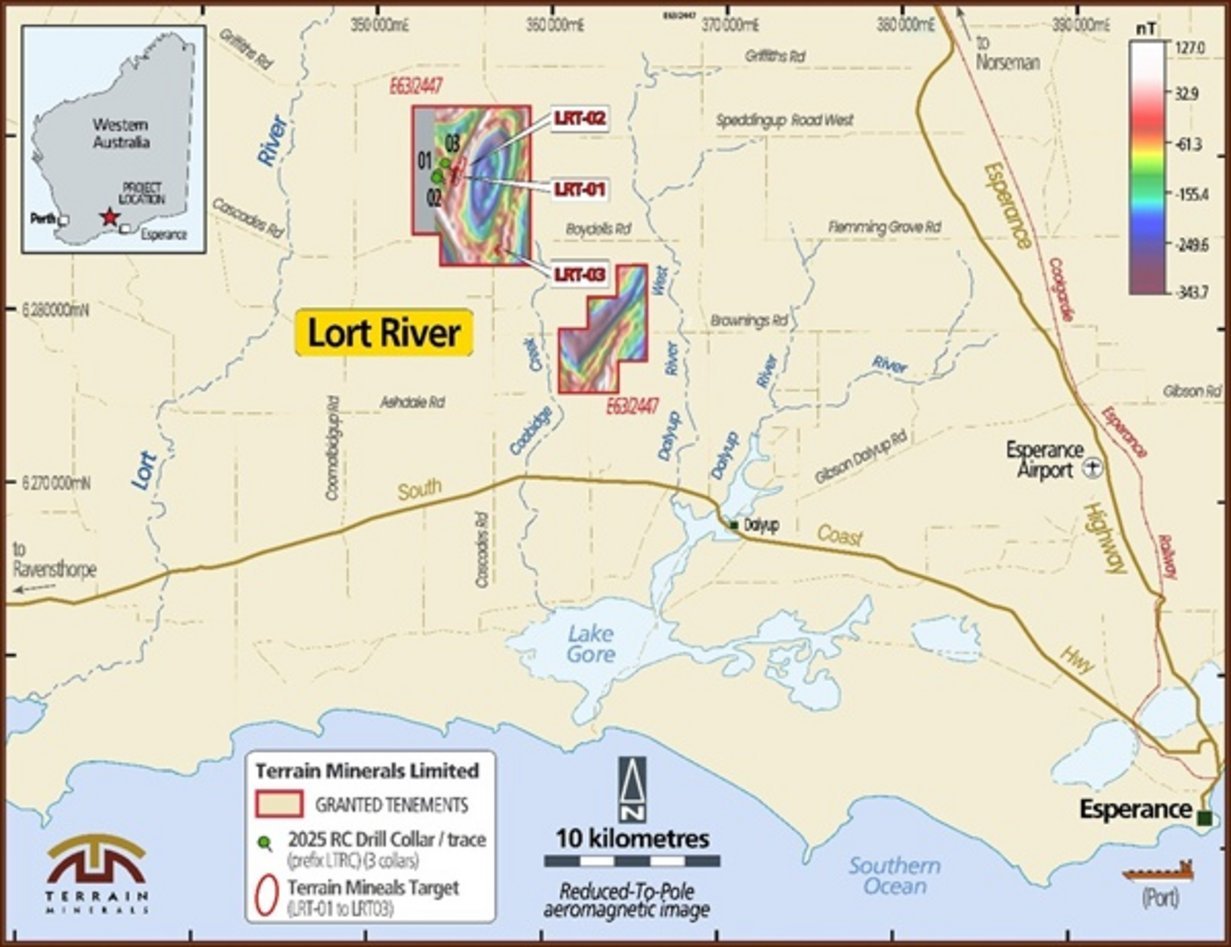
The Grade Is Encouraging—The Metallurgy Matters More
Terrain's 35-hole aircore program intersected rare earth mineralization in 25 of 35 holes, including 8 metres grading 3,349 ppm TREO with approximately 33% heavy rare earth oxides, while several holes ended in mineralization, indicating the system remains open.
Just as significant is what the company did not find.
Preliminary test work suggests Lort River is not an ionic adsorption clay deposit, despite being clay-hosted. Instead, the rare earths appear largely associated with clay-bound minerals such as monazite, implying a different processing pathway than the low-cost ammonium sulfate leaching used for ionic clay deposits. That distinction could materially influence future project economics.
The Questions That Matter
A piece today in The West Australian (opens in a new tab) correctly highlights the project's heavy rare earth potential, but investors should remain disciplined. Can the high-grade interval be replicated over meaningful tonnage? Will deeper drilling confirm continuity? Can metallurgical recoveries support an economic flowsheet? Until those questions are answered, Lort River remains a promising exploration story rather than a defined development project.
Company Profile: Terrain Minerals Ltd.
Terrain Minerals Ltd. (ASX: TMX) is an Australian mineral exploration company founded in 2011 and headquartered in Western Australia. Historically focused on gold, nickel, and base metals, the company has increasingly expanded into critical minerals exploration, with Lort River emerging as its flagship rare earth opportunity. Executive Director Justin Virgin (opens in a new tab), a former Canaccord investment banker, leads the company. Like most junior explorers, Terrain remains pre-revenue and funds exploration through equity capital. Its investment proposition now hinges on demonstrating that Lort River possesses not only attractive grades but also the metallurgy, scale, and economics required to become a commercially viable heavy rare earth project. In today's market, where ex-China supplies of dysprosium and terbium remain exceptionally scarce, those answers could prove far more valuable than the initial drill results themselves.
Register today: REEx Marketplace™ (opens in a new tab)


0 Comments
No replies yet
Loading new replies...
Moderator
Join the full discussion at the Rare Earth Exchanges Forum →