
Highlights
- China's Rare Earth Price Index climbed to 267.6, driven by gains in neodymium, terbium oxide, dysprosium alloys, and NdPr products amid tighter domestic supply.
- CREIA prices reflect China's state-directed industrial policy—including quotas, export licensing, and strategic stockpiling—not free-market price discovery.
- Outside China, roughly 90% of rare earth refining capacity remains Chinese, leaving ex-China markets thin, contract-driven, and largely invisible to pricing agencies.
- Heavy rare earths like terbium and dysprosium face physical availability constraints, with strategic bilateral deals setting prices far removed from any published benchmark.
- Investors are urged to look beyond headline indices and focus on where genuine liquidity and independent price discovery begin to emerge in ex-China supply chains.
China's Rare Earth Industry Association (CREIA) reported its domestic Rare Earth Price Index rose to 267.6 on July 2, 2026, continuing the gradual recovery that began late last year. While prices for most light rare earths were little changed, several strategically important magnet materials—including neodymium, gadolinium, dysprosium alloys, terbium oxide, and NdPr products—posted additional gains. Yet the published figures tell only part of the story. China's prices are products of a highly managed industrial system rather than a free market, while outside China the rare earth market remains remarkably opaque, fragmented, and often devoid of meaningful spot price discovery. For investors, the real pricing challenge is no longer understanding China—it's understanding the market that exists beyond it.
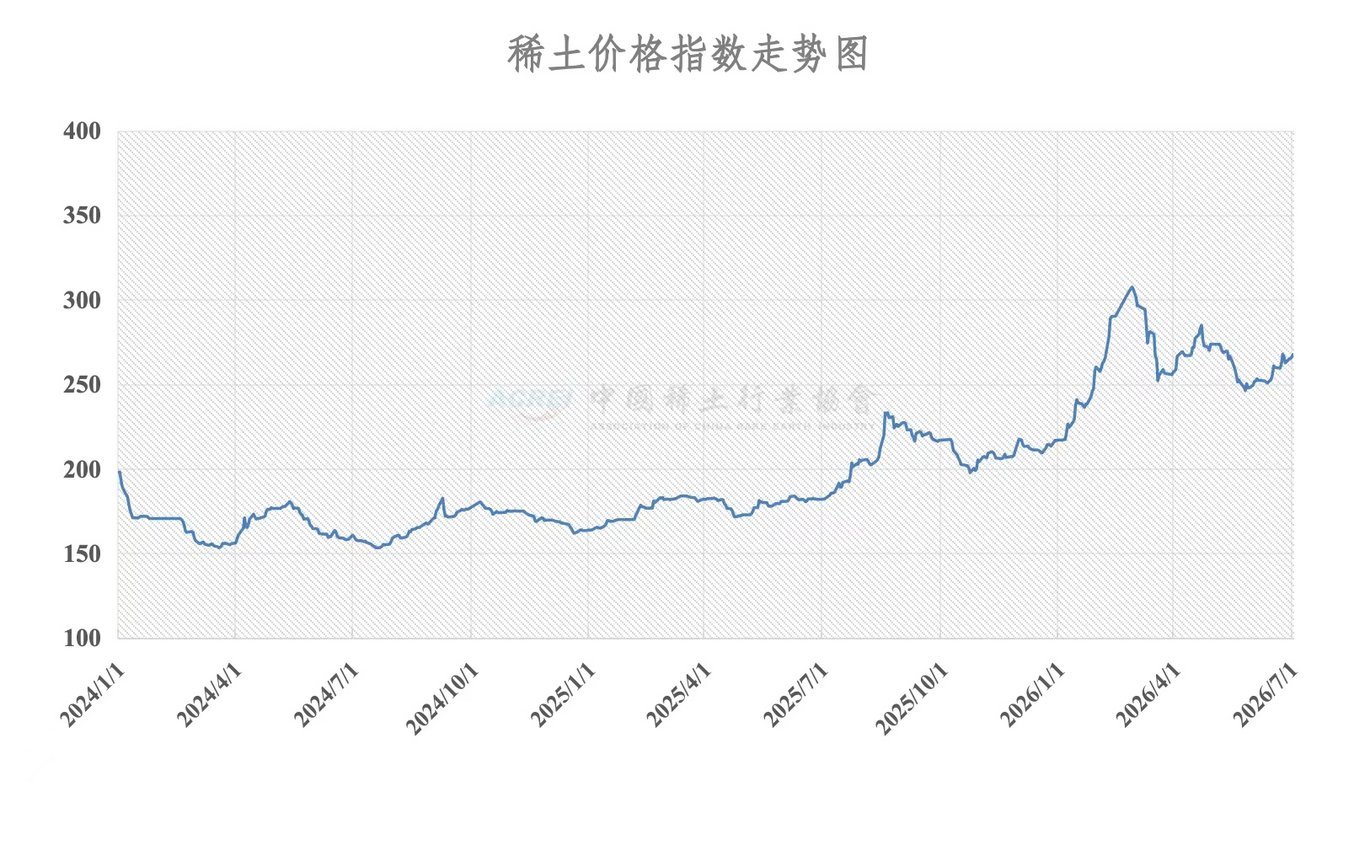
China's Domestic Index Continues Its Upward Trend
The China Rare Earth Price Index increased to 267.6, using 2010 (Index = 100) as its base year.
According to the China Rare Earth Industry Association, the index is calculated from transaction data collected from domestic rare earth enterprises. The association stresses that the information is for reference only and does not constitute investment advice.
The index continues the steady upward trend visible since mid-2025, reflecting tighter domestic supply conditions and stronger pricing for several magnet-related products.
Among notable quotations reported July 2:
| Product | RMB/kg | USD/kg* |
|---|---|---|
| NdPr Oxide | ¥741.8–761.8 | US$111.27–114.27 |
| NdPr Alloy | ¥904.4–924.4 | US$135.66–138.66 |
| Neodymium Oxide | ¥792–812 | US$118.80–121.80 |
| Neodymium Metal | ¥989.4–1,009.4 | US$148.41–151.41 |
| Terbium Oxide | ¥6,440–6,500 | US$966–975 |
| Dysprosium-Iron Alloy | ¥1,355–1,395 | US$203.25–209.25 |
| Gadolinium Oxide | ¥209.2–229.2 | US$31.38–34.38 |
*Converted at US$1 = ¥6.67 (¥1 = US$0.15).
Most cerium, lanthanum, samarium, erbium, holmium, lutetium, and yttrium products were unchanged.
These Are Not Market Prices in the Western Sense
Investors should resist the temptation to interpret CREIA's published prices as equivalent to prices quoted on transparent commodity exchanges.
China's rare earth market operates inside a sophisticated hybrid economic model where industrial policy, production quotas, export licensing, state-owned enterprises, strategic stockpiling, environmental regulation, and national security objectives all influence supply and pricing.
Unlike copper, gold, or oil, rare earth pricing inside China does not emerge solely from competitive market forces.
Instead, prices represent one component of a broader national industrial strategy designed to preserve technological leadership while supporting downstream manufacturing.
For this reason, Rare Earth Exchanges has consistently argued that China's domestic prices should be viewed as policy-influenced reference prices rather than globally discoverable market prices.
Ironically, the Ex-China Market May Be Even Less Transparent
Western buyers often assume that "non-China pricing" provides a more accurate picture of market value.
In reality, the opposite may be true. Although governments increasingly speak of building "ex-China supply chains," roughly 90% of global rare earth separation and refining capacity still resides in China. Outside China, commercial volumes remain relatively thin.
Most transactions occur through:
- bilateral contracts;
- confidential offtake agreements;
- negotiated formulas;
- long-term supply arrangements;
- strategic government-supported transactions.
Very little material changes hands through a true spot market. Consequently, no pricing agency possesses complete visibility into actual transaction prices.
Published assessments often rely on a relatively small number of market participants, trader surveys, or voluntary submissions. Depending on who reports during a particular pricing window, published prices can materially overstate—or understate—actual commercial transactions.
Rare Earth Exchanges® has repeatedly cautioned investors that many so-called benchmark prices represent only snapshots of limited data rather than comprehensive market clearing prices.
Heavy Rare Earths Remain the Real Strategic Bottleneck
The greatest disconnect between published prices and commercial reality involves the heavy rare earth elements.
Outside China, reliable commercial supply of terbium, dysprosium, lutetium, yttrium, and other heavy rare earth products remains extremely limited. Some industrial buyers report that yttrium oxide and certain specialty heavy rare earth compounds simply cannot be sourced in commercial quantities at any published price because physical availability—not quoted value—has become the principal constraint.
This is precisely why bilateral strategic agreements increasingly matter more than published indices.
For example:
- Serra Verde's strategic agreements reportedly include price floors approaching US$2,050/kg for terbium and approximately US$575/kg for dysprosium under specific contractual conditions. These are negotiated commercial arrangements—not global benchmarks.
- Likewise, the U.S. government's agreement supporting MP Materials established an effective US$110/kg NdPr floor, reflecting industrial policy and supply security objectives rather than market-wide pricing.
Neither arrangement should be interpreted as establishing industry-wide clearing prices.
Instead, they illustrate that governments and strategic buyers are increasingly paying for security of supply, not simply rare earth molecules.
The Takeaway for Investors
The headline index moved higher—but the more important development is structural.
China continues to operate the world's only truly integrated rare earth pricing ecosystem because it controls the overwhelming majority of refining, metal production, and magnet manufacturing.
Outside China, price discovery remains immature. Markets are fragmented, contract-driven, thinly traded, and often confidential. Published assessments provide useful directional information but cannot fully capture transaction economics, strategic premiums, availability constraints, or government intervention.
As geopolitical competition intensifies and ex-China supply chains slowly emerge, investors should focus less on any single quoted price and more on where genuine liquidity, transparent transactions, and independent price discovery begin to develop. Until that occurs, rare earth pricing will remain as much a function of industrial policy and strategic negotiation as of classical supply and demand.
Disclaimer: This pricing information originates from the China Rare Earth Industry Association (CREIA), an industry organization operating within China's state-directed rare earth sector. The published figures should be viewed as domestic reference prices and independently verified before being used for investment or commercial decision-making. The analysis regarding ex-China pricing reflects the editorial assessment of Rare Earth Exchanges, based on publicly available market information, private discussions with market participants on condition of anonymity, and ongoing coverage of global rare earth supply chains.
Register today: REEx Marketplace™ (opens in a new tab)


0 Comments
Discuss this article