
Highlights
- A resource estimate alone reveals little about commercial viability; processing complexity, mineralogy, and impurity profiles ultimately determine project economics.
- Flow sheet development shapes capital costs, recoveries, environmental performance, and financing—yet remains one of the most underappreciated stages in rare earth project development.
- Leading developers now integrate engineering, process modeling, and economic analysis from the outset rather than treating them as sequential steps.
- Every downstream industry from EVs to defense depends on consistent, high-purity rare earth feedstocks that can only be guaranteed through thorough resource characterization.
- Outside China, experienced rare earth metallurgists and process engineers remain scarce, making workforce development a critical and often overlooked constraint on supply chain resilience.
One of the most expensive mistakes in the rare earth industry is assuming that discovering a resource is the hard part. It isn't. The real challenge begins after the drilling ends. History is filled with promising rare earth deposits that never became commercial operations because developers underestimated one fundamental reality: a rare earth project is, above all, a highly complex processing business. Understanding a deposit's mineralogy, impurity profile, metallurgy, and downstream market requirements from the earliest stages often determines whether it becomes a profitable mine—or simply another technical report.
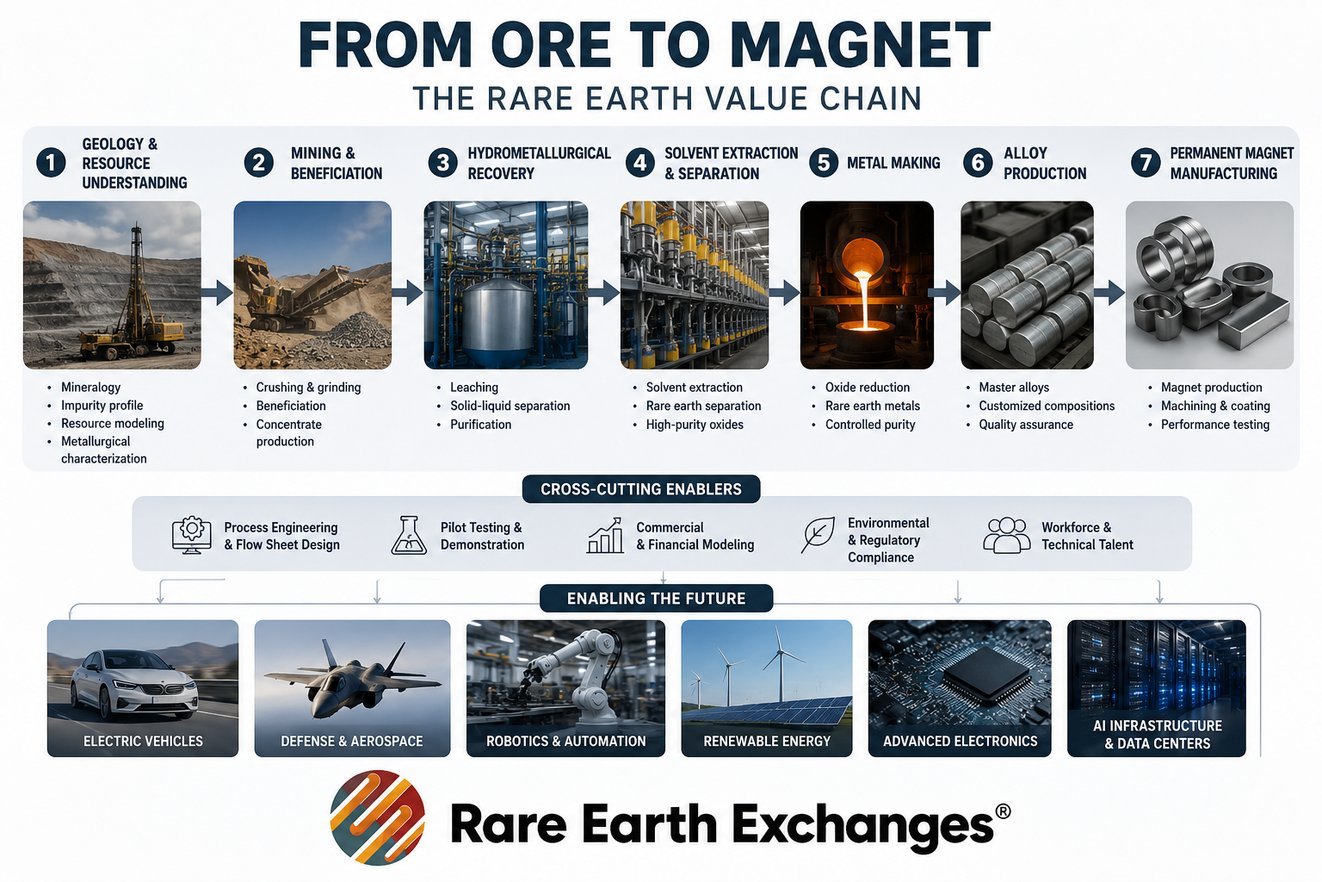
A resource estimate is only the beginning. Investors naturally gravitate toward large tonnage and attractive grades, but those metrics reveal only part of the commercial story. Rare earth elements typically comprise just a small fraction of the ore body. The remainder consists of host rock, gangue minerals, deleterious impurities, and, in some deposits, naturally occurring radioactive elements that must be managed safely, economically, and within regulatory requirements. Two deposits with similar grades can produce dramatically different economics once processing complexity is fully understood.
That is why flow sheet development deserves far greater attention than it often receives. A flow sheet is the engineering blueprint that defines every step of the mine-to-magnet value chain—from beneficiation and mineral concentration through hydrometallurgical recovery, solvent extraction, rare earth separation, metal making, alloy production, and ultimately permanent magnet manufacturing. Decisions made during flow sheet development shape capital costs, operating costs, recoveries, product specifications, environmental performance, permitting strategies, financing requirements, and ultimately project viability.
Processing also cannot be separated from geology. Mineralogy matters. Monazite, bastnäsite, xenotime, ionic adsorption clays, and more complex mixed-mineral deposits each behave differently during extraction and separation. Even within the same mineral class, variations in impurity chemistry can materially alter reagent consumption, recoveries, waste management, equipment selection, and overall project economics. There is no universal processing template. Every commercially viable project requires a processing strategy tailored to its specific resource.
As Rare Earth Exchanges® covered in a podcast in late April with L3 Process Development’s (opens in a new tab) Tommee Larochelle (opens in a new tab) (a well-respected subject matter expert on this topic), the strongest development programs increasingly reverse the traditional approach. Rather than first proving that a process works in the laboratory and only later asking whether it makes economic sense, leading developers integrate engineering, process modeling, pilot testing, demonstration plants, and commercial economics from the outset. Identifying economic constraints early can eliminate years of unnecessary testing, preserve scarce capital, shorten development timelines, and significantly improve the probability of financing and commercial success.
The implications extend well beyond mining. Every downstream industry—including electric vehicles, defense systems, robotics, aerospace, advanced electronics, renewable energy, and artificial intelligence infrastructure—depends on reliable supplies of high-purity rare earth materials. Consistent feedstock quality begins with understanding the resource itself. Poorly characterized deposits create bottlenecks that reverberate throughout the supply chain, while well-characterized resources provide the foundation for dependable oxide, metal, alloy, and permanent magnet production.
Tommee Larochelle
Source: Rare Earth Exchanges (opens in a new tab)
Perhaps the industry's most overlooked constraint is talent. Outside China, experienced metallurgists, solvent extraction specialists, chemical engineers, and rare earth process engineers remain in short supply. Building resilient supply chains requires more than capital investment and industrial policy; it also demands sustained investment in technical education, workforce development, pilot-scale expertise, and the next generation of processing professionals.
The lesson seems straightforward enough to us here at Rare Earth Exchanges. Rare earth success is not measured by the size of a resource alone. It is measured by how thoroughly that resource is understood—and how effectively that understanding is translated into an economically viable mine-to-magnet supply chain. In a world racing to secure critical minerals—what we refer to as a Great Powers Era 2.0—the winners will not simply be those who discover rare earth deposits. They will be those who understand their resources well enough to transform them into commercially competitive, scalable, and strategically resilient production.
Register today: REEx Marketplace™ (opens in a new tab)


0 Comments
No replies yet
Loading new replies...
Moderator
Join the full discussion at the Rare Earth Exchanges Forum →