
Highlights
- Yunnan Province unveiled a specialized AI platform for rare, precious, and nonferrous metal materials design, simulation, and manufacturing optimization.
- The platform integrates over 90 million curated materials records, a 17,400-core HPC system, and 40+ high-throughput experimental systems.
- Reported gains include platinum alloy development shrinking from 5–10 years to one year and titanium alloy evaluation dropping from six months to two weeks.
- China's strategy embeds AI across the full materials innovation cycle, not just mining expansion, posing a growing challenge to Western supply chains.
- Performance claims have not been independently verified and should be confirmed before use in investment or policy decisions.
China's Yunnan Province has unveiled a specialized artificial intelligence platform designed to accelerate the discovery, design, testing, and manufacturing of rare, precious, and nonferrous metal materials. While the announcement originates from a provincial government research organization, the reported results—if independently verified—suggest China is moving beyond consumer AI applications and embedding large AI foundation models directly into advanced materials research and industrial development. For Western governments and manufacturers, the announcement underscores China's growing emphasis on AI-enabled industrial competitiveness rather than simply expanding mining capacity.
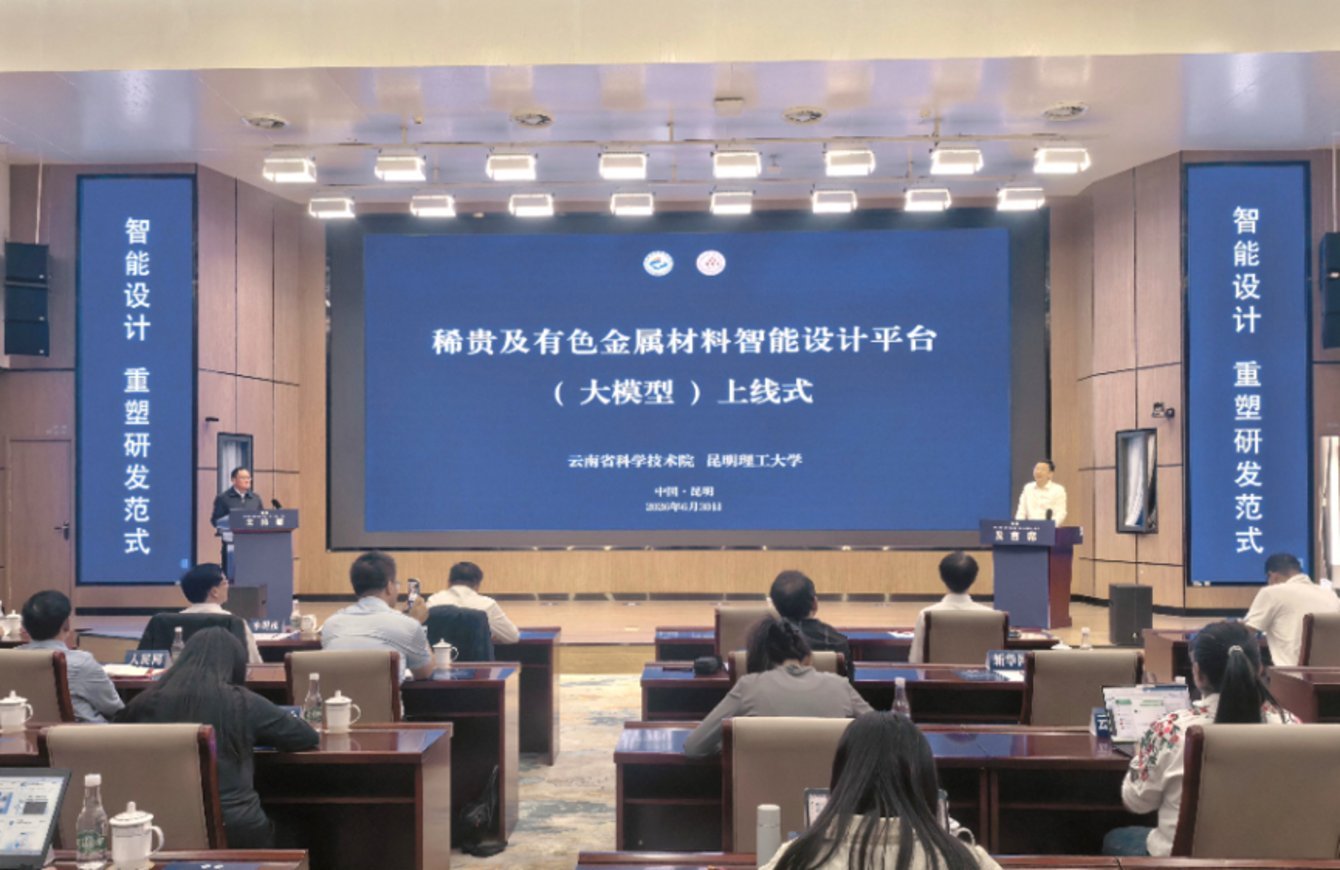
From Trial-and-Error to AI-Driven Materials Design
On June 30, the Yunnan Academy of Science and Technology announced the launch of the Intelligent Design Platform for Rare, Precious and Nonferrous Metal Materials, with Kunming University of Science and Technology serving as the principal technology developer.
According to the announcement, the platform represents a flagship achievement of Yunnan Province's Major Science and Technology Program for Rare and Precious Metal Materials Genome Engineering, an initiative first launched in 2018 by the Yunnan Provincial Department of Science and Technology. Its objective is to replace traditional materials research—often dependent on years of experimentation and repeated trial-and-error—with AI-assisted materials design, simulation, process optimization, and manufacturing support.
A Specialized AI for Metallurgy
Unlike general-purpose AI assistants, officials describe the platform as a specialized engineering system built specifically for metallurgy and advanced materials development. The platform combines a proprietary database containing more than 90 million curated materials data records, supported by a 17,400-core high-performance computing (HPC) platform, more than 40 high-throughput experimental systems, and specialized databases covering more than ten categories of rare, precious, and nonferrous metals.
According to its developers, the AI can interpret research objectives, recommend alloy compositions, predict material properties, optimize production processes, evaluate experimental outcomes, and continuously improve as new data are incorporated.
Reported Productivity Gains
The announcement cites substantial improvements in research efficiency.
Among the reported examples:
- Platinum alloy development reportedly declined from 5–10 years to approximately one year, while research costs fell by 95%.
- Titanium alloy performance evaluation reportedly decreased from six months to two weeks, saving organizations millions of yuan.
- Development costs for ultra-high-temperature materials reportedly fell by 80%.
- Officials also state that several resulting technologies have supported China's efforts to strengthen domestic capabilities in strategically important materials.
These performance claims have not been independently verified.
Why Western Industry Should Pay Attention
The most important development is not the software itself, but the industrial strategy it represents.
China appears to be integrating artificial intelligence into every stage of advanced materials development—from computational design and laboratory research to manufacturing optimization. Rather than focusing exclusively on expanding mineral production, the country is also investing in shortening innovation cycles, reducing development costs, and accelerating the deployment of new materials.
For the United States and Europe, this highlights a growing competitive challenge. The future of critical minerals will be shaped not only by mining and refining, but increasingly by computational materials science, AI-assisted alloy design, digital manufacturing, and rapid qualification of advanced materials. If the productivity improvements reported by Chinese researchers prove reproducible at industrial scale, AI could become a significant competitive advantage across the rare earth, permanent magnet, aerospace, semiconductor, and defense supply chains.
Disclaimer: This report is based on information published by the Yunnan Academy of Science and Technology, a provincial government research organization in China. The announcement references work conducted with Kunming University of Science and Technology under the Yunnan Province Major Science and Technology Program for Rare and Precious Metal Materials Genome Engineering, administered by the Yunnan Provincial Department of Science and Technology. The reported technical achievements and performance metrics have not been independently verified. Readers should seek independent confirmation before relying on these claims for investment, commercial, or policy decisions.
Register today: REEx Marketplace™ (opens in a new tab)


0 Comments
No replies yet
Loading new replies...
Moderator
Join the full discussion at the Rare Earth Exchanges Forum →