
Highlights
- Chinese researchers mapped the full weathering profile of the giant Shitouping deposit, revealing how hydrothermal alteration and tropical weathering concentrate heavy rare earths over millions of years.
- Nature creates a dual-layer orebody: light rare earths accumulate near the surface while strategically vital heavy rare earths like dysprosium and terbium migrate deeper due to lanthanide contraction.
- The study narrows the exploration blueprint for Western companies, requiring not just elevated REE granites but specific hydrothermal alteration, clay development, and long-term tropical weathering conditions.
- China's dominance stems from decades of geological mastery converted into processing expertise, solvent extraction know-how, and a fully integrated magnet manufacturing base—not geology alone.
- Western policymakers must invest in the entire geological-to-magnet value chain, from exploration models and mineralogy to separation chemistry and commercial manufacturing, to meaningfully compete.
Some scientific papers answer academic questions. Others explain why nations dominate entire industries. This new study (opens in a new tab) belongs in the second category. Chuan He of East China University of Technology (opens in a new tab), together with colleagues from several Chinese geological institutions, has peeled back the geological architecture behind the giant Shitouping ion-adsorption rare earth deposit in Jiangxi Province (opens in a new tab)—a deposit rich in both light and heavy rare earth elements. Their work demonstrates that China's world-leading heavy rare earth deposits are not geological accidents. They are the product of an extraordinarily rare convergence of magma evolution, hydrothermal alteration, tropical weathering, groundwater chemistry, and millions of years of natural fractionation. For investors and policymakers, the message is sobering: discovering rare earth deposits is only the beginning. Understanding how nature concentrates dysprosium, terbium, and other strategic heavy rare earths remains a competitive advantage that China has spent decades mastering. This study helps explain why China still dominates more than 90% of global heavy rare earth production—and why the West's supply-chain challenge extends far beyond mining.
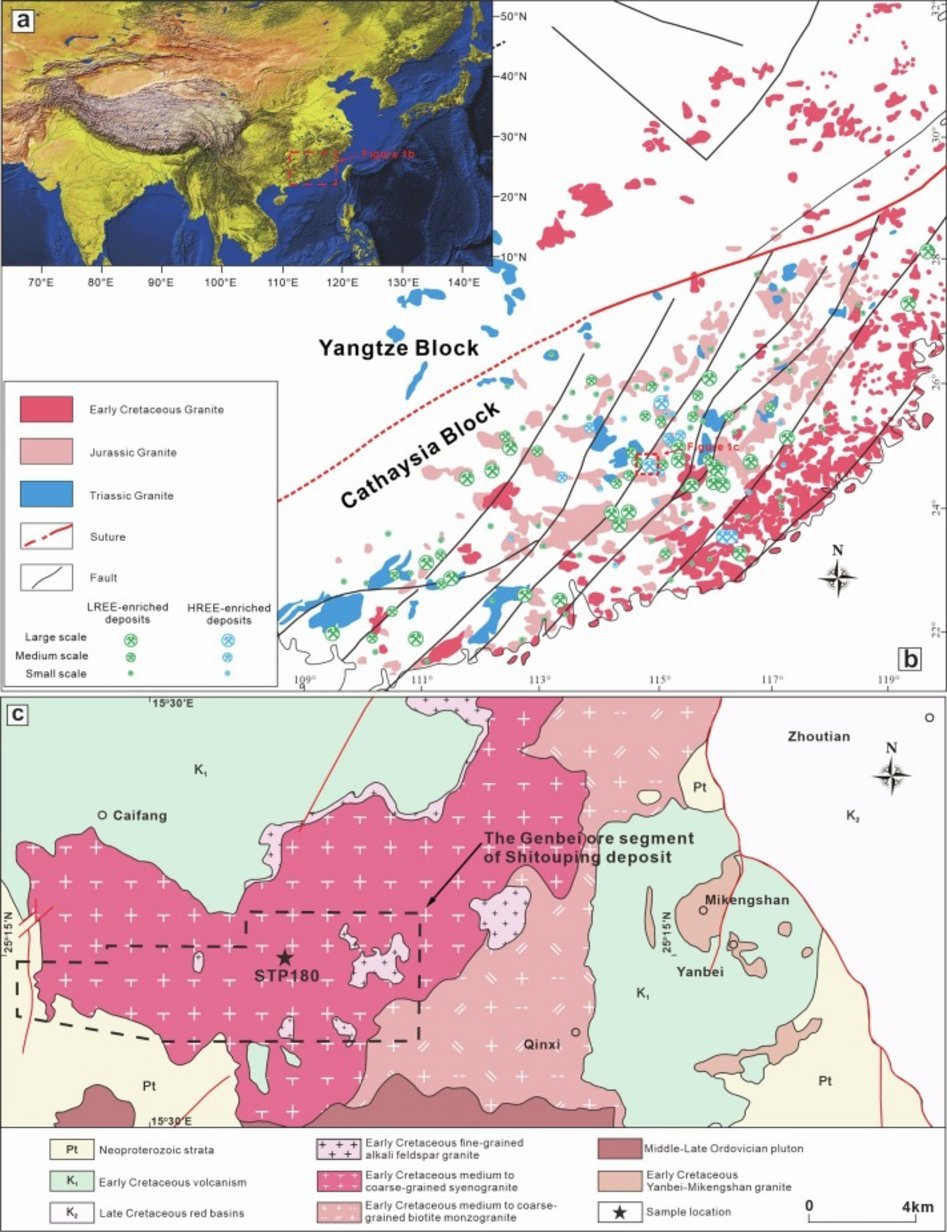
Source: Ore Geology Reviews
The Geological Recipe Behind China's Heavy Rare Earth Dominance
Think of the Earth's crust as an enormous slow-motion chemical refinery.
The researchers drilled through an entire weathering profile—from fresh granite deep underground to the clay-rich surface soils that ultimately become ore. Using electron microscopy, laser-ablation mass spectrometry, mineral mapping, sequential chemical extraction, and geochemical analysis, they reconstructed how rare earth elements migrated over immense spans of geological time.
Their conclusion is striking.
Nearly all the rare earth inventory was originally locked inside specialized accessory minerals created during late-stage granite evolution and subsequent hydrothermal alteration. Those hydrothermal fluids fundamentally changed the mineralogy, making previously resistant minerals progressively vulnerable to weathering. As rainwater, groundwater, microbes, and weak organic acids slowly attacked the granite over millions of years, rare earth elements were released in stages rather than all at once.
Nature then performed the separation.
Nature Built a Separation Circuit Long Before Humans Did
The study identifies an elegant natural sorting mechanism. Because heavy rare earth elements possess smaller ionic radii than light rare earths—a phenomenon known as lanthanide contraction—they remain mobile for longer periods in groundwater. Light rare earths tend to adsorb sooner onto clays nearer the surface. Heavy rare earths continue migrating downward before becoming trapped.
The result is a remarkable dual-layer orebody.
An upper zone becomes enriched in light rare earths such as cerium and neodymium, while a deeper zone accumulates the strategically vital heavy rare earths—including dysprosium, terbium, yttrium, and their neighboring elements—that modern defense systems, electric motors, robotics, aerospace systems, and advanced electronics increasingly require. Rather than a random accumulation of metals, the deposit represents millions of years of natural chemical engineering.
Why Investors Should Care
For Western exploration companies, the paper provides a more sophisticated exploration blueprint.
The search should not simply focus on granites containing elevated heavy rare earth concentrations. Equally important are the presence of hydrothermal alteration, weatherable fluorocarbonate minerals, altered phosphates, favorable groundwater evolution, appropriate clay mineral development, and long-term tropical weathering capable of sustaining repeated cycles of dissolution and re-adsorption.
This significantly narrows the number of truly prospective geological environments.
Just as importantly, the study reminds investors that geology alone cannot explain China's strategic position.
China possesses the deposits, but it also built the processing expertise, solvent extraction know-how, metallurgical capability, permitting systems, chemical manufacturing base, and permanent magnet industry necessary to transform ore into finished strategic materials. Those industrial capabilities—not geology alone—remain the West's largest vulnerability.
What the Paper Does Not Prove
The findings deserve attention—but not exaggeration. The research analyzes one exceptionally well-preserved Chinese deposit and proposes a genetic model that still requires validation across additional deposits worldwide. Geological understanding also does not guarantee commercial success. Ore grade, metallurgy, recovery, permitting, environmental management, capital intensity, and downstream refining ultimately determine whether a deposit becomes an economic mine.
Several proposed mechanisms—including biological weathering and aspects of long-term fractionation—remain active areas of scientific investigation rather than settled geological doctrine. These conclusions should therefore be viewed as an important advance in understanding rather than the final word on ion-adsorption deposit formation.
The Rare Earth Exchanges View
The most important takeaway is not geological—it is strategic.
Western policymakers often speak as though discovering new deposits will solve the rare earth problem. This paper illustrates why that assumption is incomplete. China's advantage began long before solvent extraction plants or magnet factories. It began with decades of painstaking geological research that taught Chinese scientists not merely where rare earths occur, but precisely how nature creates economically recoverable heavy rare earth deposits.
That accumulated scientific knowledge became industrial knowledge. Industrial knowledge became commercial dominance. Commercial dominance evolved into geopolitical leverage. The United States and its allies are investing billions to rebuild the rare earth supply chain. Success will require more than financing mines. It demands mastering the entire geological-to-magnet value chain—from exploration models and mineralogy to separation chemistry, metallurgical engineering, manufacturing, and ultimately commercial execution.
Nature spent millions of years building these deposits.
The West has only a few years to learn how to compete with them.
Citation: He, C., Yang, W.-Z., Li, M.-G., Wang, X.-G., Liu, C., Duan, J.-B., Zhang, H., Ren, G.-G., & Wu, D.-H. (2026). Genesis of LREE-HREE Co-enriched Ion-Adsorption REE Deposit: Insights from the Giant Shitouping Deposit in Jiangxi Province, South China. Ore Geology Reviews (In Press).
Register today: REEx Marketplace™ (opens in a new tab)


0 Comments
No replies yet
Loading new replies...
Moderator
Join the full discussion at the Rare Earth Exchanges Forum →