
Highlights
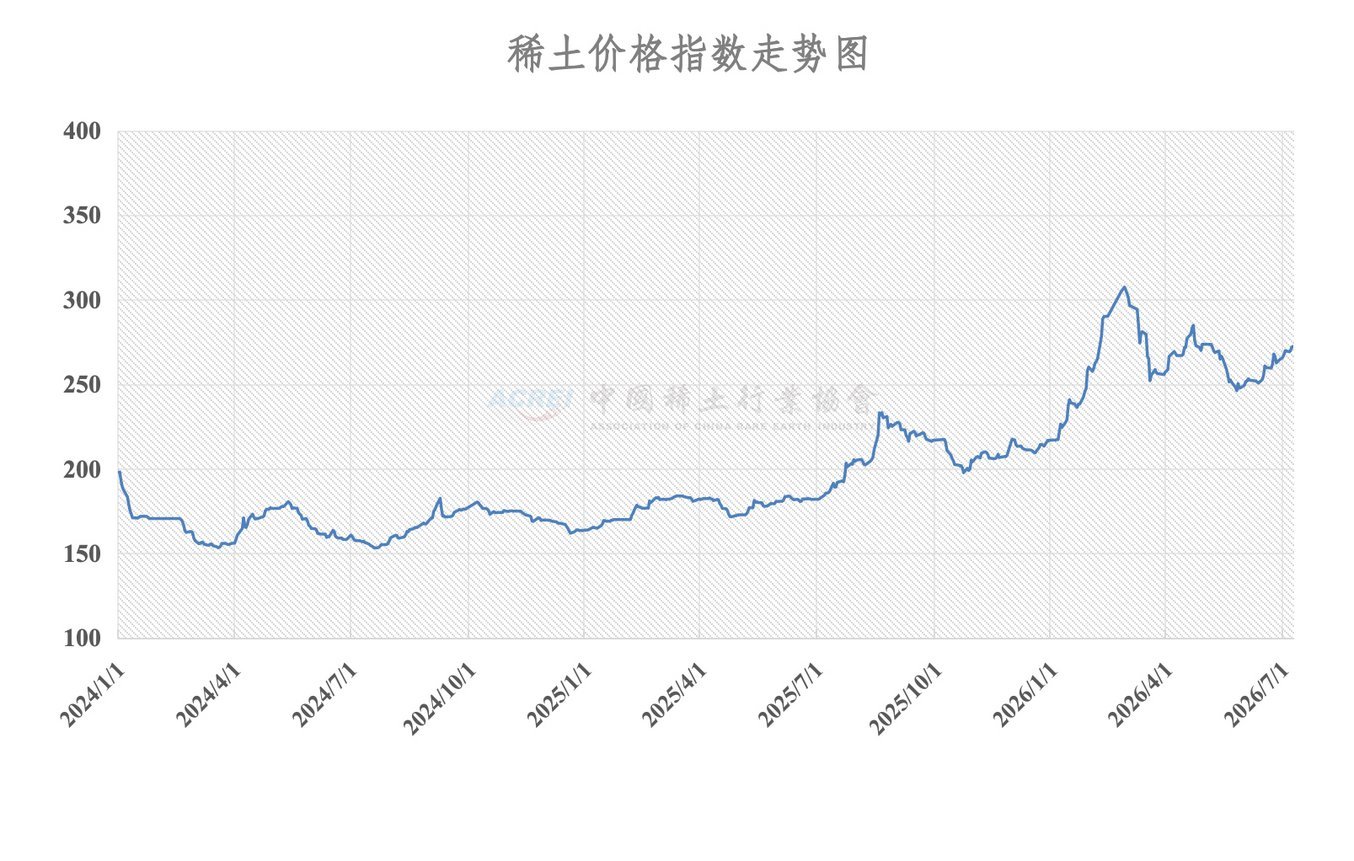
- China's CREIA Rare Earth Price Index rose to 272.4 on July 9, 2026, with heavy rare earths like dysprosium and NdPr posting gains while light rare earths remained flat.
- China's published rare earth prices reflect a state-managed industrial system shaped by quotas, export licensing, and national security objectives—not classical free-market price discovery.
- The ex-China rare earth market is equally opaque, with transactions largely bilateral, over-the-counter, and confidential, making direct price comparisons unreliable.
- A widening divergence between light and heavy rare earth markets is emerging, with commercial availability of heavy rare earth oxides outside China remaining exceptionally constrained.
- Investors should treat published rare earth price sheets as directional indicators only—the critical question is whether material can actually be sourced in commercial quantities when needed.
China's Rare Earth Industry Association (CREIA) reported its Rare Earth Price Index rose to 272.4 on July 9, 2026, continuing the recovery from late-2025 levels and reflecting generally firmer pricing across many heavy rare earth products. Dysprosium, terbium, gadolinium, holmium, erbium, and NdPr products all posted gains, while most light rare earth prices were flat or little changed. Rare Earth Exchanges' assessment: The index is an important barometer of pricing trends within China, but investors should avoid treating it as a global benchmark. Neither China's domestic market nor the emerging ex-China market exhibits the transparent price discovery found in commodities such as copper, aluminum, or gold.
Heavy Rare Earths Continue to Tighten
The July 9 pricing sheet shows continued strength in strategic heavy rare earths.
- Dysprosium oxide: ¥1,400–1,440/kg (US$210–216/kg) ▲
- Dysprosium metal: ¥1,770–1,790/kg (US$266–269/kg) ▲
- Terbium oxide: ¥5,000–5,200/kg (US$750–780/kg) →
- Holmium oxide: ¥565.6–585.6/kg (US$84.84–87.84/kg) ▲
- NdPr oxide (75%): ¥755.1–775.1/kg (US$113.27–116.27/kg) ▲
- NdPr alloy: ¥921.6–941.6/kg (US$138.24–141.24/kg) ▲
Most cerium and lanthanum products remained flat or softened modestly, reinforcing an increasingly familiar theme: value continues to migrate toward the scarcer heavy rare earth elements.
The Index Is Real—But It Is Not Classical Price Discovery
This distinction matters. China's published prices reflect actual domestic transactions collected from industry participants. However, those transactions occur within a highly managed industrial system shaped by production quotas, export licensing, strategic stockpiles, state-owned enterprises, industrial policy, and broader national security objectives. As a result, China's rare earth market does not function like a conventional competitive commodity exchange.
Ironically, the ex-China market is not a mature free market either. With roughly 90% of global rare earth separation still occurring in China, ex-China transactions remain overwhelmingly bilateral, over-the-counter, and highly confidential. Individual contracts often include proprietary specifications, minimum volumes, long-term commitments, qualification requirements, and strategic partnership terms that make direct price comparisons difficult. Price-reporting agencies provide useful snapshots but necessarily rely on limited market sampling in an opaque environment.
Rare Earth Exchanges has previously examined this evolving pricing landscape, including the U.S. Department of Defense's US$110/kg NdPr oxide floor price supporting MP Materials, project-specific pricing structures such as Serra Verde's negotiated heavy rare earth floor arrangements, and the broader challenge of constructing meaningful ex-China price indices from a thin and rapidly evolving marketplace. None of these arrangements should be interpreted as universal market benchmarks.
Buyer Beware
The immediate story is not today's index value.
It is the widening divergence between light and heavy rare earth markets. Outside China, commercial availability of heavy rare earth oxides and metals remains exceptionally constrained. In some cases—including yttrium—buyers have reported difficulty securing reliable commercial supply regardless of published price.
For investors, published price sheets should be viewed as directional indicators, not definitive market-clearing prices. In today's rare earth market, the more important question is often not "What is the quoted price?" but "Can the material actually be sourced, in commercial quantity, when it is needed?" That distinction increasingly defines the Great Powers Era 2.0.
Source Disclosure: This report is based on pricing information published by the China Rare Earth Industry Association (CREIA). CREIA states that the prices are collected from domestic industry participants for reference only and do not constitute investment advice. As with all information originating from China's state-directed rare earth sector, the data should be independently evaluated before being relied upon for investment, commercial, or policy decisions.
Register today: REEx Marketplace™ (opens in a new tab)


0 Comments
No replies yet
Loading new replies...
Moderator
Join the full discussion at the Rare Earth Exchanges Forum →