
Highlights
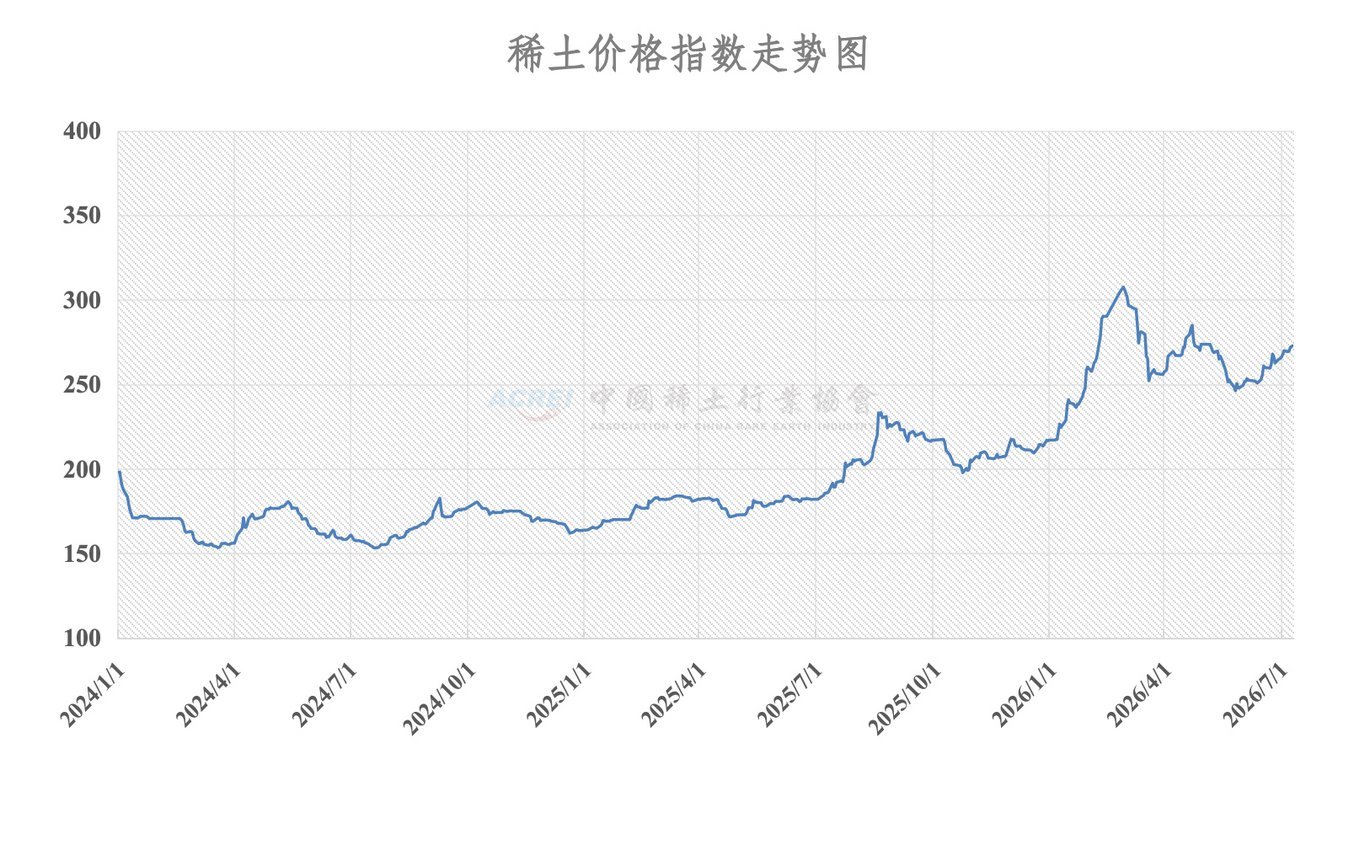
- China's CREIA index reached 272.8 on July 10, 2026, with terbium oxide rising to approximately US$1,029–1,039/kg and terbium metal to US$1,270–1,285/kg.
- Chinese reference prices reflect state quotas, export licenses, and Communist Party direction—not transparent commodity market price discovery comparable to gold or copper.
- The ex-China market is equally opaque, with bilateral confidential deals and published assessments relying on a small number of traders.
- Pentagon-backed floors like US$110/kg for NdPr at MP Materials and Serra Verde's dysprosium and terbium floors are deal-specific, not universal industry benchmarks.
- Investors must compare product form, purity, origin, volume, delivery terms, and government support before treating any rare earth price as a reliable market signal.
China’s Rare Earth Industry Association reported its Rare Earth Price Index at 272.8 on July 10, 2026, with selected heavy rare earth products advancing while most listed materials were unchanged. Terbium oxide and metal, holmium products, erbium oxide, neodymium metal, and NdPr oxide rose. Dysprosium products were flat—not higher. The update reinforces Rare Earth Exchanges® reporting that heavy rare earth availability outside China remains dangerously constrained, but neither Chinese reference prices nor emerging ex-China assessments represent transparent commodity-market price discovery.
Terbium Moves, Dysprosium Holds
CREIA calculates the index from average daily transaction data reported by domestic enterprises, using 2010 = 100. At the user-specified conversion of ¥1 = US$0.15, the principal movers were:
| Product | China Reference Price | Conversion to USD |
|---|---|---|
| Terbium oxide | ¥6,865–6,925/kg | US$1,029.75–1,038.75/kg |
| Terbium metal | ¥8,470–8,570/kg | US$1,270.50–1,285.50/kg |
| Holmium oxide | ¥576.7–596.7/kg | US$86.51–89.51/kg |
| Holmium-iron alloy | ¥582.5–602.5/kg | US$87.38–90.38/kg |
| Neodymium metal | ¥1,018.7–1,038.7/kg | US$152.81–155.81/kg |
| NdPr oxide | ¥755.8–775.8/kg | US$113.37–116.37/kg |
Dysprosium oxide remained at ¥1,400–1,440/kg, or approximately US$210–216/kg.
A Price Signal Inside a Controlled System
China’s figures are useful directional references, but they are not market-clearing prices comparable with gold or copper. Production quotas, export licenses, state-owned enterprises, strategic inventories, national-security policy, and Communist Party direction shape supply and pricing. China’s April 2025 controls on seven heavy rare earths, related compounds, and magnets demonstrated how quickly administrative decisions can overwhelm ordinary commercial signals.
What About Ex-China?
The ex-China market is scarcely more transparent. Transactions are commonly confidential, bilateral, and bespoke, while published assessments may depend heavily on a small number of traders. Rare Earth Exchanges® has described this as a market splitting into managed Chinese pricing and an emerging Western regime increasingly influenced by public subsidies and negotiated floors.
Rare Earth Deal Checklist: Compare Like With Like
Before comparing any oxide, metal, alloy, or magnet transaction, investors should check:
- Product form: concentrate, separated oxide, metal, alloy, powder, or finished magnet
- Element and purity: NdPr is not comparable with dysprosium or terbium
- Origin and traceability: Chinese, allied, recycled, or defense-compliant material
- Volume and duration: spot parcel versus multiyear offtake
- Delivery terms: freight, insurance, duties, inventory, and timing
- Specifications: magnet grade, particle size, qualification, and customer testing
- Price mechanism: fixed price, index formula, floor, ceiling, or shared upside
- Government support: subsidy, loan, stockpile commitment, or strategic premium
The Pentagon’s US$110/kg NdPr floor for MP Materials (NYSE: MP) applies to that specific 10-year arrangement—not automatically to the wider industry. Although the chatter is that this price point does apply throughout the ex-China landscape. Likewise, Serra Verde’s reported floors of US$575/kg for dysprosium and US$2,050/kg for terbium belong to a particular 15-year offtake structure, not a universal heavy rare earth benchmark. But is that price point (now under the USA Rare Earth deal landscape) adversely impacting competitive deals that could yield lower cost price points? Will an investigation commence in Washington DC?
Disclosure: The source is a state-aligned Chinese industry association operating within a state-directed rare earth system, not an independent price-discovery venue. Its figures should be independently verified and should not be treated as global spot prices or investment advice.


0 Comments
No replies yet
Loading new replies...
Moderator
Join the full discussion at the Rare Earth Exchanges Forum →