
Highlights
- China's Rare Earth Price Index remained at 272.5 on July 13, 2026, with heavy rare earths including terbium, dysprosium, and holmium posting price gains amid continued market tightness.
- NdPr oxide softened modestly while terbium metal reached US$1,278–1,293/kg and dysprosium oxide climbed to US$210.75–216.75/kg, highlighting divergence within the rare earth complex.
- China's domestic rare earth prices are shaped by quotas, export licensing, and state policy—they are not globally discovered market prices and should not be treated as universal benchmarks.
- Outside China, most rare earth transactions occur through confidential bilateral contracts, making the ex-China market far less transparent than commonly assumed.
- For manufacturers of EVs, defense systems, and permanent magnets, securing reliable heavy rare earth supply is rapidly becoming more critical than achieving the lowest quoted price.
The China Rare Earth Industry Association (CREIA) reported its Rare Earth Price Index at 272.5 on July 13, 2026, keeping the benchmark at historically elevated levels even as individual rare earth products moved in different directions. The index, based on 2010 = 100, is calculated using reported domestic transaction data submitted by Chinese rare earth enterprises and is intended to serve as a reference for China's domestic market.
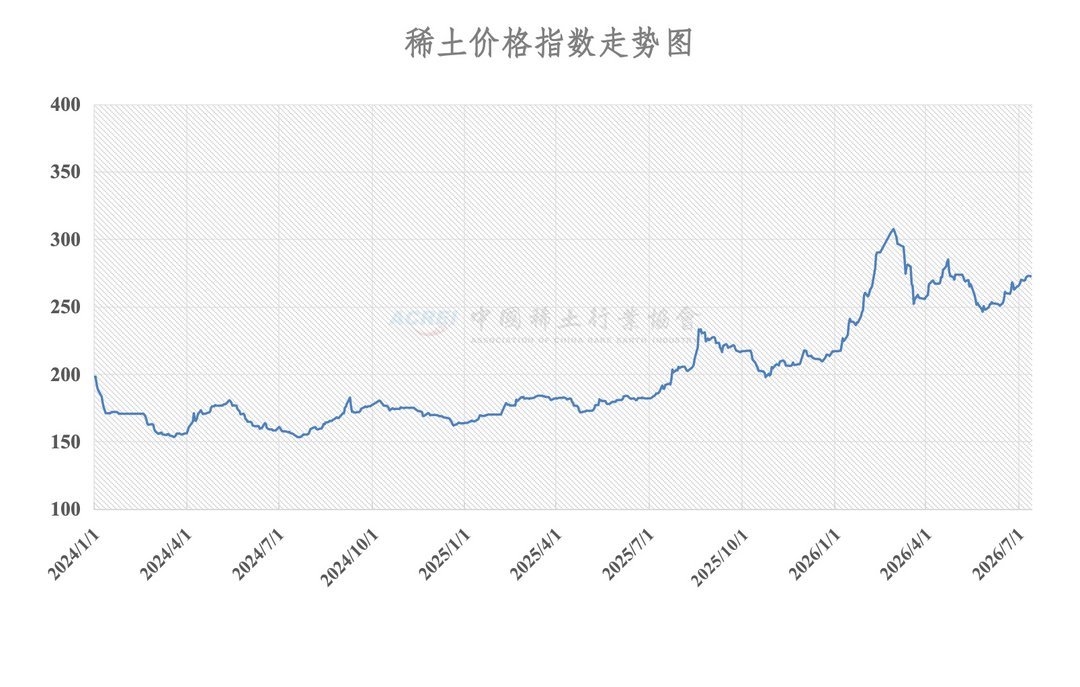
While the headline index remained relatively stable, pricing beneath the surface tells a more nuanced story. The strategically important NdPr (neodymium-praseodymium) basket softened modestly, while several heavy rare earth products—including terbium, dysprosium oxide, holmium oxide, and erbium oxide—posted gains, reflecting continued tightness in that segment of the market.
Key China Domestic Reference Prices
Using the requested illustrative conversion rate of ¥1 = US$0.15, selected domestic reference prices include:
- NdPr Oxide (75% Nd₂O₃): ¥753.4–773.4/kg (US$113.01–116.01/kg) ↓
- NdPr Alloy: ¥918.7–938.7/kg (US$137.81–140.81/kg) ↓
- Dysprosium Oxide: ¥1,405–1,445/kg (US$210.75–216.75/kg) ↑
- Dysprosium Metal: ¥1,770–1,790/kg (US$265.50–268.50/kg) →
- Terbium Oxide: ¥6,895–6,955/kg (US$1,034.25–1,043.25/kg) ↑
- Terbium Metal: ¥8,520–8,620/kg (US$1,278.00–1,293.00/kg) ↑
- Holmium Oxide: ¥581.8–601.8/kg (US$87.27–90.27/kg) ↑
- Yttrium Oxide (99.99%): ¥53.6–57.6/kg (US$8.04–8.64/kg) →
Heavy rare earths continue to represent the strongest portion of China's domestic pricing environment, underscoring their growing strategic importance.
China Prices Are Not Global Market Prices
Western investors should be careful not to interpret these figures as globally discovered market prices.
China's published rare earth prices are legitimate domestic reference prices, but they exist within a market heavily influenced by production quotas, export licensing, environmental regulation, state-owned enterprises, national industrial policy, and broader economic and national security objectives. Unlike globally traded commodities such as copper or gold, China's rare earth market does not operate through continuous, transparent international price discovery.
The Ex-China Market Is Also Far from Transparent
The challenge does not end outside China. Although frequently described as a "free market," the ex-China rare earth market remains extremely immature. China still accounts for roughly 90% or more of global rare earth separation capacity, leaving relatively little material available for open commercial trading elsewhere.
Outside China, most transactions occur through confidential bilateral contracts rather than transparent exchanges. Pricing varies significantly depending on chemical specification, purity, qualification status, delivery schedules, contract duration, strategic relationships, financing terms, and geopolitical considerations. Every contract is negotiated differently.
Commercial pricing agencies provide an important service, but they typically rely on limited transaction sampling and discussions with traders or market participants. Those snapshots offer useful directional information but should not be mistaken for comprehensive spot-market pricing.
Price Floors Are Not Industry Benchmarks
Rare Earth Exchanges® has previously highlighted several examples illustrating why isolated commercial agreements should not be interpreted as market-wide reference prices.
The U.S. Department of Defense's strategic agreement with MP Materials, for example, established an effective US$110/kg floor for NdPr within that specific public-private partnership. That arrangement reflects one strategic transaction—not a universal market benchmark. Likewise, Serra Verde's reported pricing protections—including approximately US$575/kg for dysprosium and US$2,050/kg for terbium under certain contractual arrangements—apply to that project's commercial structure rather than the broader industry.
Scarcity, Not Price, Is Becoming the Constraint
Perhaps the most important trend lies beyond published price tables. Across North America, Europe, Japan, and other non-Chinese markets, buyers increasingly report that availability—not quoted price—is becoming the limiting factor, particularly for heavy rare earth oxides and metals such as dysprosium, terbium, holmium, lutetium, and, in some instances, even yttrium.
With export controls, limited non-Chinese refining capacity, and extremely thin inventories, procurement teams often compete for relatively small volumes under confidential agreements. In today's market, the ability to secure reliable supply may prove far more valuable than negotiating the lowest published price. For manufacturers of electric vehicles, robotics, aerospace systems, defense technologies, advanced electronics, and permanent magnets, supply assurance is rapidly becoming a strategic competitive advantage.
Disclaimer: This pricing information originates from the China Rare Earth Industry Association (CREIA) and reflects official Chinese domestic reference prices collected from participating enterprises. These figures provide valuable insight into China's domestic market but should not be interpreted as globally transparent market-clearing prices. Actual commercial transactions—both inside and outside China—may differ substantially depending on contractual terms, product specifications, availability, and geopolitical considerations. Independent verification is recommended before relying on these figures for procurement, investment, or strategic business decisions.


0 Comments
No replies yet
Loading new replies...
Moderator
Join the full discussion at the Rare Earth Exchanges Forum →