
Highlights
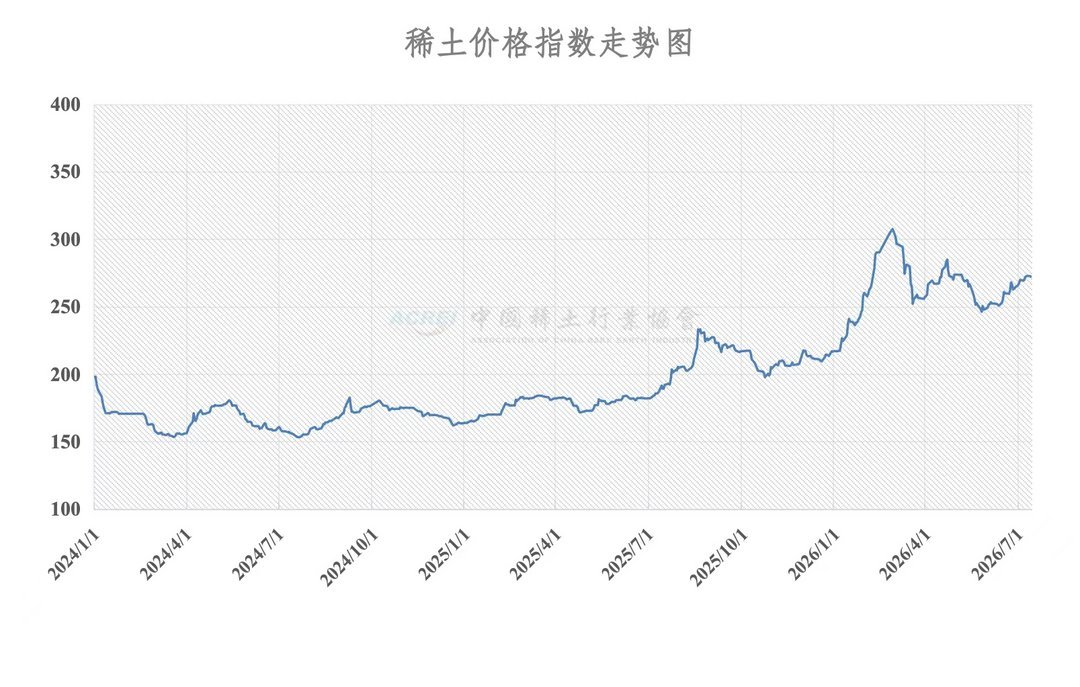
- China's rare earth price index held at 272.2 on July 14, 2026, elevated from 2024 levels despite retreating from early-2026 peaks above 300.
- Heavy rare earths remain extremely costly: terbium metal reached up to $1,292/kg and dysprosium metal up to $268.50/kg in domestic Chinese markets.
- Chinese rare earth prices operate within a state-controlled hybrid system of quotas, export licenses, and SOEs—not open market price discovery.
- Pentagon and Serra Verde contract price floors are bilateral agreements, not industry-wide benchmarks, and should not be generalized across the market.
- For Western buyers of yttrium, dysprosium, and terbium, securing qualified supply may now be a greater challenge than negotiating price.
The Association of China Rare Earth Industry reported a domestic rare earth price index of 272.2 on July 14, 2026, with 2010 set at 100. The index has retreated from its early-2026 peak above 300 but remains sharply elevated from 2024 levels.
Using the requested conversion of ¥1 = US$0.15, key reference prices were:
NdPr oxide: ¥752–772/kg (US$112.80–$115.80) NdPr alloy: ¥918.6–938.6/kg (US$137.79–$140.79) Dysprosium oxide: ¥1,405–1,445/kg (US$210.75–$216.75) Dysprosium metal: ¥1,770–1,790/kg (US$265.50–$268.50) Terbium oxide: ¥6,885–6,945/kg (US$1,032.75–$1,041.75) Terbium metal: ¥8,515–8,615/kg (US$1,277.25–$1,292.25) Yttrium oxide: ¥53.6–57.6/kg (US$8.04–$8.64)
NdPr, terbium, and several other products declined on the day, while holmium and erbium products rose. The larger story is continued scarcity—particularly for heavy rare earths needed in high-temperature magnets, defense systems, advanced ceramics, and electronics.
One Element, Two Price Universes
These Chinese quotations are not Western-style market-discovery prices. China’s rare earth system operates through production quotas, export licenses, state-owned enterprises, industrial policy, and Communist Party directives. Prices function within a hybrid state-capitalist control mechanism—not an open exchange comparable with copper or gold.
The ex-China market is scarcely more transparent. Most rare earth products trade through confidential, bilateral contracts covering purity, origin, conversion costs, delivery security, financing, and political risk. With limited non-Chinese refining capacity, there may be only a handful of executable transactions for a specific oxide or metal.
Pricing agencies often extrapolate from trader interviews, indicative offers, or small samples rather than a deep pool of completed trades. One distressed purchase, stale quotation, or strategically motivated trader can distort an assessment. Rare Earth Exchanges® has described this as a market of conditional numbers rather than a single global spot price.
Price Floors Are Contracts—not Benchmarks
The Pentagon’s US$110/kg NdPr floor applies specifically to MP Materials under its 10-year agreement; it is not an industry-wide U.S. floor, although that price point has been embraced by a growing number of individual contracts. Likewise, Serra Verde’s disclosed floors—US$575/kg for dysprosium and US$2,050/kg for terbium—belong to a particular 15-year offtake structure and should not be generalized across the market. For Western buyers, especially of yttrium, dysprosium, and terbium, the decisive question may no longer be price. It may be whether qualified material is available at all.
Disclaimer: This news item is based on data published by a Chinese industry association operating within China’s state-directed rare earth system. The figures should be independently verified and do not constitute investment advice.


0 Comments
No replies yet
Loading new replies...
Moderator
Join the full discussion at the Rare Earth Exchanges Forum →