
Highlights
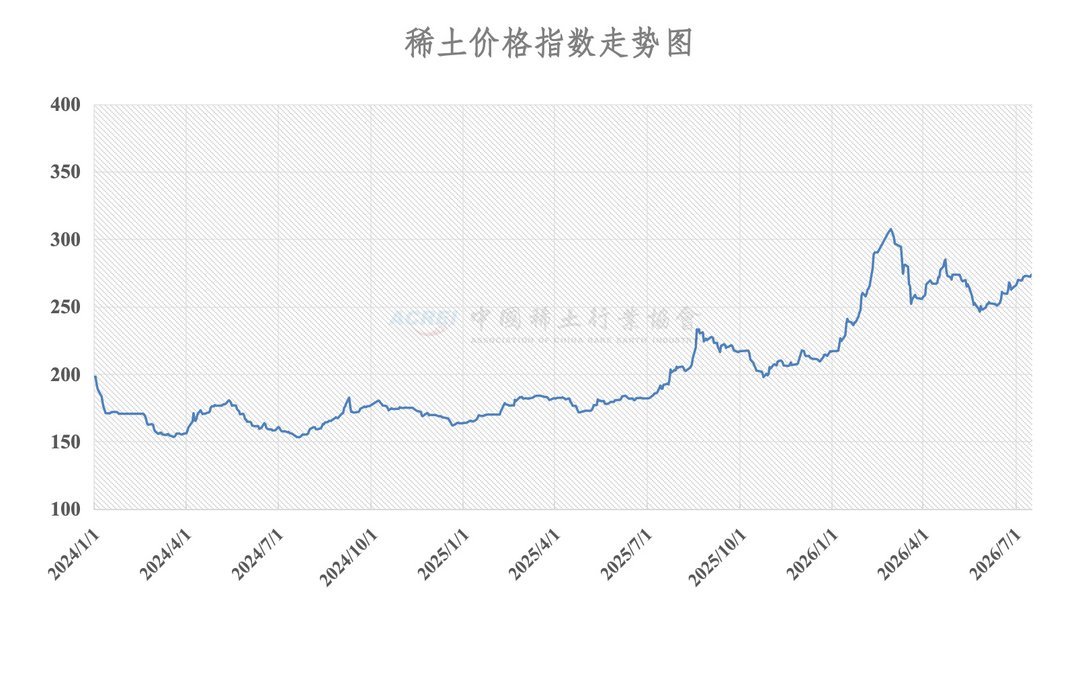
- China's official Rare Earth Price Index rose to 273.5 on July 16, 2026, with heavy rare earths like terbium, holmium, erbium, and gadolinium posting notable gains.
- China's export-control reprieve expires November 10, 2026, potentially triggering physical scarcity in ex-China markets before Western supply chains reach commercial scale.
- Neither China's state-directed domestic market nor the emerging ex-China OTC market offers true transparent price discovery, complicating investment decisions.
- Western governments are investing across the full mine-to-magnet value chain, but most new facilities remain two to three years or more from meaningful commercial output.
- In Great Powers Era 2.0, strategic control of separation, refining, metals, alloys, and magnets—not just mining—will determine who holds geopolitical and pricing leverage.
China's official Rare Earth Price Index climbed to 273.5 on July 16, 2026, extending its recovery from earlier this year. Heavy rare earth products—including terbium, holmium, erbium, and gadolinium—posted gains, while neodymium-praseodymium (NdPr), the industry's benchmark magnet feedstock, remained largely stable. But the published prices tell only part of the story. China's domestic market remains heavily shaped by state industrial policy, production quotas, export controls, and broader national security objectives rather than unconstrained market discovery. At the same time, the emerging ex-China market is becoming increasingly driven by physical scarcity as allied governments race to build mine-to-magnet supply chains that remain at least two to three years from meaningful commercial scale. With China's temporary export-control reprieve scheduled to expire on November 10, 2026, the risk of tighter ex-China availability—and scarcity-driven pricing—could increase materially if restrictions return before new Western capacity comes online. Adding another layer of complexity, Beijing continues to stimulate domestic demand through state-directed industrial and infrastructure investment while accelerating production of next-generation defense systems, both of which could further tighten demand for select strategic rare earths and critical minerals. In the emerging Great Powers Era 2.0™, the contest is no longer simply about price—it is increasingly about who can secure physical supply.
China's Rare Earth Prices Rise—But the Real Story Is the Market Behind the Numbers
China's official Rare Earth Price Index climbed to 273.5 on July 16, 2026, according to the China Association of Rare Earth Industry (CREIA), continuing its steady rebound from spring lows. Calculated from domestic transactions using 2010 as the base year (100), the index now sits near its highest level in more than a year. The headline, however, is not the index itself. It is what the price movements reveal about an increasingly fragmented global rare earth market.
Heavy Rare Earths Continue to Show Strength
CREIA's latest reference prices indicate renewed firmness across several strategically important heavy rare earth products:
- Terbium oxide: ¥5,000-5,200/kg (US$750-780/kg) — steady at elevated levels
- Dysprosium oxide: ¥1,405-1,445/kg (US$211-217/kg) — stable
- Holmium oxide: ¥613-633/kg (US$92-95/kg) ↑
- Erbium oxide: ¥523-543/kg (US$78-81/kg) ↑
- Gadolinium oxide: ¥812-832/kg (US$122-125/kg) ↑
Meanwhile, NdPr oxide, the industry's primary magnet feedstock, remained essentially unchanged at ¥757-777/kg (US$114-117/kg), while NdPr alloy held at ¥924-944/kg (US$139-142/kg).
(USD conversions assume approximately ¥6.67 = US$1.)
These Are Reference Prices—Not Free-Market Prices
Investors should resist comparing Chinese rare earth pricing with transparent commodity markets such as copper or gold.
China's rare earth sector operates within a hybrid state-capitalist system shaped by production quotas, export licensing, state-owned enterprises, industrial policy, Communist Party priorities, and national security objectives. Commercial transactions certainly occur, but pricing exists within a framework of government intervention that limits conventional market discovery.
Ironically, the ex-China market is not yet a fully transparent free market either.
China still performs the overwhelming majority of commercial rare earth separation and downstream processing. Outside China, most transactions remain confidential bilateral agreements negotiated over months, often involving product specifications, qualification requirements, delivery schedules, financing terms, strategic relationships, and geopolitical considerations. Published price assessments provide useful reference points, but they represent snapshots—not universally executable market-clearing prices.
As Rare Earth Exchanges® has previously reported, even sophisticated pricing agencies frequently rely on a relatively small universe of traders and market participants. That methodology has value but also limitations. In specialized markets with thin liquidity, buyers can easily overpay if benchmark assessments are mistaken for actual transaction prices.
The Ex-China Market Isn't a True Free Market Either
A common assumption is that if China's prices are distorted, the ex-China market must represent "true" market pricing. That assumption is also incorrect.
Outside China, rare earths are not traded on deep, transparent commodity exchanges like gold, copper, or crude oil. Instead, most transactions occur through confidential over-the-counter (OTC) contracts negotiated directly between producers, processors, traders, and industrial consumers. Every agreement can differ in chemistry, purity, oxide versus metal form, delivery schedules, payment terms, qualification status, logistics, volume commitments, and geopolitical risk allocation.
The market is also extraordinarily small. China still controls the overwhelming majority of commercial rare earth separation and much of the downstream production of metals, alloys, and magnets. As a result, only a limited volume of material is bought and sold outside China, leaving relatively few transactions available for independent price discovery.
This creates a difficult environment for so-called pricing agencies. Most rely on voluntary submissions, trader interviews, dealer quotes, or a limited sample of commercial transactions. Those assessments can provide some valuable market intelligence, but they should not be interpreted as definitive clearing prices. Depending on the participants surveyed, quoted prices may reflect asking prices rather than executed transactions, unusually favorable deals, distressed sales, or isolated shortages. Buyers should ask the tough questions.
Recent strategic agreements illustrate the point. The U.S. Department of Defense-supported agreement with MP Materials (NYSE: MP) established a US$110/kg price floor for NdPr oxide under that specific commercial structure. Likewise, reported pricing associated with Serra Verde included a minimum price near US$2,050/kg for selected heavy rare earth products under negotiated terms. Neither agreement establishes an industry benchmark (although it's arguable the DoD/MP deal sort of does). Each reflects unique commercial objectives and risk-sharing arrangements.
For investors, the takeaway is straightforward: both China's domestic market and the emerging ex-China market require careful interpretation. One is shaped by state-directed industrial policy; the other remains an immature, illiquid OTC market where confidentiality, scarcity, and strategic considerations often matter as much as price. Until a much larger volume of non-Chinese separated rare earth products enters global commerce, true international price discovery will remain elusive.
Great Powers Era 2.0™ Is Changing the Economics
The larger investment story extends well beyond today's prices. Rare earth supply chains are entering a structural transition driven by the Great Powers Era 2.0 thesis. Governments across North America, Europe, Australia, Japan, South Korea, and India are no longer financing mines alone—they are investing across the entire strategic value chain: separation, refining, metals, alloys, magnets, recycling, digital provenance, and supply-chain intelligence. That investment will gradually increase feedstock availability outside China.
It will also produce a fundamentally different cost structure. Western supply chains will likely operate with higher labor costs, stricter environmental standards, longer permitting timelines, higher financing costs, and greater regulatory oversight than the state-directed system China spent decades constructing. Strategic resilience—not lowest cost—is becoming the principal policy objective.
That shift represents one of the largest industrial investment opportunities in a generation.
The Clock Is Ticking Toward November 10
Timing now matters as much as pricing. If China's temporary export-control accommodations expire on November 10, 2026, before significant Western mine-to-magnet capacity reaches commercial scale, ex-China markets could become increasingly driven by physical scarcity rather than published benchmark prices.
Most announced Western separation facilities, metal plants, alloy production lines, and magnet factories remain at least two to three years from meaningful commercial output, with many projects extending well beyond that horizon. New mines will help, but ore alone does not solve the strategic bottleneck.
For investors, that distinction is everything. The winners of the next decade may not simply be those discovering rare earth deposits. They are more likely to be companies that control the highest-value portions of the supply chain—separation, refining, metals, alloys, magnets, recycling, qualification, and digital provenance—where geopolitical leverage increasingly translates into pricing power.
Source: China Association of Rare Earth Industry (CREIA), July 16, 2026. Analysis and commentary by Rare Earth Exchanges®.


0 Comments
No replies yet
Loading new replies...
Moderator
Join the full discussion at the Rare Earth Exchanges Forum →