
Highlights
- Rare earth elements embedded deep in supply chains are now strategic liabilities, not just commodity inputs, as China's 2025 export controls disrupted global manufacturing.
- Procurement, finance, and engineering must evolve beyond cost optimization to prioritize supply-chain resilience, provenance verification, and geopolitical risk management.
- ERP systems must transform into geopolitical intelligence platforms capable of tracking materials from mine to magnet across multiple jurisdictions and export-control regimes.
- Companies able to prove diversified, verifiable critical mineral supply chains may command valuation premiums, while opaque sourcing strategies risk growing geopolitical risk discounts.
- The emerging concept of a Geopolitical Price, distinct from Chemistry Price, signals a fundamental shift in how strategic materials are valued on corporate balance sheets.
For nearly half a century, globalization taught executives a remarkably simple lesson. Buy wherever production is cheapest.
Reduce inventories. Consolidate suppliers. Eliminate redundancy. Treat raw materials as interchangeable commodities and let markets optimize the rest. It was one of the greatest wealth-creating periods in modern history. Hundreds of millions escaped poverty. China transformed itself from an agrarian economy into the world's industrial powerhouse by integrating into global trade. Western corporations rewarded shareholders through increasingly sophisticated global sourcing strategies, while accountants measured success through lower input costs, higher inventory turns, and ever-thinner operating margins. Efficiency became a religion.
That religion is ending.

Rare Earth Exchanges® has argued that the world has entered the Great Powers Era 2.0™—an era in which geopolitics increasingly shapes economics rather than the other way around. The post-Cold War assumption that global markets would naturally deepen integration through free trade and economic interdependence is giving way to a world where economic relationships are increasingly subordinated to national security and strategic competition. COVID-19 exposed the fragility of globally optimized supply chains. Russia's invasion of Ukraine demonstrated how commodities can become geopolitical weapons. China's export controls on gallium, germanium, graphite, and rare earth elements showed that control over upstream materials can reverberate across entire downstream industries. While President Donald Trump's second administration has accelerated this transition through industrial policy, tariffs, and domestic supply-chain initiatives, its roots extend much deeper—to Xi Jinping's more assertive economic strategy beginning in 2012 and the rise of China, Brexit, the resurgence of nationalism, friend-shoring, and a growing recognition that hyper-globalization created strategic dependencies as well as economic efficiencies.
Put another way, Great Powers Era 2.0 is the broader geopolitical transformation of which what some academics describe as "Globalization 2.0" is one important economic expression. Jessie Poon and colleagues (opens in a new tab) at the University at Buffalo argue that the world is moving away from Globalization 1.0—a liberal, efficiency-driven model built on free trade, comparative advantage, open markets, and lowest-cost production—toward a system increasingly organized around geoeconomics, national security, and trusted political alliances. Governments are no longer viewing supply chains simply as engines of efficiency, but as strategic assets whose resilience, geographic diversity, and political alignment directly affect national security. The rise of friend-shoring, ally-shoring, industrial policy, export controls, and strategic supply-chain resilience reflects this broader transformation.
Rare Earth Exchanges agrees with this analysis but extends it further. Great Powers Era 2.0 contends that the defining shift is not simply a new phase of globalization, but the transition from a largely unipolar, U.S.-led economic order to an increasingly multipolar world characterized by the full rise of China and sustained competition among major powers. Nations are no longer content merely to extract resources or manufacture low-cost goods; they seek to move up the value chain, secure domestic industrial capabilities, control critical technologies and strategic materials, and, when necessary, weaponize economic interdependence through export controls, sanctions, investment restrictions, and industrial policy. In this environment, rare earth elements, critical minerals and specialty metals, permanent magnets, semiconductors, batteries, pharmaceuticals, and other strategic supply chains cease to be ordinary commercial markets. They become instruments of economic statecraft, national security, and geopolitical influence. For corporations, the implications are profound. Strategy, accounting, procurement, capital allocation, and risk management must evolve from optimizing almost exclusively for cost and efficiency to optimizing for resilience, trusted partnerships, supply-chain transparency, and long-term strategic continuity.
The implications extend far beyond trade policy. They redefine what companies should value.
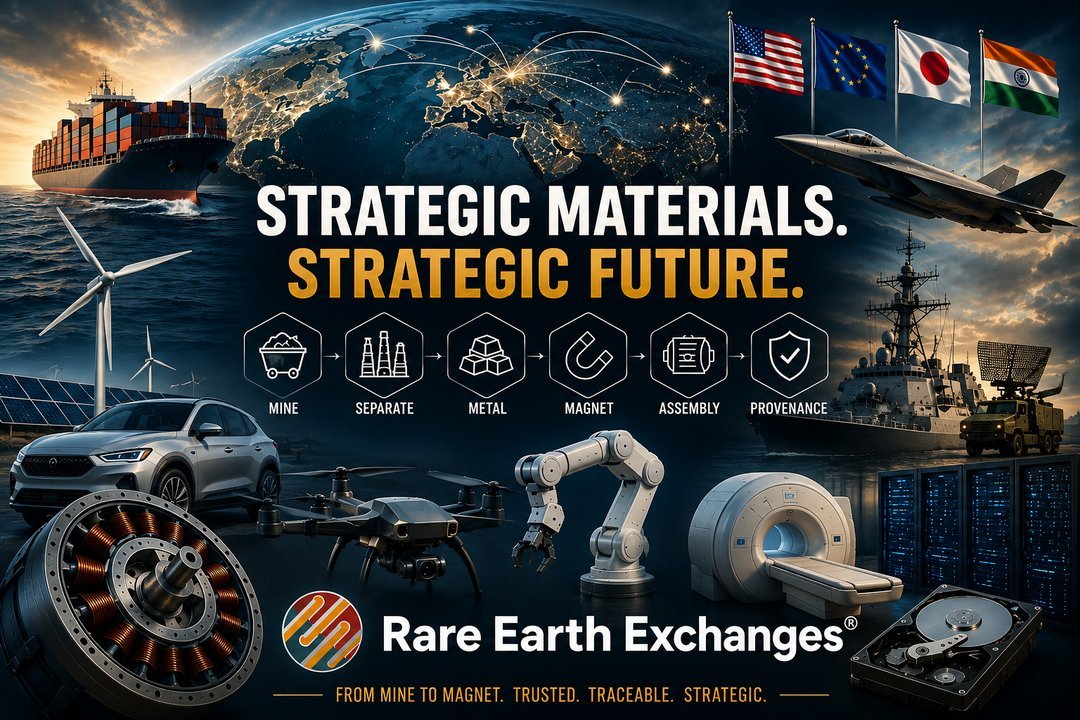
Most Companies Never Buy Rare Earths
Most do not. Automakers typically purchase complete electric drive units, traction motors, steering systems, or e-axles from Tier 1 suppliers rather than buying rare earth magnets themselves. Aircraft manufacturers procure flight-control systems, actuators, avionics, and auxiliary power equipment. Wind turbine manufacturers source complete generators and nacelle assemblies, while industrial companies purchase servo motors, variable-speed drives, pumps, compressors, and factory automation systems. Robotics manufacturers integrate precision motors, harmonic drives, sensors, and actuators into industrial, logistics, and humanoid robots. Drone manufacturers buy complete propulsion systems, gimbal motors, flight-control assemblies, and payload stabilization systems. Medical device companies procure MRI components, surgical robotics, and diagnostic imaging equipment. Consumer electronics companies source hard drives, speakers, smartphones, haptic devices, sensors, and precision actuators. Defense contractors acquire guidance systems, radar assemblies, electric propulsion systems, electro-optical sensors, and precision electromechanical components.
In nearly every case, the rare earths are not purchased directly—they are embedded inside permanent magnets, which are themselves embedded inside higher-value products. By the time a finished motor, generator, actuator, or guidance system reaches the OEM, the rare earth supply chain has effectively disappeared from view, buried several supplier tiers below the purchasing decision. That invisibility became one of globalization's greatest efficiencies—and, increasingly, one of its greatest strategic vulnerabilities.
In nearly every case, the rare earths are several layers removed from the purchasing decision.
What arrives on a purchase order is a motor. Or an actuator. Or a servo. Or a radar module.
Hidden inside is a permanent magnet. Hidden inside that magnet are rare earth metals such as neodymium, praseodymium, dysprosium, terbium, samarium, or other strategic elements.
The rare earth supply chain is therefore largely invisible to the companies that ultimately depend upon it.
Instead of managing strategic materials, most organizations manage finished components whose upstream origins remain buried two, three, or even six supplier tiers away. Yet that opacity was acceptable when global trade functioned predictably. It becomes a strategic liability when governments begin controlling the movement of the materials inside those components.
The Death of the Lowest-Cost Supplier
For decades, procurement organizations viewed these embedded magnets as simply another manufacturing input.
The motor met specification. The supplier delivered on time. The cost was competitive. Little else mattered. And finance departments likewise treated rare earths as insignificant cost elements buried deep inside bills of material. That logic made sense when geopolitical disruption appeared unlikely.
It makes far less sense when export licensing can halt production across multiple industries.
Rare Earth Exchanges™ has raised awareness worldwide, placing rare earth elements, critical minerals and specialty metals at the center of economic security and industrial competitiveness, warning that concentrated supply risks have materially increased. China's export controls during 2025 demonstrated that disruption need not originate from military conflict. Administrative licensing alone proved sufficient to delay magnet shipments, interrupt manufacturing schedules, and force companies worldwide to reconsider procurement strategies.
The economic paradox is striking. Rare earth magnets typically account for well under one percent of the total value of an electric vehicle, industrial robot, MRI machine, wind turbine, or missile system. Yet without those magnets, none of those systems function.
A component representing less than one percent of cost can immobilize one hundred percent of production. The cheapest supplier suddenly becomes the most expensive decision.
The New Unit of Strategic Value
This observation leads to a much larger realization. Companies are not really buying magnets. They are buying certainty.
A motor purchased today carries far more embedded information than its invoice suggests.
- Where was the ore mined?
- Where were the rare earths separated?
- Where were the metals produced?
- Where were alloys manufactured?
- Who sintered the magnet?
- Who assembled the motor?
- Which countries exercised export jurisdiction over every step?
For decades, none of those questions materially affected enterprise value. But today, as we move into the Great Powers Era 2.0, every one of them can determine whether a factory remains operational. Consequently, the economic value of a motor increasingly extends beyond horsepower, efficiency, or cost. Its value now includes geopolitical resilience, and even national security. This is the beginning of a profound change in corporate accounting.
From Lean Supply Chains to Strategic Supply Networks
In the previous sections we have established that Great Powers Era 2.0™ fundamentally changes how companies value strategic materials. We now address the more difficult question: How must companies themselves change? The answer is profound because the challenge is no longer confined to procurement. It reaches into finance, engineering, treasury, legal, information technology, investor relations, and ultimately the boardroom. The corporation itself must evolve.
For decades, multinational companies were engineered for a remarkably stable world. Procurement teams negotiated lower prices. Finance departments measured success through inventory turns and working-capital efficiency. Engineers optimized performance while operations relentlessly removed redundancy from manufacturing networks. Each function became highly efficient—but each optimized for assumptions that are increasingly breaking down.
The defining assumption was simple: if one supplier disappeared, another would emerge somewhere else in the global market.
Great Powers Era 2.0 challenges that assumption. In strategic industries, there may not be another supplier. A modern electric vehicle illustrates the problem perfectly. The automaker may never purchase rare earth oxides or metals directly. Instead, it buys electric drive systems from a Tier 1 supplier, which sources permanent magnets from another company, which purchases alloys from another supplier, which depends upon separated rare earth oxides produced somewhere else in the world (currently about 90% China). By the time the finished motor reaches the assembly line, the automaker may have little visibility into where the strategic materials originated or which governments exercised jurisdiction over them during processing. That hidden complexity was largely irrelevant during the globalization era. Today it has become a board-level risk, although most boards remain oblivious to this.
The New Mission of Procurement
Procurement departments are quietly becoming one of the most strategically important organizations inside modern corporations.
Historically, purchasing professionals were rewarded for reducing costs, negotiating favorable contracts, improving delivery performance, and minimizing inventory. Those objectives remain important, but they are no longer sufficient.
Tomorrow's procurement executives will increasingly be expected to answer questions that would have sounded unusual only a few years ago. Can this supplier survive export controls? Where were the magnets manufactured? Fabricated? Which country separated the rare earth elements? Where were the oxides transformed to metals? How many qualified alternatives exist if geopolitical conditions deteriorate? Can the company prove the provenance of the material to regulators, investors, or defense customers?
The ability to qualify a second or third strategic supplier may ultimately create more shareholder value than another round of cost reductions. Redundancy, once viewed as inefficiency, increasingly becomes a competitive advantage. Procurement is evolving from a purchasing function into an enterprise risk-management capability.
The ERP Revolution Nobody Is Talking About
The digital infrastructure supporting global commerce must evolve as well. Today's enterprise resource planning (ERP) systems excel at tracking suppliers, invoices, inventory, purchase orders, and production schedules. What they rarely capture is the strategic history embedded inside a product.
A future ERP system may need to know far more than who sold the motor. It may need to identify where the rare earth ore was mined, where it was separated into oxides, where those oxides became metals, where alloys were produced, where magnets were sintered and finished, and finally where those magnets were incorporated into motors, actuators, guidance systems, or medical devices. Alongside those manufacturing steps will increasingly sit additional layers of information: export-control exposure, domestic-content compliance, carbon intensity, chain-of-custody documentation, geopolitical risk scores, and digital provenance certificates. In other words, ERP software begins evolving from an accounting platform into a geopolitical intelligence platform.
That transformation may ultimately prove as significant as the rise of cloud computing or artificial intelligence.
Trust Becomes Infrastructure
One consequence of this evolution is that documentation itself becomes strategic infrastructure. For decades, companies relied on supplier declarations, invoices, certificates of origin, and shipping documents to establish compliance. Those methods were largely sufficient in a world where cost and logistics dominated commercial decision-making.
Governments increasingly want something far more robust.
Defense procurement has already begun moving toward verifiable mine-to-magnet traceability, with imminent new Department of Defense DFAR rules commencing at the start of the new year. As strategic material regulations expand, commercial markets are likely to follow. Companies will increasingly need digital systems capable of documenting every transformation—from ore extraction to oxide separation, metallization, alloy production, magnet manufacturing, and final assembly.
This shift creates an entirely new category of industrial infrastructure. The companies that verify supply chains may become almost as strategically important as those that operate them. In Great Powers Era 2.0, trust itself becomes a form of infrastructure.
Finance Discovers the Value of Resilience
Perhaps no corporate function faces a greater philosophical shift than finance. For decades, excess inventory represented trapped capital. Strategic stockpiles reduced returns. Long-term offtake agreements limited flexibility. Supporting new suppliers appeared unnecessarily expensive.
Those assumptions begin to reverse once interruption itself becomes a measurable financial risk. A company may willingly finance strategic inventories, provide prepayments to emerging processors, support domestic magnet manufacturing, invest in recycling capacity, or underwrite second-source qualification—not because these decisions maximize quarterly earnings, but because they maximize the probability that production continues during disruption.
The financial language changes as well. Working capital increasingly becomes resilience capital. These expenditures should not be viewed as inefficiencies. They represent investments in corporate continuity.
Engineering Joins the Geopolitical Conversation
Engineering organizations also find themselves confronting questions that previously belonged to procurement. Can products be redesigned to reduce dysprosium or terbium content? Could alternative motor architectures reduce dependence on permanent magnets in selected applications? Can systems tolerate multiple magnet chemistries without sacrificing performance? How rapidly can a design qualify materials from an alternative supplier? Engineering is no longer optimizing solely for efficiency, power density, or cost. It is increasingly designing products that can survive geopolitical disruption. The result is a much closer relationship between engineers, procurement specialists, finance teams, and national-security experts than most corporations have ever experienced.
Boards and Investors Begin Asking Different Questions
These changes ultimately reach the boardroom. Directors are likely to spend less time asking whether procurement reduced costs by two percent and more time asking how much of the company's revenue depends upon a single country's rare earth supply chain. They will want to understand how many qualified supply pathways exist, how long manufacturing could continue under export restrictions, and whether management truly understands supplier exposure beyond Tier 1.
Investors are likely to evolve in parallel. Markets have repeatedly demonstrated that previously overlooked risks eventually become valuation drivers. Cybersecurity evolved from an IT issue into a board-level governance issue. Climate disclosure moved from corporate social responsibility into securities regulation. Artificial intelligence governance is rapidly following the same path.
Strategic critical materials exposure may be next. Companies capable of demonstrating diversified, resilient, and verifiable supply chains could increasingly command valuation premiums, while firms unable to explain where their embedded magnets originate may face growing geopolitical risk discounts.
The Rise of Strategic Material Accounting
All of these developments point toward a broader conceptual transformation. Rare Earth Exchanges believes the market is beginning to distinguish between two different forms of value. The first is familiar: the Chemistry Price. It reflects purity, grade, processing costs, transportation, and the traditional forces of commodity markets. The second is new: the Geopolitical Price. It reflects something entirely different—political alignment, export-control exposure, domestic processing capability, digital provenance, regulatory compliance, supply continuity, and confidence that the material will remain available during periods of international tension.
Two magnets with identical technical specifications may therefore possess dramatically different enterprise value.
Not because the atoms differ. Because the geopolitical risk does. This distinction represents one of the most important accounting changes of the emerging industrial era. Increasingly, corporations will not simply purchase magnetic performance; they will purchase certainty.
From Just-in-Time to Just-in-Case
The globalization era rewarded efficiency because markets assumed stability. Every redundant supplier represented unnecessary expense. Every extra day of inventory appeared wasteful. Every additional processing facility reduced returns on capital.
Those decisions generated extraordinary prosperity. They also concentrated risk. Great Powers Era 2.0 does not reject globalization. It reorders its priorities. Yes, efficiency will always remain important. And in parallel, resilience becomes indispensable.
The industrial leaders of the coming decade will not necessarily own the world's largest mines or negotiate the lowest prices. They will understand every layer of their supply networks—from ore to oxide, from metal to alloy, from magnet to motor, and from component to finished product. They will know which governments exercise jurisdiction over each stage, where vulnerabilities exist, and how rapidly alternative pathways can be activated when markets fracture. They will recognize something that traditional accounting rarely measured. Resilience is no longer an operating expense. It is becoming one of the most valuable assets on the balance sheet.
The globalization era taught corporations to optimize for cost. Great Powers Era 2.0 teaches them to optimize for continuity.
That may prove to be one of the defining management innovations of the twenty-first century.
Rare Earth Exchanges Take
For decades, rare earth elements disappeared into the global economy, hidden inside magnets that were themselves hidden inside motors, generators, actuators, medical devices, industrial robots, aircraft, missiles, smartphones, wind turbines, and thousands of other products. Most manufacturers never purchased rare earths directly; they purchased finished components and assumed the invisible supply chains behind them would always function. Great Powers Era 2.0 ends that assumption. The companies that lead the next industrial age will compete not only on technology, manufacturing excellence, or cost, but on their ability to understand, verify, finance, and secure every layer of their strategic supply networks. In the coming decade, the most valuable characteristic of a rare earth magnet may not be its magnetic strength. It may be the certainty that it will still be available when geopolitical competition makes everything else uncertain.


0 Comments
No replies yet
Loading new replies...
Moderator
Join the full discussion at the Rare Earth Exchanges Forum →