
Highlights
- China's large industrial enterprises grew 5.4% in H1 2026, with semiconductor exports surging 88.7% and industrial profits up 18.8% through May.
- Despite headline gains, Beijing acknowledged 'strong supply and weak demand,' falling prices, unpaid corporate debts, and excess capacity across key sectors.
- China claims 70% of global quadruped robot sales and over 400 humanoid robot models released, signaling deep AI and robotics integration in manufacturing.
- Western analysts warn China's export-dependent, state-directed industrial model masks weak domestic consumption and capital misallocation risks.
- REEx's Great Powers Era 2.0 framework argues China's supply-chain dominance is eroding as nations invest in domestic manufacturing and friend-shoring alternatives.
China’s Ministry of Industry and Information Technology used a July 20 briefing to present a confident picture of industrial expansion, technological progress, and export strength. Yet beneath the headline numbers, officials acknowledged a more difficult reality: China still faces “strong supply and weak demand,” structural imbalances, intense price competition, and a severe external environment.
Exports, Chips, and AI Power the Growth Story
China reported that value added from large industrial enterprises rose 5.4% in the first half of 2026, while industrial profits increased 18.8% during the first five months. Exports denominated in yuan rose 13.4%, led by integrated circuits, electronic components, wind turbines, batteries, vehicles, and ships. Semiconductor exports reportedly surged 88.7%, while electronic-component exports increased 62.6%. China also claimed major gains in artificial intelligence and computing infrastructure. More than 30% of large manufacturers reportedly use AI technologies, while domestic open-source AI models have surpassed 10 billion cumulative downloads. Intelligent computing capacity reached 2,185 EFLOPS, up 177%, supported by more than 5.1 million 5G base stations.
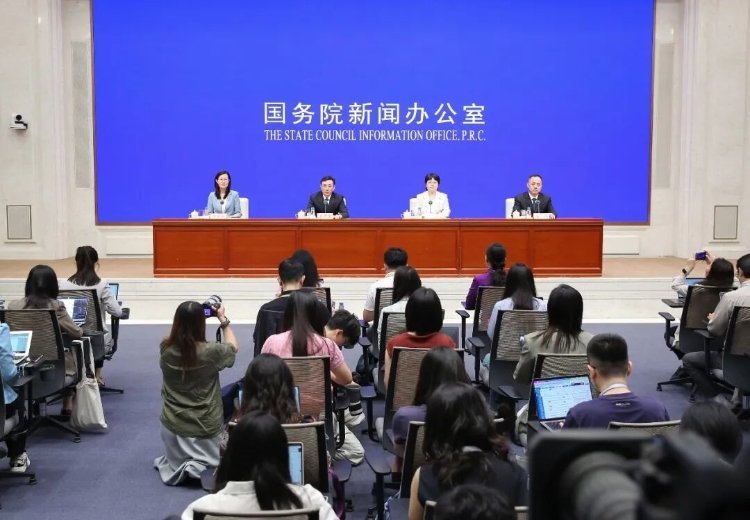
Officials from China's Ministry of Industry and Information Technology brief reporters during a State Council Information Office press conference on first-half 2026 industrial and technology developments in Beijing.
For the West, those numbers matter because they suggest China is not merely building AI models—it is integrating AI into factories, robotics, pharmaceuticals, telecommunications, and advanced manufacturing at scale.
The Factory Floor Is Becoming the Laboratory
Officials highlighted several claimed breakthroughs: a reusable rocket recovery, second-generation blade batteries, megawatt fast charging, large-scale production of T1200-grade carbon fiber, an approved invasive brain-computer interface device, and rapid expansion in industrial and humanoid robotics. China said quadruped robots now account for nearly 70% of global sales, while domestic companies have released more than 400 humanoid robot models. These claims could carry major implications for aerospace, defense, autonomous systems, advanced materials, and manufacturing competitiveness—but independent technical validation remains essential.
The Warning Signs Beijing Could Not Hide
The same briefing revealed mounting pressure. Officials repeatedly referenced weak domestic demand, “involution-style” competition, excess capacity, falling prices, unpaid corporate debts, and the need for government intervention to stabilize photovoltaic, battery, automotive, and other industries.
That language suggests China's industrial machine may be producing faster than its domestic economy can absorb. Strong exports can offset that imbalance temporarily, but they also increase the risk of trade disputes, tariffs, and accusations of state-supported overcapacity abroad.
Equally noteworthy is how Beijing intends to respond. Rather than emphasizing market-led consolidation and price discovery, officials repeatedly stressed administrative coordination, industrial planning, standards-setting, production guidance, and government oversight. That approach has unquestionably helped China scale strategic industries at extraordinary speed.
However, Rare Earth Exchanges suggests that over the longer term it also carries economic risks. Persistent state direction can weaken market signals that normally eliminate excess capacity, discourage inefficient investment, and reward innovation. As government guidance increasingly substitutes for competitive market forces, businesses may become more responsive to policy priorities than to customer demand, potentially reducing entrepreneurial risk-taking, slowing creative destruction, and encouraging capital allocation based on administrative objectives rather than commercial returns.
For Western investors, these vulnerabilities matter as much as China's strengths. Rare Earth Exchanges' Great Powers Era 2.0™ framework argues that China's current dominance in many strategic supply chains represents a powerful but not permanent advantage. As geopolitical competition intensifies, governments across North America, Europe, Australia, India, Japan, South Korea, the Gulf states, and parts of Africa are investing heavily to build their own processing, manufacturing, and technology ecosystems. China's industrial lead is unlikely to disappear quickly, but the era of largely uncontested supply-chain monopolies is beginning to erode. The next decade is likely to be defined less by China's ability to expand production than by its ability to defend market share in an increasingly multipolar industrial landscape.
The Western Takeaway
China's industrial policy continues to deliver remarkable scale, infrastructure, and commercialization. Yet its model is becoming increasingly dependent on exports, state coordination, subsidies, and administrative management rather than market-led adjustment. Western governments should take China's technological progress seriously—but they should also recognize that the same system generating industrial momentum may be masking weak domestic consumption, capital misallocation, and persistent overcapacity.
From the perspective of Rare Earth Exchanges' Great Powers Era 2.0™, the more important story is structural. China's extraordinary position across many critical supply chains was built during an era when globalization rewarded efficiency above all else. That era is ending. Governments increasingly view supply chains through the lenses of national security, economic resilience, industrial sovereignty, and geopolitical influence. As nations invest in domestic manufacturing, friend-shoring, stockpiles, and alternative processing capacity, China's once-unassailable position in sectors ranging from semiconductors to batteries and rare earths will almost inevitably face greater competition. The transition will take years—not months—but the direction of travel is becoming increasingly clear.
President Donald Trump's second administration has accelerated this transition, not by creating the underlying forces, but by amplifying trends already underway. Brexit, the COVID-19 pandemic, China's expanding use of export controls, Russia's invasion of Ukraine, and growing strategic rivalry among major powers had already begun shifting governments away from hyper-globalization. As we reveal in “The Brilliance of Trump: The Man Who Forced the Great Powers Era 2.0” Trump's aggressive use of tariffs, industrial policy, and reciprocal trade measures has further compressed that timeline, forcing allies and competitors alike to reassess economic dependencies and strategic vulnerabilities.
The United States, however, should not mistake China's challenges for its own victory. Washington confronts significant structural headwinds, including historically high federal debt (accelerating under Trump 2.0), persistent inflationary pressures, widening wealth inequality, rising fiscal burdens, and an increasingly volatile geopolitical environment spanning the Middle East, Ukraine, and the Indo-Pacific. These realities constrain America's own industrial ambitions even as it seeks to reduce dependence on China.
Ultimately our Great Powers Era 2.0 thesis is likely to prove inherently inflationary. Redundant factories, duplicated supply chains, strategic inventories, domestic manufacturing incentives, and reshoring all improve resilience—but they also increase costs. For nearly four decades, globalization rewarded efficiency and lowest-cost production. The emerging era rewards resilience, redundancy, trusted partners, and strategic control. Those priorities may produce stronger national security and more robust supply chains, but they are also likely to reshape global trade and sustain higher structural costs for businesses and consumers alike.
Source disclaimer: This report is based on a briefing published by China’s Ministry of Industry and Information Technology and state-affiliated media. The figures and technological claims reflect official Chinese government reporting and should be independently verified.


0 Comments
No replies yet
Loading new replies...
Moderator
Join the full discussion at the Rare Earth Exchanges Forum →