
Highlights
- BRE defined a new 9-kilometer Velhinhas exploration corridor with drill results up to 19.6% TREO and exceptional yttrium-rich heavy rare earth intercepts
- The company holds approximately A$135 million in cash, funding roughly ten quarters of exploration at current spending rates
- No Mineral Resource Estimate has been declared for Monte Alto, Sulista, or Velhinhas, leaving key economic and metallurgical questions unanswered
- BRE's proximity to the planned Camaçari processing hub and Atlantic deep-water port gives it a significant infrastructure advantage over many junior rare earth explorers
- REEx ranks BRE among leading heavy rare earth exploration prospects but notes the critical challenge remains moving material from mine to separation, metal, alloy, and magnet
Brazilian Rare Earths (ASX: BRE) reported another strong exploration quarter, expanding its Monte Alto District with a new 9-kilometer rare earth corridor, exceptional yttrium-rich heavy rare earth drill results, and a healthy cash position. The announcement, released July 23, 2026 by Managing Director and CEO Dr. Bernardo da Veiga, strengthens the geological investment case but does not yet demonstrate commercial production. For investors, the central question remains whether these discoveries can become an economically viable, non-Chinese source of separated rare earths and permanent magnet materials.
Brazilian Rare Earths continues doing what successful explorers should do: finding more mineralization. The company announced a new 9-kilometer exploration corridor at Velhinhas, exceptional yttrium-rich heavy rare earth drilling, formalized the broader Monte Alto District, completed the demerger of its Alurion bauxite-gallium business, and retains approximately A$135 million in cash, providing roughly ten quarters of funding at its current expenditure rate.
| Category | Quarterly Activities |
|---|---|
| District Expansion | Expanded the Monte Alto District by defining a new 9 km Velhinhas rare earth exploration corridor through airborne geophysics and drilling |
| Geophysics | Completed 1,948 line-km high-resolution airborne magnetic and radiometric survey identifying four parallel mineralized trends across Velhinhas |
| Velhinhas Drilling | Completed 2,812 meters of reconnaissance diamond drilling in 18 holes, with 11 holes intersecting significant rare earth mineralization |
| Best Velhinhas Results | Reported assays up to 19.6% TREO, 33,607 ppm NdPr, 1,463 ppm Dy₂O₃, 248 ppm Tb₄O₇, 7,431 ppm Y₂O₃, and 1,087 ppm U₃O₈. |
| Heavy Rare Earth Discovery | Reported exceptional yttrium-rich HREE+Y drill intercepts including 2.5 m @ 7.5% TREO, including 1.3 m @ 10.9% TREO with 58,249 ppm Y₂O₃ and significant Dy-Tb values |
| Critical Minerals | Confirmed mineralization containing NdPr, dysprosium, terbium, yttrium, niobium, scandium, tantalum, and uranium |
| District Consolidation | Formally adopted the unified Monte Alto District, combining Monte Alto, HREE+Y Discovery, Velhinhas, and regional exploration corridors |
| Exploration Portfolio | Expanded land position to 126 granted exploration licenses covering approximately 1,683 km² in Bahia, Brazil, including acquisition of two new exploration tenements |
| Corporate Actions | Shareholders approved the Allurion Resources demerger with 99.94% support. Completed an oversubscribed A$50 million IPO for Armagosa; BRE retained approximately 16% ownership |
| Management | Appointed dedicated Alurion executive leadership and board to advance the Amargosa bauxite-gallium project |
| Exploration Spending | Invested approximately A$13.4 million in exploration activities during the quarter |
| Financial Position | Ended the quarter with approximately A$135 million in cash, providing an estimated 10 quarters of funding at the current expenditure rate |
| Upcoming Catalyst | Planned release of Scoping Study and initial Mineral Resource Estimates, commencement of trial mining and bulk sample testing, Phase II Velhinhas drilling, additional Monte Alto HREE+Y drilling, 10,000 m Sulista South drilling, and 2,500 m Sulista West extension drilling |
| REEx Investor Watch List | Watch for: Mineral Resource Estimate (MRE), metallurgical recovery data, separation/refining strategy, offtake agreements, economic studies, permitting progress, and commercialization of the mine-to-magnet supply chain |
Why This Matters
The exploration results deserve attention. BRE continues reporting unusually high TREO grades alongside meaningful concentrations of yttrium, dysprosium, and terbium—three of the most strategically important heavy rare earth elements. The company correctly highlights that the United States remains effectively dependent on Chinese processing for yttrium, an increasingly important material for semiconductors, defense electronics, advanced ceramics, lasers, and aerospace applications.
The Questions Investors Still Need Answered
This remains an exploration company, not a producer. The quarterly report explicitly states that no Mineral Resource Estimate has yet been declared for Monte Alto, Sulista, or Velhinhas. Investors still lack reserve estimates, definitive economic studies, commercial-scale metallurgy, permitting milestones, customer offtakes, financing for downstream processing, and a fully articulated separation strategy.
For REEx readers, the essential question is straightforward: Who will separate these rare earths into market-ready products? BRE has previously engaged Carester, one of the world's leading rare earth separation engineering firms, suggesting management recognizes the importance of downstream processing expertise. However, investors still await a clearly defined commercial separation strategy, capital plan, and project timeline.
This is an important topic, as mining is only the first link in the supply chain. The United States and its allies remain constrained by shortages in rare earth separation, metals, alloys, and magnet manufacturing. Until those bottlenecks are addressed, even exceptional discoveries cannot fully reduce Western dependence on China.
REEx Assessment: One of the Better Heavy Rare Earth Stories
Fundamentally, Brazilian Rare Earths stands above many junior explorers. REEx Insights ranks BRE among the leading heavy rare earth exploration prospects, reflecting its geological quality, district-scale potential, management execution, and strategic positioning.
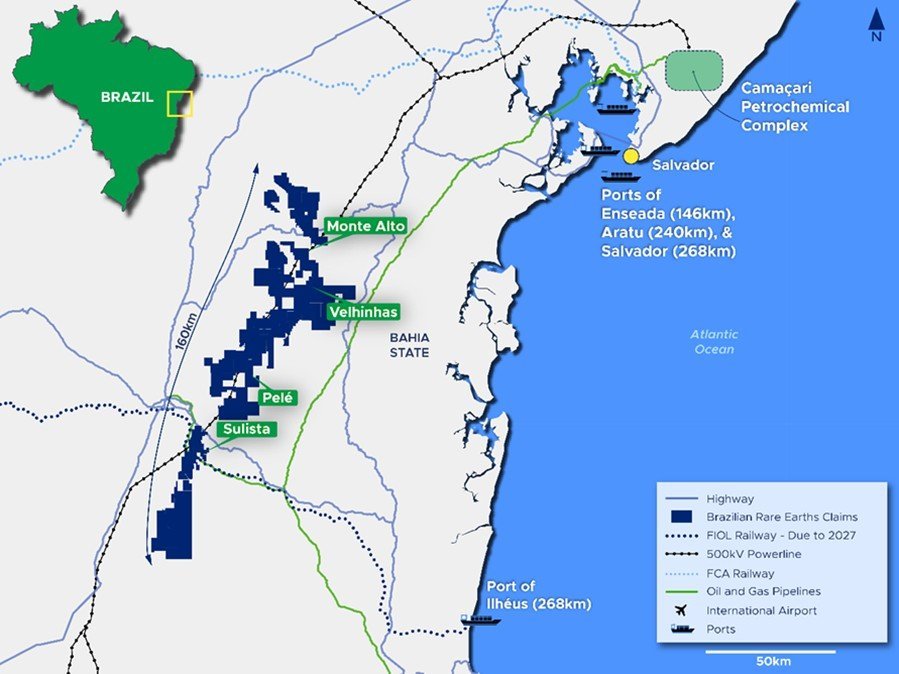
The company benefits from a sophisticated leadership team and support from major long-term investors, including Australian mining entrepreneur and billionaire Gina Rinehart. Geography also works in BRE's favor. The Monte Alto District sits in Bahia near the planned Camaçari rare earth processing hub, a major industrial complex with access to an Atlantic deep-water port—an infrastructure advantage many emerging rare earth projects lack.
Unlike many rare earth explorers located in remote regions requiring billions of dollars in new infrastructure, BRE benefits from Bahia's established industrial base. The planned Camaçari processing hub sits adjacent to one of Brazil's largest petrochemical and chemical manufacturing complexes, providing access to reagents, skilled labor, power, transportation infrastructure, and an Atlantic export terminal. Those advantages could materially reduce capital intensity if the project advances toward commercial development.
REEx believes the company's technical story is credible and largely free of excessive promotional language. The real investment challenge is no longer proving there are rare earths in the ground—it is proving they can move economically from mine to separation, metal, alloy, magnet, and ultimately the customer.


0 Comments
No replies yet
Loading new replies...
Moderator
Join the full discussion at the Rare Earth Exchanges Forum →