
Highlights
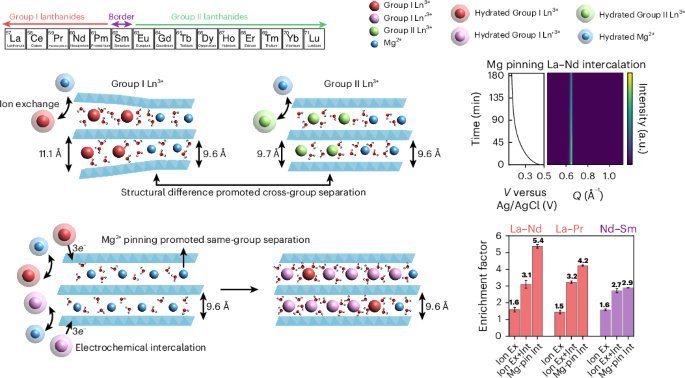
- Researchers achieved 97% neodymium purity after two separation cycles using engineered manganese oxide atomic channels, up from a 1.6-fold to 5.4-fold enrichment over lanthanum.
- The technique uses water and electricity instead of conventional solvent extraction, potentially enabling smaller, modular processing plants with reduced environmental impact.
- Published in Nature Chemical Engineering, the study is a credible proof of concept but has not yet demonstrated commercial scalability, economic competitiveness, or industrial throughput.
- Rare earth separation—not mining—remains the West's greatest strategic bottleneck, with China dominating commercial separation capacity globally.
- Investors are advised to monitor the technology's development while continuing to base decisions on today's industrial realities rather than early-stage laboratory results.
Researchers at the University of Chicago, Northwestern University, and Argonne National Laboratory have demonstrated a promising laboratory technique that separates rare earth elements using water, electricity, and engineered manganese oxide channels rather than conventional solvent extraction chemistry. Published in Nature Chemical Engineering (opens in a new tab), the research represents a meaningful scientific advance toward cleaner rare earth processing—but it remains an early-stage laboratory demonstration. REEx's key takeaway: the work validates an innovative separation concept, yet commercialization will require years of engineering, scale-up, and economic validation before it can materially impact global rare earth supply chains.
Can Atomic Channels Rewrite Rare Earth Separation? Investors Should Watch the Science—Not the Hype
The rare earth industry has searched for decades for an alternative to solvent extraction—a process that consumes enormous volumes of acids, organic solvents, water, and energy. Now researchers led by Associate Professor Chong Liu (opens in a new tab) at the University of Chicago, working with Northwestern University and Argonne National Laboratory, have demonstrated an elegant laboratory approach that may eventually become part of that solution.
Chong Liu, PhD, Associate Professor of Molecular Engineering in the UChicago Pritzker School of Molecular Engineering

Instead of relying on complex solvent chemistry, the team engineered layered manganese oxide with atomic-scale channels that selectively capture rare earth ions based on the size of their hydrated ionic shells. By introducing magnesium ions to stabilize—or "pin"—those channels, they significantly improved separation performance. In laboratory testing, the researchers increased neodymium enrichment over lanthanum from 1.6-fold to 5.4-fold, producing material that reached 97% neodymium purity after two separation cycles.
Where the Science Stands
Published in the peer-reviewed journal Nature Chemical Engineering, the study combines electrochemical separation, density functional theory modeling, and synchrotron X-ray validation. The experimental work appears technically sound, and the authors appropriately describe it as an early-stage proof of concept rather than a commercial technology.
Importantly, this research addresses one of the most difficult problems in rare earth processing: separating chemically similar lanthanides without relying on massive solvent extraction facilities.
The Questions Investors Should Ask
The article naturally emphasizes the scientific achievement, but several commercial questions remain unanswered:
- Can the process operate continuously at industrial throughput?
- What are the capital and operating costs compared with solvent extraction?
- What are the energy requirements?
- Can it economically separate the full suite of commercially important light and heavy rare earth elements?
- How does it perform using real-world concentrates containing impurities rather than laboratory feedstocks?
- What are the durability and replacement costs of the manganese oxide separation media?
Until those questions are answered, investors should view this as a promising platform technology—not a near-term replacement for today's industrial separation plants.
Why It Matters to the West
This work is particularly relevant because rare earth separation—not mining—remains the West's greatest strategic bottleneck. China dominates commercial separation capacity, while most Western projects still depend on conventional solvent extraction systems that require significant capital investment, environmental permitting, and operational expertise.
If successfully commercialized, electrochemical separation technologies could eventually enable smaller, modular, lower-chemical processing plants located closer to mines, recycling facilities, or magnet manufacturers. That could reduce environmental impacts, shorten supply chains, and diversify processing capacity outside China. However, investors should maintain perspective. Commercial deployment, if it occurs, is likely years away.
REEx Assessment
This is credible, high-quality academic research published in one of the field's leading journals. It advances scientific understanding of rare earth separation and introduces a potentially important new processing pathway. What it does not demonstrate is commercial scalability, economic competitiveness, or an immediate solution to Western rare earth dependence. For investors, the signal is clear: watch this technology—but continue investing based on today's industrial realities, not tomorrow's laboratory promise.
Key Scientists Behind the Research
- Dr. Chong Liu — Associate Professor, University of Chicago Pritzker School of Molecular Engineering; senior author and principal investigator leading the electrochemical rare earth separation research.
- Siqi Zou, Ph.D. — Former University of Chicago Pritzker School of Molecular Engineering doctoral researcher; co-first author who helped develop the layered manganese oxide separation platform.
- Jiadong Liu — Graduate researcher, University of Chicago Pritzker School of Molecular Engineering; co-first author responsible for experimental rare earth separation studies.
- Dr. Woo Cheol Jeon — Postdoctoral researcher, Northwestern University; co-first author who led the density functional theory (DFT) modeling that explained rare earth ion behavior within the atomic-scale channels.
- Dr. George C. Schatz — Charles E. and Emma H. Morrison Professor of Chemistry, Northwestern University; internationally recognized computational chemist and co-author, whose team developed the quantum mechanical simulations validating the separation mechanism.
- Researchers at Argonne National Laboratory — Collaborated by providing advanced synchrotron X-ray characterization, enabling experimental validation of the atomic-scale separation mechanism.
Source: Zou, S. et al. Pinning ångström-size solid ionic channels for rare-earth element separation, Nature Chemical Engineering (2026), DOI: 10.1038/s44286-026-00418-8.


0 Comments
No replies yet
Loading new replies...
Moderator
Join the full discussion at the Rare Earth Exchanges Forum →