
Highlights
- Rare earth permanent magnets represent under 1% of vehicle cost yet can halt production of $40,000–$60,000+ vehicles when supply is disrupted.
- Automakers like Ford and GM are 5–6 commercial relationships removed from the magnets embedded in their vehicles, creating dangerous supply chain blind spots.
- China controls approximately 90% of permanent magnet production, and Western alternatives remain under construction or in early ramp-up phases.
- November 10, 2026 marks the expiration of China's temporary rare earth export licensing reprieve, posing an imminent stress test for global auto supply chains.
- The semiconductor shortage proved obscure Tier 3 suppliers can idle factories—rare earth magnets present an even greater and less-monitored vulnerability.
In automotive manufacturing, the most expensive part is often the one that costs the least—if you cannot get it.
When China's temporary rare earth export licensing reprieve expires on November 10, 2026, the first companies to feel the shock may not be Ford or General Motors. They may be suppliers several layers below them—companies most consumers have never heard of, but without whom no vehicle rolls off an assembly line. That is the lesson Rare Earth Exchanges® has emphasized for more than a year: the greatest supply chain risk is no longer the mine. It is the magnet.
The Invisible Supply Chain
Automakers do not purchase rare earth magnets. They purchase complete systems.
The supply chain begins with rare earth mining before moving through separation plants, metal refiners, alloy producers, and magnet manufacturers. Those magnets are then integrated by Tier 2 suppliers into traction motors, electric power steering, brake boosters, HVAC compressors, coolant pumps, actuators, sensors, and dozens of other assemblies. Tier 1 suppliers—including companies such as Magna, Denso, Bosch, Continental, ZF, Aptiv, and Lear—deliver complete systems directly to OEMs such as Ford and General Motors.
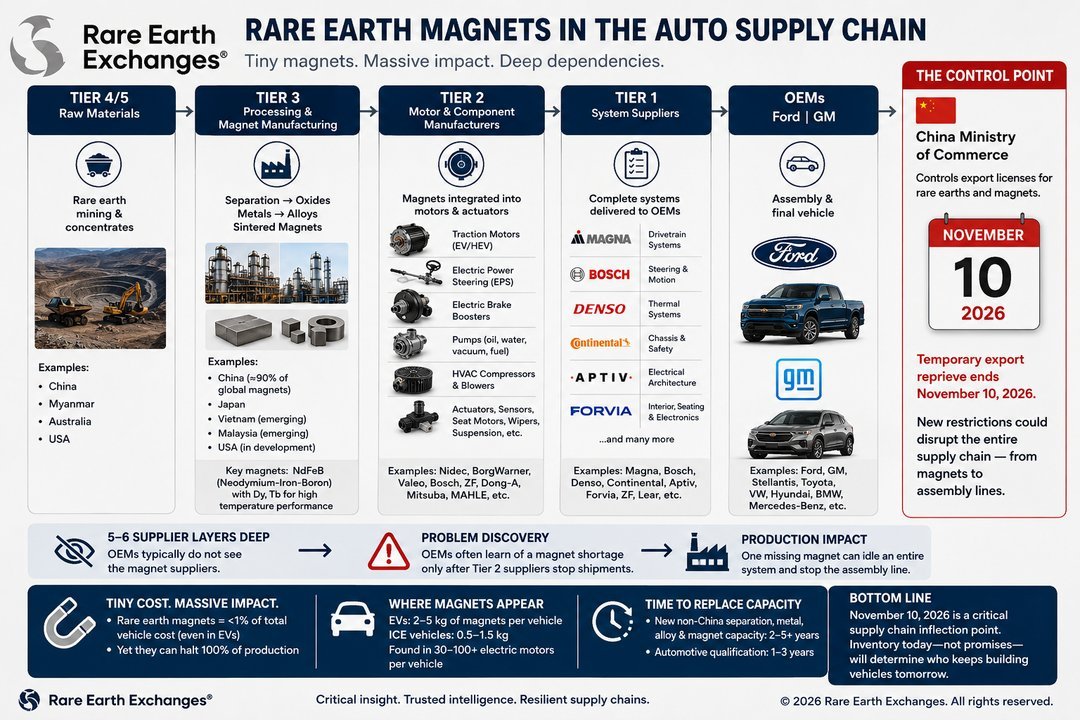
By the time a vehicle reaches final assembly, the critical magnet may be five or six commercial relationships removed from the automaker. That distance creates dangerous blind spots. An OEM may not discover a magnet shortage until after a motor supplier informs a systems supplier that production has stopped. By then, the disruption is already cascading toward the assembly line.
The Cheapest Part Can Stop the Most Expensive Product
Rare earth permanent magnets typically represent well under 1% of a vehicle's total manufacturing cost, even in most electric vehicles. Yet few components carry greater strategic importance. They are embedded throughout modern automobiles—not only in traction motors, but also in electric power steering, braking systems, coolant and oil pumps, HVAC compressors, windshield wipers, seat adjusters, active suspension systems, sensors, speakers, and numerous precision actuators. A premium vehicle may contain well over 100 electric motors, many relying on high-performance neodymium-iron-boron (NdFeB) magnets.
The paradox is remarkable: a component costing perhaps tens or a few hundred dollars can prevent delivery of a vehicle worth $40,000, $60,000, or more. The magnet itself is typically relatively inexpensive. The cost of not having it can be measured in billions of dollars of lost production.
Ford and GM Have a Strategy. The Calendar Has Another.
General Motors has assembled one of the West's most comprehensive mine-to-magnet strategies through partnerships involving MP Materials, VAC, Niron Magnetics, and other emerging suppliers. Ford has likewise diversified sourcing while investing in recycling, alternative motor technologies, and North American supply chains. These initiatives are strategically sound.
The calendar is less forgiving.
Most Western separation plants, metal production, alloy manufacturing, and magnet factories remain under construction, qualification, or early commercial ramp-up. Automotive qualification cycles often require years, not months.
Few industry observers expect these investments to materially reduce dependence on China before November.
The Countdown Has Already Begun
The semiconductor shortage taught automakers that seemingly obscure Tier 3 suppliers could idle billion-dollar factories.
Rare earth magnets present an even greater vulnerability because the global supply chain remains overwhelmingly dependent on China for separation, metal production, alloy manufacturing, and approximately 90% of permanent magnet production. If China's Ministry of Commerce allows its current licensing reprieve to expire—or reimposes stricter export controls—the effects will propagate rapidly through suppliers that many OEMs do not directly monitor.
November 10 is therefore more than a regulatory deadline. It is a stress test of every automaker's supply chain intelligence.
The question is no longer whether Ford, General Motors, or their competitors have announced rare earth partnerships.
The question every board should already be asking is far simpler: Which supplier in our supply chain runs out of rare earth magnets first—and how many days later does our assembly line stop?


0 Comments
No replies yet
Loading new replies...
Moderator
Join the full discussion at the Rare Earth Exchanges Forum →