
Highlights
- Critical Metals' consortium has reached the final evaluation stage of Kenya's competitive tender for the Mrima Hill rare earth and niobium project, one of the world's largest undeveloped critical mineral deposits.
- Mrima Hill offers attractive geology and favorable logistics near the Port of Mombasa, positioning it as a potential non-Chinese rare earth feedstock source.
- Claims of accelerated development, regional processing hubs, and NdFeB magnet production remain aspirational until development rights are formally awarded.
- Winning a government tender is not equivalent to building a commercially competitive mine-to-magnet supply chain, which requires separation, metal production, and long-term offtake agreements.
- Rare Earth Exchanges warns investors that the real milestone will be evidence that Mrima Hill can integrate into a viable, Western-aligned rare earth supply chain.
Critical Metals Corp (opens in a new tab). (Nasdaq: CRML) announced that its consortium has advanced to the final stage of Kenya's competitive tender process for the Mrima Hill rare earth and niobium project (opens in a new tab), one of the world's best-known undeveloped critical mineral deposits. The development is strategically important because Mrima Hill could eventually become a meaningful non-Chinese source of rare earth feedstock. Investors, however, should distinguish between progress in a government tender and the creation of a commercial supply chain. Key takeaways: (1) the consortium has been shortlisted but has not secured development rights; (2) Mrima Hill combines attractive geology with favorable logistics near the Port of Mombasa; (3) claims regarding rapid development, downstream processing, and magnet production remain forward-looking; and (4) Rare Earth Exchanges® believes success will ultimately depend on execution across the entire mine-to-magnet value chain.
Sample of Africa Rare Earth Assets Including Mrima Hill
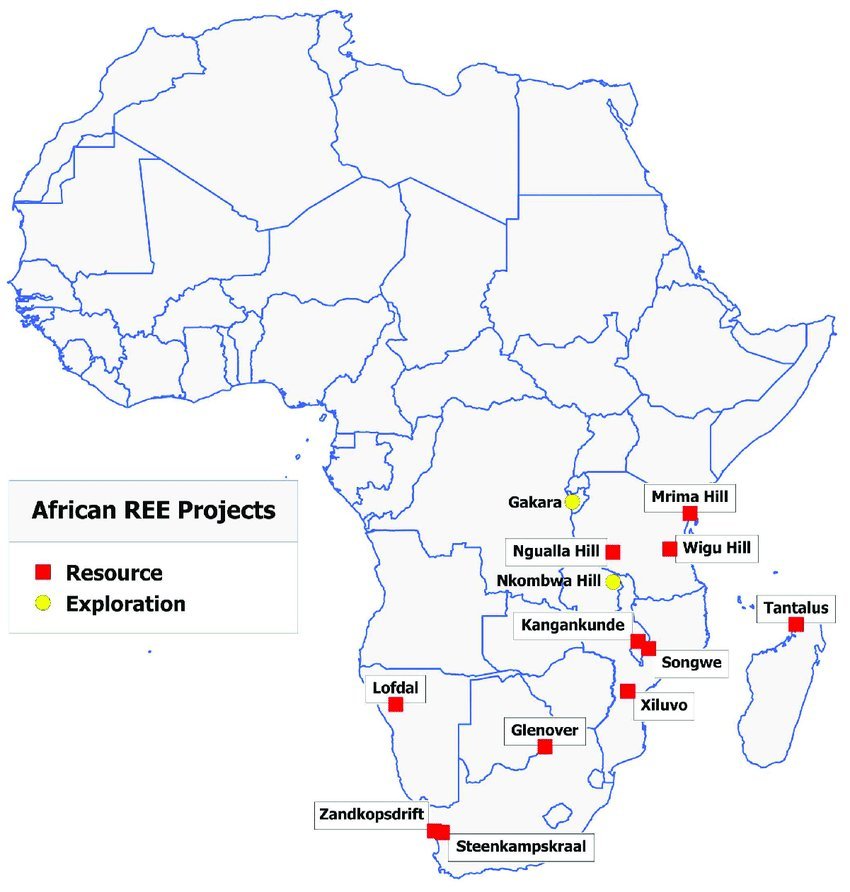
Source: ResearchGate
A Step Forward—Not the Finish Line
Some mining announcements celebrate discoveries. This one celebrates opportunity.
Critical Metals announced that its consortium has advanced to the final evaluation stage of Kenya's tender process for the right to develop the Mrima Hill rare earth and niobium project. The company views the project as complementary to its Tanbreez rare earth asset in Greenland and central to its Western-aligned critical minerals strategy. Mrima Hill has been recognized for decades as a significant rare earth and niobium deposit. What is new is Kenya's effort to competitively advance its development.
Vision Meets Reality
The company accurately reports its progress in the tender process. Beyond that, however, the announcement outlines a strategic vision rather than established facts. Accelerated development, regional processing hubs, separated rare earth oxides, and eventual NdFeB magnet production all depend on winning the tender, completing feasibility studies, securing permits, financing construction, and successfully executing a technically complex project.
Likewise, statements that the consortium is "fully funded" through development and Phase 1 construction should be viewed alongside the project's final scope, contractual obligations, and ultimate capital requirements.
The Bottleneck Is Still Downstream
The release correctly recognizes that strategic advantage no longer comes from owning deposits alone.
Rare Earth Exchanges® continues to emphasize that the industry's defining constraint remains downstream capability. Mining can diversify raw material supply, but reducing dependence on China requires commercially competitive separation, metal production, alloy manufacturing, magnet fabrication, customer qualification, and long-term offtake agreements.
Mrima Hill has the potential to become an important strategic asset for Kenya and Western supply chains. But investors should remember one essential lesson: winning a government tender is not the same as winning the rare earth race.
Rare Earth Exchanges assessment: The company announcement is credible regarding the consortium's advancement in Kenya's selection process. The strategic narrative around integrated processing and magnet production is logical but remains aspirational until development rights are awarded and the project advances through financing, engineering, permitting, and commercial execution. For investors, the real milestone will not be the tender award—it will be evidence that Mrima Hill can become part of a viable, non-Chinese rare earth supply chain.


0 Comments
No replies yet
Loading new replies...
Moderator
Join the full discussion at the Rare Earth Exchanges Forum →