
Highlights
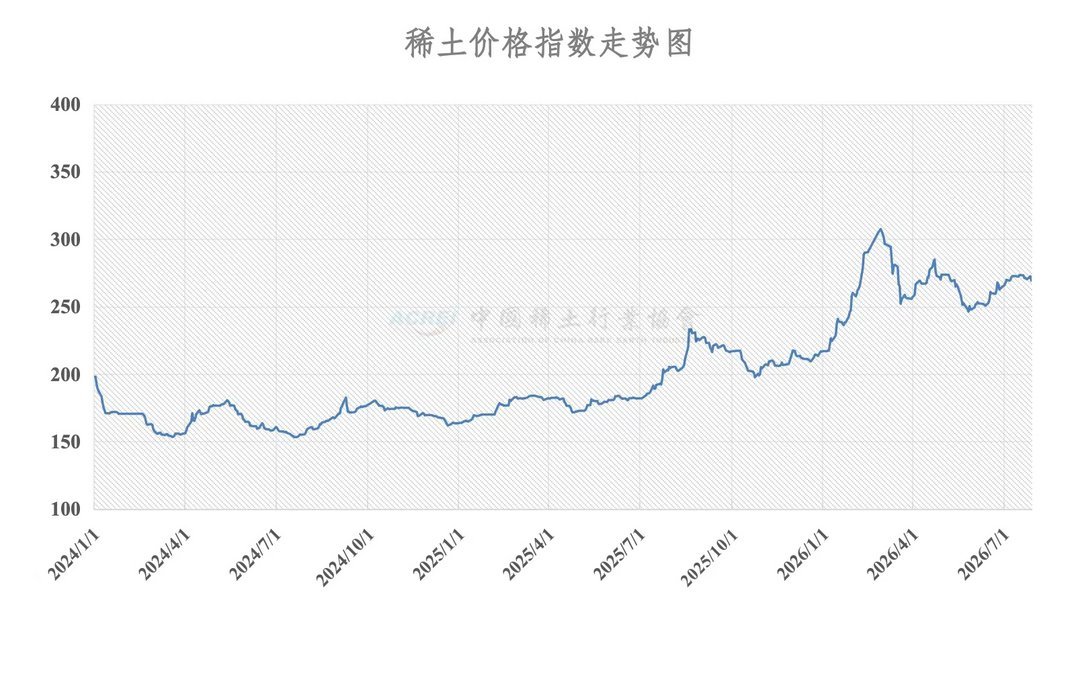
- China's rare earth price index closed at 269.2 on July 28, 2026, roughly 169% above its 2010 baseline despite modest daily declines in some heavy rare earth products.
- Heavy rare earths like dysprosium, terbium, and lutetium remain critically constrained outside China, with ex-China prices often several times higher than domestic Chinese reference prices.
- China manages rare earth markets through production quotas, export licensing, and state-directed industrial policy rather than transparent, competitive market mechanisms.
- Western buyers face availability challenges, not just price risk, as commercially meaningful heavy rare earth production outside China remains extremely limited.
- Published Chinese domestic prices are state-influenced reference transactions and should not be treated as equivalent to transparent commodity benchmarks like gold or copper.
China's official rare earth price index edged down to 269.2 on July 28, 2026, remaining near the highest levels seen in years despite modest declines across several heavy rare earth products. According to the China Association of Rare Earth Industry (CREIA), most light rare earth prices were unchanged while dysprosium, terbium, gadolinium, holmium, lutetium, and neodymium-praseodymium (NdPr) products softened modestly. Yet the larger story is not today's price movement. It is China's continued ability to manage strategic mineral markets through industrial policy rather than conventional market forces. Meanwhile, outside China, heavy rare earth supply remains critically constrained, with transparent price discovery still largely absent. Importantly, a different market emerges "ex-China" with price points based on bespoke contracts. In the case of heavy rare earth oxides or metals, prices can be several times higher in the West.
State-backed Update
The China Association of Rare Earth Industry (CREIA) reported that its Rare Earth Price Index closed at 269.2 on July 28, 2026, down slightly from recent readings but still roughly 169% above the 2010 base value of 100.
According to CREIA, the index is calculated using:
- 2010 domestic transaction data as the baseline.
- Average daily transaction prices reported by Chinese rare earth enterprises.
- A proprietary pricing model developed by the association.
CREIA states that the index is intended solely as a reference for industry participants and does not constitute investment advice.
Key Rare Earth Prices
Conversion used: ¥6.15 = US$1.00 (approximate)
Light Rare Earths
| Product | China Price (¥/kg) | Approx. US$/kg | Daily Trend |
|---|---|---|---|
| Praseodymium Oxide (99%) | ¥203.3–223.3 | $33.06–36.31 | ▼ |
| Praseodymium Oxide (99.99%) | ¥223.0–243.0 | $36.26–39.51 | ▼ |
| NdPr Oxide | ¥743.1–763.1 | $120.83–124.08 | ▼ |
| NdPr Metal | ¥905.5–925.5 | $147.24–150.49 | ▼ |
| Neodymium Oxide | ¥167.0–187.0 | $27.15–30.41 | Unchanged |
Heavy Rare Earths
| Product | China Price (¥/kg) | Approx. US$/kg | Daily Trend |
|---|---|---|---|
| Dysprosium Oxide | ¥1,380–1,420 | $224.39–230.89 | Unchanged |
| Dysprosium Metal | ¥1,775–1,795 | $288.62–291.87 | Unchanged |
| Terbium Oxide | ¥5,000–5,200 | $813.01–845.53 | Unchanged |
| Gadolinium Oxide | ¥788.7–808.7 | $128.24–131.50 | ▼ |
| Holmium Oxide | ¥593.9–613.9 | $96.57–99.82 | ▼ |
| Yttrium Oxide | ¥58.7–62.7 | $9.54–10.20 | Unchanged |
| Lutetium Oxide | ¥4,650–4,765 | $756.10–774.80 | Unchanged |
The Real Story Is Not Today's Prices
Daily price movements tell only part of the story. The more significant development is China's continued ability to maintain relative domestic pricing stability while using production quotas, export licensing, and industrial policy to shape global supply. Small day-to-day changes in China's published prices should not be interpreted as evidence that supply constraints have eased. Heavy rare earths—including dysprosium, terbium, lutetium, holmium, and yttrium—remain among the world's most strategically constrained industrial materials.
Heavy Rare Earths Remain the West's Greatest Vulnerability
Outside China's sphere of influence, commercially meaningful heavy rare earth production remains extremely limited.
Today, most global heavy rare earth supply still originates from:
- Southern China
- Myanmar
- Laos
Malaysia possesses processing capability and prospective resources but is not yet an independent large-scale supplier of separated heavy rare earth oxides. Although the West shows mounting interest in Southern Alliance Mining (QNS.SI) and Carester, the Japanese government has partnered with Malaco Mining. Note QNS is the only producing rare earth mine (legally) in Malaysia.
While projects such as Brazil's Serra Verde represent important diversification efforts, investors should distinguish geological potential from demonstrated, repeatable commercial production. Public discussions have sometimes characterized Serra Verde as a relatively straightforward ionic-clay operation producing meaningful heavy rare earth volumes. Industry observers have questioned whether those descriptions fully reflect the deposit's complexity and whether frequently cited production figures represent sustained commercial output rather than pilot-scale performance.
For many Western industrial consumers, the primary challenge is not price—it is availability. Certain products, including yttrium oxide, can at times be difficult to procure in commercial quantities regardless of published quotations.
China's Prices Are Reference Prices—Not Classical Market Discovery
Investors should be cautious about treating Chinese domestic prices as equivalent to internationally traded commodity benchmarks such as gold, copper, or crude oil. China's rare earth industry operates under a hybrid economic model that combines market mechanisms with extensive state direction, including:
- Production quotas
- Export licensing and controls
- Strategic stockpiling
- Industrial policy
- State-owned enterprise participation
- National security priorities
- Chinese Communist Party policy guidance
Consequently, published domestic prices reflect state-influenced reference transactions, not fully transparent, competitive market-clearing prices.
Ex-China Pricing Is Still an Emerging Market
Ironically, pricing outside China is also far from transparent.
With only an estimated 10% of global rare earth separation capacity located outside China, there is no deep, liquid spot market comparable to those for major industrial commodities.
Instead, most Western transactions occur through:
- Confidential bilateral contracts
- Long-term offtake agreements
- Project-specific pricing formulas
- Volume- and specification-dependent negotiations
Pricing agencies generally rely on voluntary transaction reports and trader surveys. Those methodologies can introduce sampling bias, particularly in thinly traded heavy rare earth markets where relatively few transactions occur. As a result, published assessments should be viewed as informed estimates rather than definitive market prices.
Rare Earth Exchanges has previously examined these limitations, including analyses of:
- The U.S. Department of Defense-supported agreement establishing an approximately $110/kg NdPr price floor for MP Materials—a transaction-specific benchmark that should not automatically be applied across the industry.
- Serra Verde financing assumptions referencing heavy rare earth pricing near $2,050/kg for certain baskets of heavy rare earth products. Those assumptions are specific to that project's financing and should not be interpreted as industry-wide spot prices.
Every rare earth supply agreement differs based on chemistry, purity, delivery schedules, contractual commitments, strategic value, and geopolitical considerations. Buyers relying exclusively on generic pricing indices risk materially overpaying—or underestimating supply risk.
Bottom Line
China's July 28 price report offers little evidence that the structural dynamics of the rare earth market have changed. Light rare earth supply is gradually diversifying as projects such as MP Materials, Lynas Rare Earths, Arafura Rare Earths, Energy Fuels, and others advance production. Heavy rare earths, however, remain overwhelmingly concentrated within China's sphere of influence.
For Western governments, defense contractors, and manufacturers of electric vehicles, robotics, aerospace systems, and advanced electronics, security of supply—not today's published Chinese prices—remains the defining strategic issue.
Source Disclaimer: This report is based on pricing data published by the China Association of Rare Earth Industry (CREIA), an organization operating within China's state-directed rare earth sector. CREIA states that its prices are intended for reference purposes only. Because China's rare earth market is shaped by government policy, production quotas, export controls, strategic objectives, and state participation, the reported prices should not be interpreted as fully transparent market-clearing prices. Readers should independently verify material information and consider both Chinese and ex-China market conditions when evaluating pricing or investment decisions.


0 Comments
No replies yet
Loading new replies...
Moderator
Join the full discussion at the Rare Earth Exchanges Forum →