
Highlights
- Bayan Mining has begun its first-ever reverse-circulation drilling program at the 100%-owned Desert Star project in California, drilling up to 1,000 meters.
- Surface sampling returned rock-chip assays up to 6.68% TREO and confirmed commercially important minerals including monazite, xenotime, and allanite.
- No JORC or NI 43-101 resource estimate, economic study, or metallurgical recovery data yet exists for Desert Star.
- Critical unknowns include NdPr content, thorium and uranium levels, achievable metallurgical recoveries, and whether mineralization continues at depth.
- Bayan closed the June quarter with only A$1.44 million in cash, covering an estimated 3.23 quarters of operations at current spending rates.
Bayan Mining and Minerals Ltd (opens in a new tab). (ASX: BMM) has reached an important milestone by launching the first-ever drilling program at its 100%-owned Desert Star Rare Earth Project in California. Surface sampling has identified encouraging rare earth mineralization, and mineralogical studies confirm commercially important minerals including monazite and xenotime. However, Desert Star remains an early-stage exploration project—not a defined mineral deposit. Rare Earth Exchanges®' assessment: the geology is becoming more compelling, but investors should recognize that no mineral resource, economic study, or proven processing flowsheet yet exists.
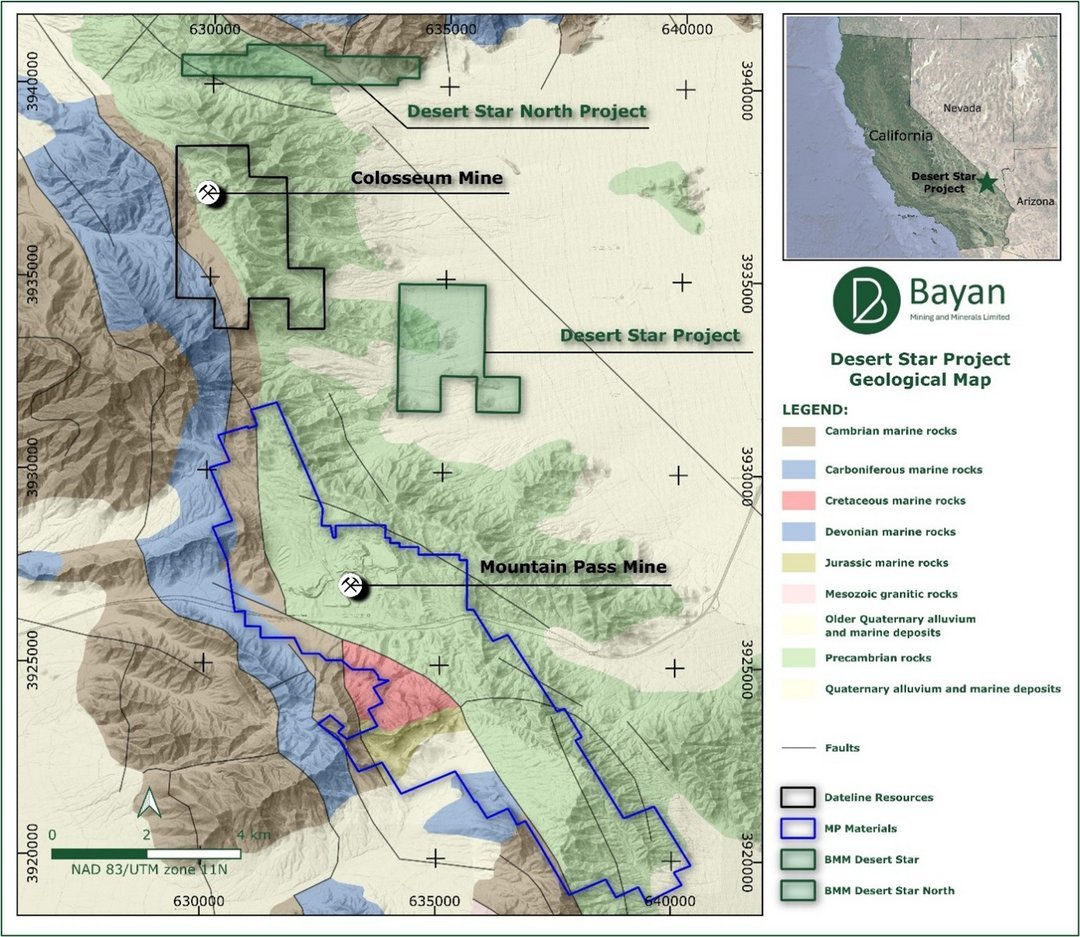
Rare Earth Exchanges (REEx) reports that Bayan Mining and Minerals has advanced Desert Star from surface exploration into its inaugural reverse-circulation drilling campaign. The company is drilling up to 1,000 meters to determine whether high-grade surface mineralization extends below ground with sufficient thickness and continuity to justify further development. Previous work identified rock-chip assays grading up to 6.68% total rare earth oxides (TREO) and heavy mineral concentrate samples grading up to 9.11% TREO. X-ray diffraction and petrographic studies confirmed the presence of monazite, xenotime, allanite, zircon, and apatite, providing evidence of a monazite-dominant rare earth system.
Encouraging Geology—But Still No Deposit
Investors should distinguish between promising exploration results and an economic discovery. Desert Star remains a grassroots exploration project. The company has completed geological mapping, geophysical interpretation, surface sampling, mineralogical characterization, and now maiden drilling. However, it has not published a JORC or NI 43-101 resource estimate, Preliminary Economic Assessment, prefeasibility study, feasibility study, or metallurgical recovery study specific to Desert Star. The current drill program is effectively a proof-of-concept designed to determine whether surface mineralization persists at depth.
Importantly, Bayan itself notes that its highest reported TREO values came from heavy mineral concentrate samples, which may represent residual or transported concentrations rather than the underlying bedrock source.
What Investors Still Don't Know
Several critical questions remain unanswered:
- What percentage of the TREO consists of high-value neodymium and praseodymium (NdPr)?
- What are the concentrations of thorium and uranium, which can materially affect permitting and processing costs?
- What metallurgical recoveries are achievable?
- Can Desert Star ore be economically concentrated, cracked, separated, and refined in the United States?
- Will drilling demonstrate sufficient width, continuity, and scale to support a future resource estimate?
These questions—not surface assay headlines—will ultimately determine project value.
Financial Snapshot
Bayan finished the June quarter with A$1.44 million in cash, representing an estimated 3.23 quarters of funding at its current spending rate. While adequate for an early-stage explorer, additional capital will likely be required if drilling results justify expanded exploration.
Rare Earth Exchanges Assessment
Bayan deserves credit for progressing Desert Star from surface prospecting to drilling while confirming that the rare earth mineralization is hosted in recognized commercial minerals rather than anomalous geochemistry alone. That meaningfully strengthens the geological case. Nevertheless, investors should remain disciplined. Strategic location in the United States is valuable, but economic geology—not geography—creates mines. Until drilling demonstrates continuity and metallurgy demonstrates commercial recoverability, Desert Star should be viewed as a promising exploration concept rather than a de-risked rare earth development project.


0 Comments
No replies yet
Loading new replies...
Moderator
Join the full discussion at the Rare Earth Exchanges Forum →