
Highlights
- China's Rare Earth Price Index reached 268.4 on July 29, 2026, remaining near its highest levels since early 2024 despite modest softening in some heavy rare earth products.
- Heavy rare earths including dysprosium, terbium, yttrium, and holmium face severe supply constraints outside China, where availability often matters more than posted price.
- NdPr oxide traded at ¥739.6–759.6/kg (US$103–106/kg), remaining the benchmark light rare earth underpinning EV motors, wind turbines, and defense systems.
- Rare earth prices in both China and ex-China markets lack transparent price discovery due to state-directed quotas, export licensing, and confidential bilateral contracts.
- Project-specific deals like MP Materials' US$110/kg NdPr floor and Serra Verde's US$2,050/kg heavy rare earth floor do not represent industry-wide benchmarks.
China's Rare Earth Price Index edged to 268.4 on July 29, 2026, remaining near its highest levels since early 2024 despite modest weakness across several heavy rare earth products. Data published by the China Rare Earth Industry Association (CREIA) show relatively stable pricing for most light rare earth products while dysprosium, gadolinium, yttrium, scandium, and the benchmark NdPr oxide eased modestly.
Rare Earth Exchanges® cautions investors that neither China's domestic prices nor emerging ex-China prices should be interpreted as equivalent to transparent market prices for globally traded commodities such as copper or gold. Rare earth pricing remains one of the world's most opaque commodity markets.
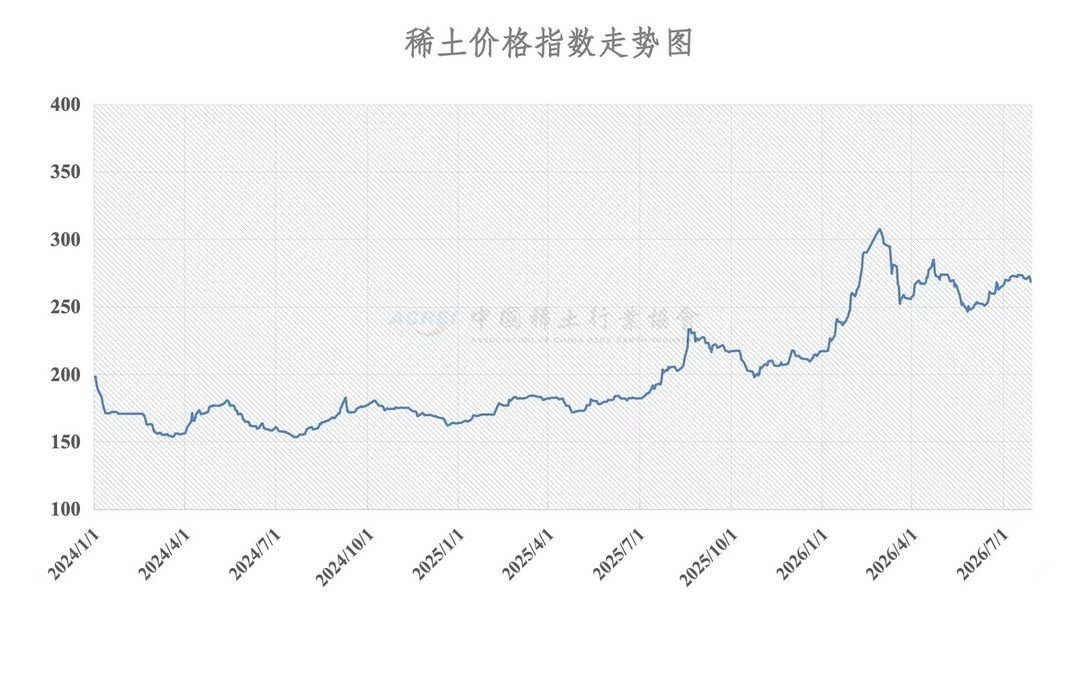
China's Official Market Snapshot
CREIA calculates its index using reported domestic enterprise transactions against a 2010 baseline (Index = 100). At 268.4, China's official index remains elevated despite recent volatility.
Most Important Light Rare Earth Products
- NdPr Oxide: ¥739.6–759.6/kg (US$103.44–106.24/kg) ▼
- NdPr Metal: ¥903.2–923.2/kg (US$126.32–129.12/kg) ▼
- Lanthanum Oxide: ¥4.2–6.2/kg (US$0.59–0.87/kg) →
- Cerium Oxide: ¥14.3–16.3/kg (US$2.00–2.28/kg) →
Most Important Heavy Rare Earth Products
- Dysprosium Oxide: ¥1,380–1,420/kg (US$193.01–198.60/kg) →
- Dysprosium Metal: ¥1,755–1,775/kg (US$245.45–248.25/kg) ▼
- Terbium Oxide: ¥5,000–5,200/kg (US$699.30–727.27/kg) →
- Holmium Oxide: ¥593.9–613.9/kg (US$83.06–85.86/kg) →
- Yttrium Oxide (99.999%): ¥88–108/kg (US$12.31–15.10/kg) →
- Scandium Oxide: ¥6,720–6,780/kg (US$939.86–948.25/kg) ▼
Conversion based on ¥7.15 = US$1.00.
Heavy Rare Earths Continue to Define Strategic Risk
The most consequential market remains the heavy rare earth sector. Although Chinese domestic prices softened modestly, availability outside China remains severely constrained. In the ex-China market, buyers periodically report difficulty procuring specialty oxides—including yttrium, dysprosium, terbium, and holmium—in commercial quantities. In many cases, availability rather than posted price determines whether a transaction can occur at all.
NdPr remains the benchmark light rare earth because it underpins NdFeB permanent magnets used in electric vehicles, robotics, drones, wind turbines, industrial automation, and advanced defense systems.
Rare Earth Pricing Is Not Traditional Price Discovery
Rare Earth Exchanges has consistently cautioned readers against treating either Chinese or ex-China rare earth prices as fully transparent market-discovery mechanisms. Within China, prices reflect transactions occurring inside a state-directed hybrid economic system shaped by production quotas, export licensing, state-owned enterprises, industrial policy, strategic stockpiling, and broader Communist Party economic priorities. These published prices are useful reference points, but they do not represent unrestricted global market equilibrium.
Outside China, price discovery is equally imperfect.
China still performs roughly 90% of global rare earth refining, leaving relatively little material available for independent international trade. Most ex-China transactions occur through confidential bilateral contracts negotiated over specifications, purity, delivery schedules, financing, and long-term strategic relationships. Published assessments from pricing agencies often reflect a limited sample of dealer or trader conversations rather than broad exchange-based trading.
Recent transactions over the last year illustrate this complexity. The U.S. Department of Defense-supported agreement with MP Materials established a US$110/kg NdPr price floor under that specific commercial arrangement. Likewise, Serra Verde disclosed a heavy rare earth pricing floor of approximately US$2,050/kg under a project-specific agreement. Neither transaction establishes an industry-wide benchmark.
As Rare Earth Exchanges has previously examined in its analyses of ex-China pricing, pricing agency sampling methodologies, and emerging Western price floors, every rare earth transaction remains highly bespoke. Buyers who assume one published number represents the market risk materially overpaying—or underestimating scarcity.
Bottom Line
China's official market remains relatively stable, but investors should focus less on daily price movements than on physical availability, particularly for heavy rare earth oxides and metals outside of China or in the "ex-China" emerging market. Until significant refining capacity develops outside China, neither domestic Chinese prices nor ex-China assessments will offer the transparent price discovery seen in mature commodity markets.
Disclaimer: This report is based on pricing published by the China Rare Earth Industry Association, which states the information is collected from domestic enterprises for industry reference only and does not constitute investment advice. The data reflect China's domestic market and should be interpreted alongside independent market intelligence and an understanding of the structural limitations affecting both Chinese and ex-China rare earth pricing.


0 Comments
No replies yet
Loading new replies...
Moderator
Join the full discussion at the Rare Earth Exchanges Forum →