
Highlights
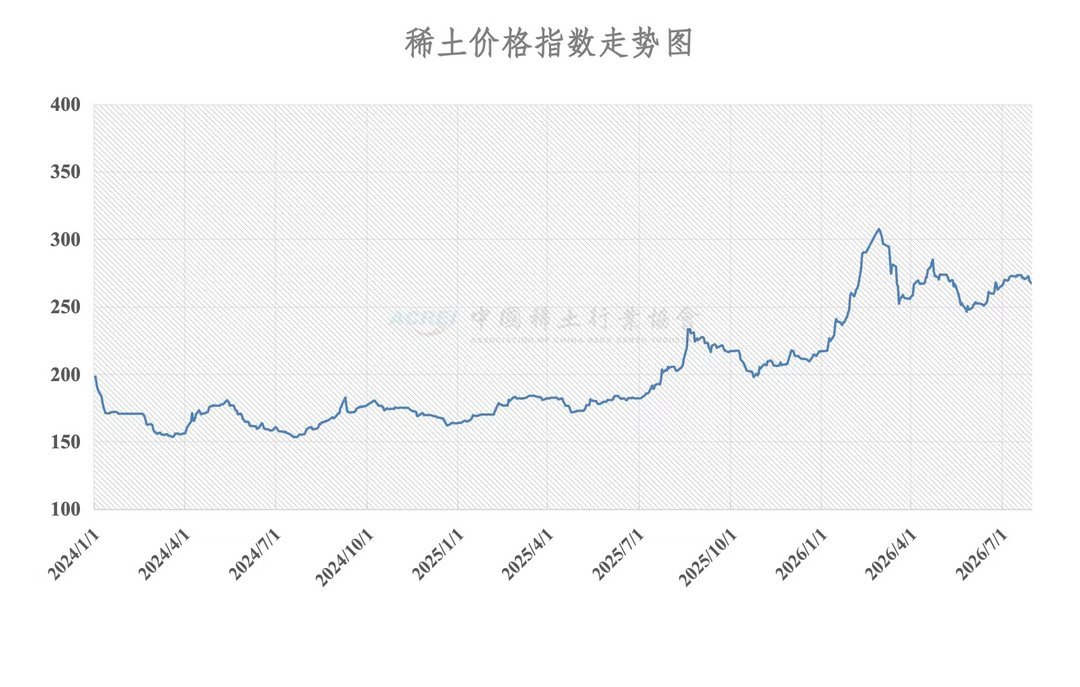
- China's CREIA Rare Earth Price Index stands at 267.3, roughly 167% above its 2010 baseline, with heavy rare earths like terbium oxide holding at US$750–780/kg.
- Physical availability of dysprosium, terbium, and yttrium outside China is increasingly constrained, with some buyers unable to source material at any published price.
- There is no true global rare earth spot market—ex-China pricing is determined by hundreds of confidential bilateral contracts with highly variable commercial terms.
- Government-backed strategic contracts, such as US DoD-supported price floors for NdPr and Serra Verde's dysprosium and terbium agreements, are replacing traditional market price discovery.
- Investors should treat published rare earth price sheets as directional indicators only, not as transparent commodity benchmarks comparable to gold or copper.
China's Rare Earth Industry Association (CREIA) reported its July 30, 2026 Rare Earth Price Index at 267.3, remaining near its highest level in more than two years. Most light rare earth prices were flat to modestly lower, while heavy rare earth prices remained exceptionally elevated despite minor daily fluctuations. For investors, however, today's prices tell only part of the story. The far more important development is the widening disconnect between China's managed domestic market and the increasingly fragmented, opaque, and supply-constrained ex-China market for heavy rare earths.
China's Official Market Snapshot
CREIA reported its Rare Earth Price Index at 267.3, using 2010 transaction data as its baseline (Index = 100). The index remains roughly 167% above the base period, reflecting continued strength in China's domestic rare earth sector.
Selected prices (¥1 = US$0.15) include:
Light Rare Earths
- NdPr Oxide (75% Nd₂O₃): ¥734.7–754.7/kg (US$110.21–113.21/kg) ↓
- NdPr Alloy: ¥895.7–915.7/kg (US$134.36–137.36/kg) ↓
- Neodymium Oxide: ¥617.2–637.2/kg (US$92.58–95.58/kg) ↓
- Praseodymium Oxide: ¥221.8–241.8/kg (US$33.27–36.27/kg) ↓
Heavy Rare Earths
- Dysprosium Oxide: ¥1,380–1,420/kg (US$207–213/kg) → Flat
- Dysprosium Metal: ¥1,755–1,775/kg (US$263–266/kg) → Flat
- Terbium Oxide: ¥5,000–5,200/kg (US$750–780/kg) → Flat
- Holmium Oxide: ¥595.5–615.5/kg (US$89.33–92.33/kg) ↑
- Holmium-Iron Alloy: ¥595.6–615.6/kg (US$89.34–92.34/kg) ↑
- Yttrium Oxide (99.99%): ¥58.7–62.7/kg (US$8.81–9.41/kg) → Flat
The Real Story Is Outside China
Today's modest price changes are not the biggest development. The real story is that heavy rare earth availability outside China continues to tighten, while meaningful price discovery remains elusive. Market participants across North America, Europe, Japan, South Korea, and Australia continue to report difficulty sourcing dysprosium, terbium, yttrium, lutetium, and other heavy rare earth products in commercial quantities. In some cases, buyers report that certain yttrium products simply cannot be procured, regardless of published reference prices. Increasingly, the market is constrained not by price but by physical availability.
This reflects a structural reality: China still performs approximately 90% of global rare earth separation and refining, giving it extraordinary influence over the downstream supply chain. Even where mines exist outside China, many still depend on Chinese processing or intermediate products.
There Is No True Global Rare Earth Spot Market
Rare Earth Exchanges® has consistently argued that neither China's domestic prices nor so-called ex-China prices represent true commodity market discovery comparable to gold, copper, or crude oil. China's domestic market operates within a hybrid state-capitalist framework shaped by production quotas, export licensing, strategic stockpiles, industrial policy, and broader Communist Party directives. Published prices should therefore be viewed as policy-influenced reference values rather than purely competitive market-clearing prices.
Outside China, the opposite problem exists.
There is no single ex-China rare earth market. Instead, there are hundreds of highly confidential bilateral transactions negotiated directly between producers, traders, processors, magnet manufacturers, and end users. Unlike exchange-traded commodities, each contract can produce a materially different effective price.
Every Rare Earth Contract Is Different
Two transactions for identical dysprosium oxide may carry significantly different economics depending on commercial terms.
Pricing may vary based on:
- Incoterms (EXW, FOB China, CIF Rotterdam, FCA warehouse, DDP customer facility)
- Freight and marine insurance
- Customs duties and VAT treatment
- Export licensing responsibilities
- Delivery location (including Rotterdam warehouses or U.S. bonded facilities)
- Warehouse storage and demurrage
- Currency denomination and foreign-exchange adjustments
- Payment timing (prepayment, letters of credit, Net-30, Net-90)
- Minimum annual purchase commitments
- Take-or-pay provisions
- Product purity and impurity specifications
- Moisture content and particle-size requirements
- Metal versus oxide form
- Delivery schedules
- Strategic inventory obligations
- Force majeure protections
- Government intervention clauses
- Price floors and ceiling mechanisms
- Inflation adjustments
- Recycling credits
- Technical support and toll-processing rights
These contractual variables often have as much impact on economic value as the nominal price itself.
Even "Rotterdam Prices" Require Context
Investors frequently refer to "Rotterdam pricing" as though it represents an exchange-traded benchmark.
In reality, there is generally no universally accepted Rotterdam spot price.
Instead, quotations may reference:
- CIF Rotterdam
- Delivered Rotterdam warehouse
- FCA bonded warehouse
- Individual trader inventories
- Distributor offers
- Pricing-agency surveys
- Isolated negotiated transactions
These are valuable market references but should not be interpreted as broad market-clearing prices.
Likewise, many pricing agencies build assessments from limited surveys of traders, distributors, and selected transactions. In such a thin market, these samples can unintentionally skew reported prices, particularly during periods of limited liquidity.
Strategic Contracts Are Creating a New Pricing Reality
Government intervention is increasingly replacing traditional market forces. Rare Earth Exchanges has previously examined the U.S. Department of Defense-supported $110/kg NdPr price floor associated with MP Materials, a strategic measure intended to encourage domestic magnet production rather than establish a universal market benchmark.
Similarly, disclosed commercial arrangements involving Serra Verde include project-specific heavy rare earth price floors—approximately US$575/kg for dysprosium and US$2,050/kg for terbium under long-term agreements. These negotiated prices apply to particular commercial relationships and should not be interpreted as representative industry-wide pricing. As Western governments increasingly underwrite domestic supply chains, strategic contracts—not exchange trading—may become the dominant mechanism for financing new rare earth production.
Rare Earth Exchanges' View
The greatest misunderstanding among investors is the belief that rare earths possess transparent global benchmark pricing.
They do not. Instead, rare earth pricing increasingly reflects a complex negotiation among chemistry, logistics, contract structure, financing, strategic partnerships, geopolitical risk, and government industrial policy.
In today's market, availability frequently matters more than quoted price. The supplier capable of delivering verified, specification-compliant heavy rare earth material on schedule may command a premium regardless of published reference prices. As the world enters Great Powers Era 2.0™, the rare earth market is evolving away from commodity trading and toward strategic industrial procurement. Investors should therefore view published price sheets as useful directional indicators—but never as definitive measures of true market value.
Editorial Note: This information originates from the China Rare Earth Industry Association (CREIA), an organization operating within China's state-directed rare earth industry. While CREIA is an important industry source, its pricing and market information should be independently verified.


0 Comments
No replies yet
Loading new replies...
Moderator
Join the full discussion at the Rare Earth Exchanges Forum →