
Highlights
- Southern Illinois University researchers used microalgae to more than double rare earth element concentrations from Hicks Dome rock in a laboratory setting.
- The biological mechanism behind the algae's rare earth concentration effect remains unknown, and no commercial-scale demonstration has been conducted.
- Potential applications include processing coal ash, mine tailings, electronic waste, and industrial byproducts to recover critical minerals.
- Experts note that China's rare earth dominance stems from processing and refining expertise, not geology, making processing innovation a strategic priority for the West.
- Rare Earth Exchanges calls for greater government support of unconventional processing research as a path toward supply chain resilience.
Researchers led by Daniel Hummer, PhD, Associate Professor of Geology, and Scott Hamilton-Brehm, PhD, Associate Professor of Microbiology, at Southern Illinois University (opens in a new tab) (SIU), together with graduate researcher Kristina Kohl, have reported an intriguing proof-of-concept that could eventually reshape rare earth processing. Working with rare-earth-bearing rock from Hicks Dome in southern Illinois (opens in a new tab)—a prospective domestic rare earth deposit—the team found that microalgae more than doubled the concentration of rare earth elements recovered after laboratory processing. The researchers believe algae could one day complement conventional chemical processing while potentially recovering critical minerals from mining waste, coal ash, and electronic waste. The work remains highly preliminary: the biological mechanism is unknown, commercial performance has not been demonstrated, and significant engineering and economic hurdles remain. Nevertheless, Rare Earth Exchanges believes this is precisely the type of unconventional processing research Western governments should be supporting as they seek alternatives to China's overwhelming dominance of rare earth separation and refining.
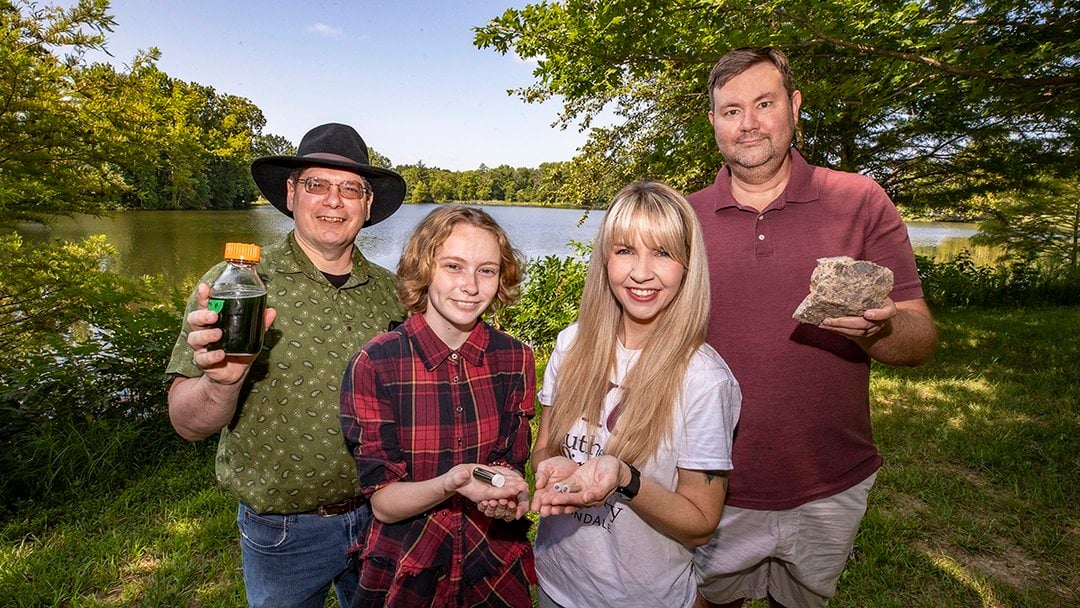
SIU associate professors Scott Hamilton-Brehm, left, and Daniel Hummer, right, along with graduate students Mercedez Hanlon and Kristina Kohl, middle left and right, were able to successfully double the concentration of rare earth elements.
Source: SIU; Russell Bailey
The Real Bottleneck Isn't Mining—It's Processing
Rare earth elements are essential to modern life. They enable electric vehicles, wind turbines, smartphones, advanced robotics, MRI scanners, fighter aircraft, precision-guided weapons, and countless other civilian and defense technologies. Despite their name, Rare Earth Exchanges® community members know rare earth elements are not especially rare in Earth's crust. The real challenge is finding concentrations that can be economically processed and then separating the individual elements with sufficient purity. Today, China dominates the most valuable portion of that supply chain—the complex separation, refining, and magnet manufacturing that transform mineral deposits into usable industrial materials.
Hummer believes Hicks Dome, an ancient crypto-volcano in southern Illinois, may represent one of the more promising domestic rare earth prospects in the United States.
A Living Laboratory Produces an Unexpected Result
To test an unconventional idea, SIU researchers constructed an artificial stream using a livestock watering trough containing circulating water and illuminated by LED lights. After crushing Hicks Dome rock into fine particles, researchers introduced the material into the flowing water before adding microalgae.
Several weeks later, laboratory analysis revealed an unexpected outcome.
Following removal of the organic material using a patented separation process, the concentration of rare earth elements in the recovered material had more than doubled. Perhaps most remarkably, the researchers openly acknowledge they do not yet understand the biological mechanism responsible for the effect. Determining how algae interact with rare earth minerals now becomes the central scientific question.
Why Investors Should Watch Closely
If future research validates these findings, algae-assisted processing could eventually become a complementary technology rather than a replacement for conventional rare earth extraction.
Potential applications could include:
- Concentrating rare earth-bearing materials before conventional refining.
- Recovering valuable elements from coal ash, mine tailings, and industrial waste.
- Recycling rare earths from electronic waste.
- Producing biodiesel or agricultural biostimulants from the remaining algae biomass, improving overall process economics.
Such an approach aligns with the growing "urban mining" movement, where recovering critical minerals from waste streams becomes an increasingly important source of future supply.
Important Limitations
Investors should view these findings as promising—but preliminary.
This was a controlled laboratory experiment rather than an industrial-scale demonstration.
Researchers have not yet identified why algae increase rare earth concentration, nor have they demonstrated commercial recovery rates, throughput, operating costs, scalability, energy requirements, or economic competitiveness against existing processing technologies.
Most importantly, a higher concentration of rare earth elements does not necessarily translate into greater overall recovery or lower production costs. Those questions remain unanswered and will require substantially more research before commercial conclusions can be drawn.
Rare Earth Exchanges Assessment
This study highlights an important reality often overlooked in Western critical minerals policy: the greatest opportunity for innovation may lie not in discovering new deposits, but in reinventing how rare earths are processed. China's strategic advantage today stems less from geology than from decades of investment in separation, refining, metallurgy, recycling, and permanent magnet manufacturing. Technologies capable of lowering processing costs, reducing chemical consumption, or economically recovering rare earths from coal refuse, mine tailings, industrial waste, and electronic scrap could gradually erode part of that advantage.
Whether algae ultimately become part of the commercial rare earth toolkit remains uncertain. But research like this expands the range of possible solutions. In a world where supply-chain resilience increasingly depends on processing innovation as much as mining, even unconventional biological approaches deserve serious scientific—and investor—attention.
Citation: Keltner B. SIU Scientists Use Algae to Double the Concentration of Rare Earth Elements. Southern Illinois University News. July 27, 2026.


0 Comments
No replies yet
Loading new replies...
Moderator
Join the full discussion at the Rare Earth Exchanges Forum →