
Highlights
- China supplies 60% of mined magnet rare earths, 90% of refined output, and 90%+ of sintered permanent magnets as of 2025
- America's mine-to-magnet response remains fragmented across agencies and electoral cycles, lacking a unified industrial operating system
- Key U.S. policy deadlines loom: DFARS restrictions expand January 1, 2027, while Chinese export controls could tighten by November 2026
- America needs market-compatible industrial policy—predictable permitting, multi-year procurement, allied offtake agreements, and strategic price floors
- A durable equilibrium requires the U.S. to coordinate without commanding, and China to innovate without the rigidity of top-down control
China did not dominate rare earths by discovering the world’s best rocks. It built an operating system around them. Beijing connected state ownership, production quotas, research institutes, local industrial clusters, export licensing and downstream manufacturing into one strategic machine. The result is formidable: in 2025, China supplied 60% of mined magnet rare earths, 90% of refined output (about 98% of heavies) and 90%+ of sintered permanent magnets. The United States has awakened, but its mine-to-magnet response remains fragmented and years from self-sufficiency.
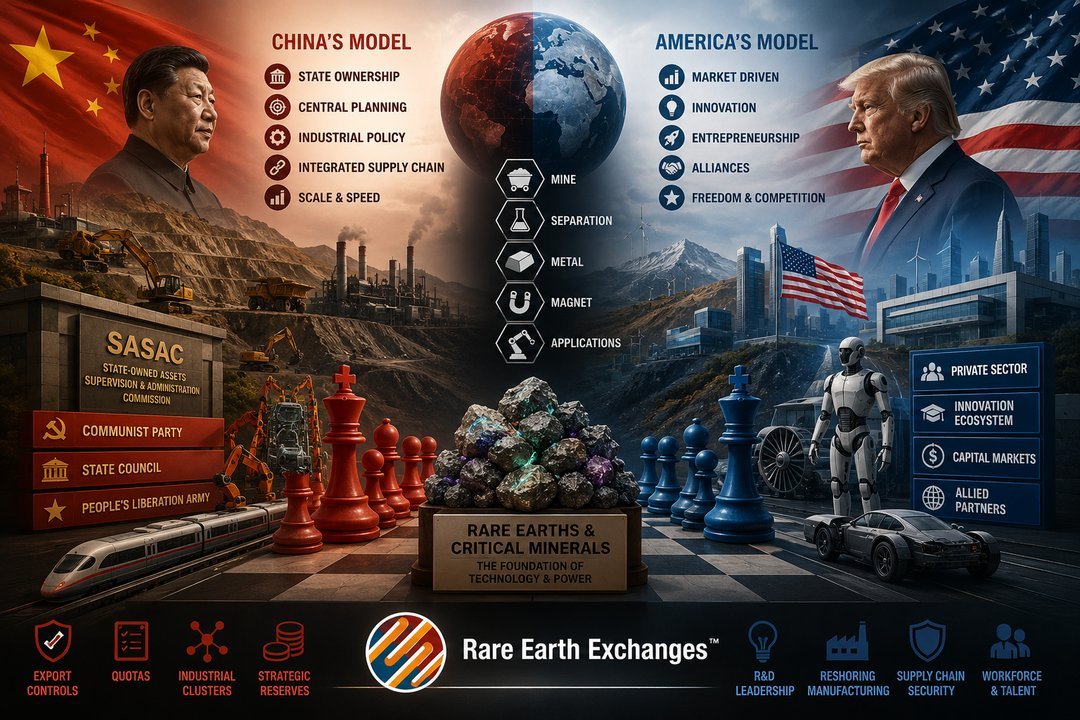
China holds the near-term advantage. America may hold the stronger intermediate hand—but only if it learns to coordinate government, markets and allies without sacrificing the creativity that distinguishes its economy.
The Party Above the Mine
While some observers suggest China’s government involves layers of national government composed of the State, Communist Party and People’s Liberation Army, this is actually not the right way to understand it. Rather, it has three interlocking systems of power. The state writes laws, budgets and industrial regulations. The Communist Party establishes strategic direction, controls senior appointments and supplies a cohesive vision across ministries, provinces and state enterprises. The PLA is not a separate civil-government tier; it is a Party-led armed force whose security requirements create demand for protected mineral and technology supply chains.
Rare-earth policy shows this architecture in action. China’s 2024 regulations declare rare-earth resources state-owned and establish unified planning, production controls, traceability, technological development and environmental supervision. These are not isolated mining rules. They govern an industrial chain extending from ore through separation, metals, alloys and magnets.
Corporate consolidation makes that policy executable. China Rare Earth Group was formed from assets belonging to Chinalco, China Minmetals, Ganzhou Rare Earth and two major research organizations. It operates under central State-owned Assets Supervision and Administration Commission (SASAC) oversight. By 2024, Beijing had reduced rare-earth production-quota eligibility from six groups to only two state-owned champions: China Rare Earth Group and China Northern Rare Earth.
Central Command, Local Competition
SASAC is more than a regulator. It acts as the government’s shareholder. Central SASAC supervises nationally controlled enterprises, while provincial and municipal SASAC bodies oversee regional companies. This multilayered ownership structure allows the state to consolidate assets, appoint management, restructure industries and redirect capital toward strategic priorities while retaining commercial companies and public listings. State capital has deliberately been concentrated in strategically important industries and dominant enterprises.
China is therefore centralized in strategy but decentralized in execution. National authorities set production quotas, technology restrictions, environmental rules and export policy. Provinces and municipalities compete for factories, laboratories, infrastructure, subsidies and tax revenue. Local SOEs, private companies, universities and industry associations translate broad national objectives into projects. Academic research on Chinese rare-earth governance also finds that local governments bargain over, reinterpret and sometimes resist central directives.
Special economic zones provide laboratories for investment, exports and industrial clustering. Hong Kong and Macao are different: as special administrative regions, they maintain separate customs and economic systems and function more as financial, legal and trade gateways than ordinary provincial implementation arms. China has applied the wider model beyond minerals to batteries, electric vehicles and robotics, combining subsidies, manufacturing scale and integrated supply chains.
When Coordination Becomes Compulsion
China’s model can finance infrastructure, tolerate long payback periods and create domestic demand before private returns become obvious. But coordination can become compulsion. Provincial subsidy races and politically imposed growth targets can generate duplicate factories, price wars and excess capacity that spills into export markets, provoking dumping allegations and trade retaliation. Beijing itself has moved to restrict disorderly local subsidies amid concerns about overcapacity and “involution.” Beijing hides both regional and national debt, using creative accounting to move capital around in ingenious ways.
The innovation record is mixed. Plan-supported industries have produced genuine technological progress, and some research finds that industrial-policy support raises patent output. Other studies find that hard growth targets, selective subsidies and SOE incentives can misallocate capital or suppress breakthrough innovation. The danger increases as policymaking becomes more top-down: organizations learn to satisfy measurable political targets while disruptive ideas that challenge incumbents receive less oxygen.
Demography compounds the risk. The IMF expects Chinese growth to slow as the labor force contracts, productivity moderates and domestic demand remains weak. Capital controls—including the standard US$50,000 annual individual foreign-exchange purchase quota—also restrict easy household diversification abroad. This does not imply imminent instability, but it makes employment, property values, pensions and domestic confidence more politically consequential. An aging society must simultaneously finance social care, defense, technological upgrading and industrial support.
America’s Fragmented Awakening
America possesses the opposite strengths and weaknesses. It has the world’s deepest capital markets, the most funded military, entrepreneurial risk-taking, research universities and a culture that rewards dissent and experimentation. Yet it struggles to coordinate permitting, financing, procurement, diplomacy and commercial offtake across agencies and electoral cycles.
Washington is assembling the pieces of an industrial strategy: Defense Department magnet investments, Energy Department processing programs, EXIM’s Project Vault, DFC financing and accelerated permitting. The Energy Department’s new common screening process connecting applicants with multiple federal partners implicitly acknowledges the fragmentation problem. These initiatives are meaningful, but they still resemble a portfolio of programs more than a unified operating system.
The answer for America is NOT Chinese-style state ownership. America needs market-compatible industrial policy: predictable permitting deadlines, multi-year procurement, strategic price floors or contracts for difference, shared testing and characterization to separation facilities, rotating stockpiles and allied offtake agreements, not to mention tax incentives both domestically and externally with allies, and workforce development at all layers of the value chain. Government should absorb geopolitical and first-of-a-kind risk while competing companies solve technical and manufacturing problems.
The Diplomat as Deal Maker
Importantly, based on our emerging investment thesis, the State Department must evolve into part diplomatic service, part corporate-development organization. Embassies should map deposits, power, ports, permitting and political risk; assemble DFC, EXIM, Energy, Defense and private investors around bankable transactions; and negotiate packages that include local processing, workforce development and host-country revenues. Current DFC and EXIM initiatives provide the beginnings of this economic-statecraft model.
Under the Rare Earth Exchanges® Great Powers Era 2.0 thesis, resource-producing nations increasingly intend to move up the value chain. They want refining, manufacturing, technology transfer and skilled employment—not another century of exporting raw materials. Washington cannot win by requesting ore while Beijing offers infrastructure and industrial partnership. The successful Western coalition must make partner countries richer, more capable and less dependent. Take Malaysia as an example. While there is a rare earth rush to access heavies (currently the southeast Asian nation supplies China), the aim of partnership must be mutually beneficial win-win math—Malaysia seeks to move up the value chain—although its own policies, laws and political culture could get in the way, as we have discussed.
The Calendar of Vulnerability
Since President Trump’s return in January 2025, tariffs, sanctions, export licensing and countermeasures have accelerated the U.S.-China contest. The coming calendar is unusually dangerous. The November 3, 2026 midterm elections may heighten American policy volatility. On November 10, China’s suspension of its expanded October 2025 rare-earth controls is scheduled to end. That is a decision point—not a guaranteed cutoff—while the narrower April 2025 licensing regime continues to constrain access. Recent U.S.-China talks have not eliminated concerns about Chinese compliance or supply reliability.
On January 1, 2027, DFARS restrictions expand across the covered-country supply chain for Defense Department procurement, encompassing mining, refining and separation for covered materials, including neodymium-iron-boron magnets. The rules contain exceptions and nonavailability provisions, but the policy deadline is arriving faster than compliant capacity.
Meanwhile, the Iran war has consumed interceptors and intensified concern over American munitions inventories. The Army’s new Patriot framework seeks to triple production capacity only by 2030. Critical-mineral users report that some Chinese materials remain nearly unobtainable, while industry representatives say eliminating supply problems within three years will be difficult. The IEA’s longer view is harsher: announced non-Chinese projects would satisfy well below 20% of ex-China magnet demand in 2035.
The Great-Power Verdict
China holds the tactical advantage for at least the next several years. Yet ironically, Great Powers Era 2.0 (which Trump 2.0 helped accelerate) may become harder for Beijing over time. More countries want domestic value creation and strategic autonomy, while China must manage aging, debt, weak consumption and the inefficiencies of tighter political control. Its greatest strength—cohesive orchestration—can harden into rigidity.
America’s intermediate outlook can brighten if it learns to orchestrate without suffocating. Its winning model is neither laissez-faire drift nor a command economy. And it must advance a culture of long-term investment when it comes to critical infrastructure—that’s what rare earth and critical minerals represent. It is a strategic state that identifies missions, finances bottlenecks and mobilizes allies while preserving competition, scientific openness, individual initiative and entrepreneurial failure.
China built the commanding heights of the magnet economy. America must now build a coalition economy faster than Beijing can turn today’s leverage into permanent power.
REEx Message: Both Nations Need to Change
A durable equilibrium requires both nations to evolve. The United States must rediscover the virtues that once built its industrial strength: long-term planning, disciplined execution, strategic investment in shared industrial infrastructure, and competition grounded in productive enterprise rather than financial engineering, crony capitalism and short-term profit taking at the expense of long-term execution.
America cannot simply subsidize mines while neglecting the separation plants, metals, alloys, magnet manufacturing, workforce development, permitting reform, and logistics that transform resources into strategic capability.
China, meanwhile, faces the opposite challenge. Its state-directed model delivered extraordinary industrial capacity, but sustaining innovation and avoiding mounting debt, capital misallocation, surplus crises, and demographic pressures will likely require a gradual shift toward greater market discipline, transparency, and entrepreneurial dynamism.
In dialectical terms, each system increasingly needs elements of what it has historically rejected: America requires more strategic coordination without sacrificing free enterprise, while China requires more market freedom without abandoning stability. The future competitive advantage may belong not to the nation that clings most rigidly to ideology, but to the one that most intelligently synthesizes planning with markets, state capacity with private innovation, and national purpose with economic liberty. Welcome to Great Powers Era 2.0!


0 Comments
No replies yet
Loading new replies...
Moderator
Join the full discussion at the Rare Earth Exchanges Forum →