
Highlights
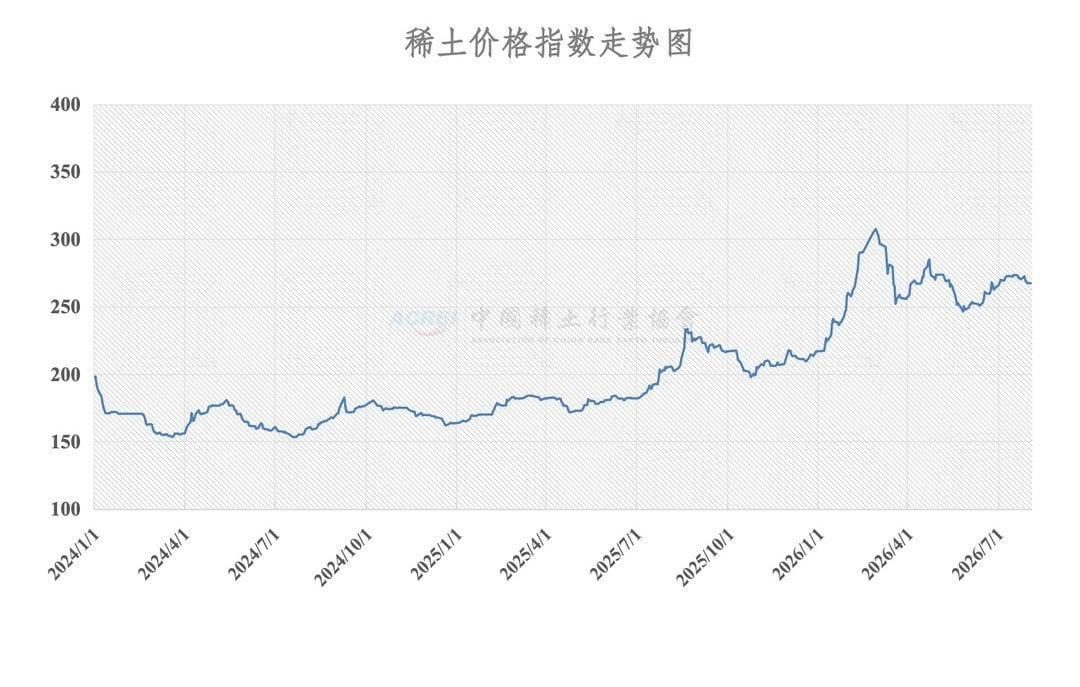
- China's Rare Earth Price Index reached 267.4 on August 3, 2026, staying elevated after briefly surpassing 300 earlier this year.
- Heavy rare earths remain a critical choke point, with terbium metal reaching up to US$1,260/kg and dysprosium metal up to US$266/kg in Chinese markets.
- NdPr oxide prices hover near the US$110/kg floor, a level increasingly referenced in Western supply contracts despite not being a universal benchmark.
- Ex-China rare earth contracts can differ by 20–50% or more based on purity, provenance, qualification status, and strategic supply assurances.
- China's rare earth market is shaped by state quotas, export controls, and Party directives—not freely discovered global commodity pricing.
China's Rare Earth Price Index reached 267.4 on August 3, 2026, remaining elevated after briefly exceeding 300 earlier this year. Most listed products were unchanged. NdPr oxide increased, while gadolinium oxide and NdPr alloy declined. The report does not document a technological breakthrough. Its business significance lies in persistent pricing pressure across magnet materials and the continued scarcity of qualified heavy rare earth supply outside China.
REEx Insight
The headline is not daily price movement. As Rare Earth Exchanges® reports daily, it is China's continuing control over separation, metals, alloys, and magnet inputs—the decisive layers of power in Great Powers Era 2.0.
These figures should not be treated as freely discovered global market prices. China's rare earth market is shaped by production quotas, export controls, state-owned enterprises, inventories, national-security policy, and Communist Party directives. It is a hybrid state-market mechanism, not a Western-style commodity exchange.
Nor is the ex-China market fully transparent. Transactions are generally bilateral, confidential, specification-dependent, and thinly traded. Price-reporting agencies often rely on limited trader sampling, which can distort a market where purity, qualification, delivery terms, provenance, and volume materially affect each deal.
Magnet Materials Stay Expensive
Using the requested conversion of ¥1 = US$0.15:
| Product | Chinese price | U.S. equivalent |
|---|---|---|
| Praseodymium oxide, ≥99% | ¥790.5–810.5/kg | US$118.58–121.58/kg |
| Neodymium oxide, ≥99% | ¥785.9–805.9/kg | US$117.89–120.89/kg |
| NdPr oxide, Nd₂O₃ 75% | ¥736.4–756.4/kg | US$110.46–113.46/kg |
| NdPr alloy, Nd 75% | ¥895.8–915.8/kg | US$134.37–137.37/kg |
The NdPr oxide range now sits near the US$110/kg floor established specifically for MP Materials. That arrangement should not automatically be interpreted as an industry-wide Western benchmark but is used increasingly in contracts for NdPr.
Heavy Rare Earths Remain the Choke Point
| Product | Chinese price | U.S. equivalent |
|---|---|---|
| Dysprosium oxide | ¥1,380–1,420/kg | US$207–213/kg |
| Dysprosium metal | ¥1,755–1,775/kg | US$263.25–266.25/kg |
| Terbium oxide | ¥6,695–6,755/kg | US$1,004.25–1,013.25/kg |
| Terbium metal | ¥8,305–8,405/kg | US$1,245.75–1,260.75/kg |
| Gadolinium oxide | ¥201.6–221.6/kg | US$30.24–33.24/kg |
| Holmium oxide | ¥595.5–615.5/kg | US$89.33–92.33/kg |
| Yttrium oxide | ¥58.7–62.7/kg | US$8.81–9.41/kg |
For comparison, ex-China, Serra Verde's negotiated floors of US$575/kg for dysprosium and US$2,050/kg for terbium apply to that specific 15-year arrangement—not the entire market.
Key Terms in Ex-China Rare Earth Contracts and Their Influence on Price
| Contract Term | Influence on Price |
|---|---|
| Product Specification | The single biggest pricing driver. Prices vary substantially depending on whether the material is oxide, metal, alloy, strip-cast alloy, powder, or finished magnet. |
| Purity | Higher purity (e.g., 99.99% vs. 99%) commands significant premiums. Some aerospace and semiconductor applications require ultra-high-purity material. |
| Chemical Composition | Exact percentages of Nd, Pr, Dy, Tb, Co, Fe, B, and other elements directly affect value and performance. |
| Heavy Rare Earth Content | Small additions of dysprosium or terbium for high-temperature magnets can dramatically increase contract value due to scarcity. |
| Grain Structure / Metallurgical Quality | Particularly important for magnet alloys. Grain size, crystal orientation, oxygen content, and microstructure influence magnetic performance and pricing. |
| Qualified Producer Status | Material from a producer qualified by automotive, aerospace, or defense customers often commands premiums because qualification may take months or years. |
| Country of Origin / Provenance | Non-Chinese, traceable supply generally commands premiums, particularly for defense, automotive, and government procurement. |
| DFARS Compliance | Material certified compliant with U.S. DFARS sourcing requirements often sells at higher prices due to limited qualified supply. |
| Chain of Custody Documentation | Complete traceability from mine through separation, metal production, alloying, and magnet manufacturing adds value and reduces procurement risk. |
| Volume Commitment | Larger multi-year contracts often receive discounts, while small spot purchases typically pay substantial premiums. |
| Contract Duration | Long-term supply agreements may include fixed prices, floors, ceilings, or indexed pricing that differ markedly from spot transactions. |
| Delivery Schedule | Guaranteed delivery windows or just-in-time logistics generally increase contract value compared with flexible delivery terms. |
| Incoterms (FOB, CIF, DDP, etc.) | Determines responsibility for freight, insurance, customs, and risk transfer, significantly affecting the delivered price. |
| Payment Terms | Faster payment (cash, prepayment) often earns discounts; extended payment terms increase supplier risk and price. |
| Packaging & Handling | Specialized packaging for reactive metals or ultra-high-purity materials increases overall cost. |
| Quality Assurance Testing | Independent laboratory certification, ICP-MS analysis, magnetic property testing, and statistical sampling add cost but reduce buyer risk. |
| Minimum Order Quantity (MOQ) | Small purchases generally have higher per-kilogram costs due to production setup and logistics expenses. |
| Export Licensing Risk | Chinese export controls or licensing uncertainty may be reflected as a geopolitical risk premium. |
| Force Majeure Clauses | Contracts allocating geopolitical or regulatory risk differently can materially affect negotiated pricing. |
| Strategic Supply Premium | Buyers in defense, semiconductors, medical devices, or critical infrastructure frequently pay premiums to secure guaranteed access during shortages. |
REEx Takeaway
Unlike gold, copper, or aluminum, there is no single transparent "market price" for most rare earth products outside China. Two contracts signed on the same day for "NdPr oxide" can differ by 20–50% or more once purity, qualification, provenance, delivery schedule, contract duration, testing requirements, and strategic supply assurances are considered. This is why Rare Earth Exchanges argues that transaction-level intelligence—not headline price assessments—is the next competitive frontier for the Western rare earth market.
Source disclaimer: This report originates from the China Rare Earth Industry Association within China's state-directed industrial system. Its figures are reference ranges, not investment advice, and should be independently verified before commercial use.


0 Comments
No replies yet
Loading new replies...
Moderator
Join the full discussion at the Rare Earth Exchanges Forum →