
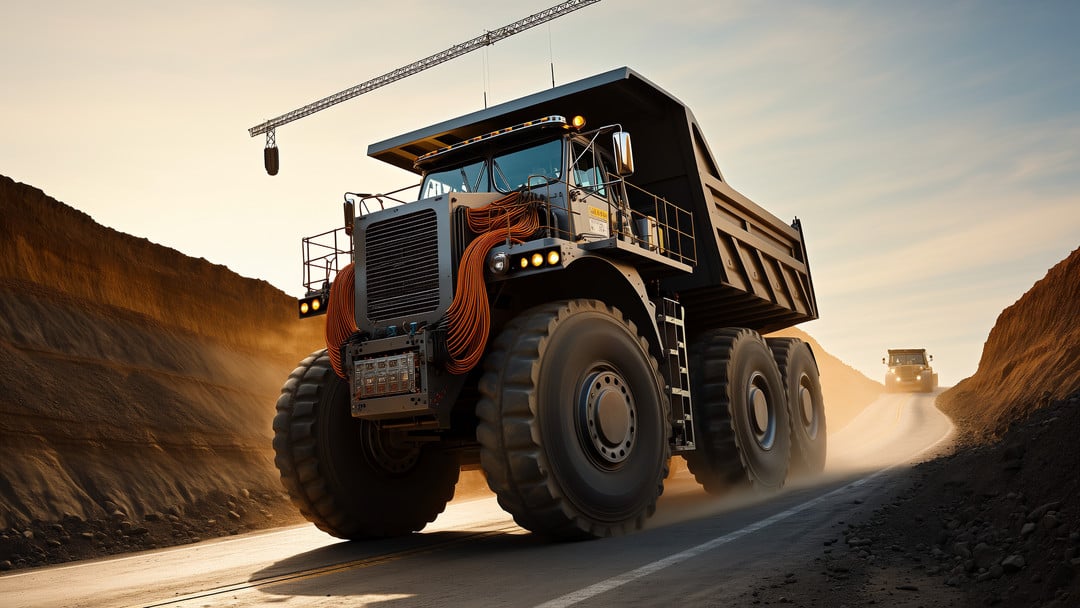
Diesel haulage was long optimized around fuel logistics, engine maintenance windows, and ventilation constraints, while early electrified haulage was limited by charging time, power delivery, and thermal reliability on long grades under high payload. Electric mining trucks shift the bottlenecks toward power availability, charging and trolley scheduling, and drivetrain thermal margins, but they can reduce drivetrain complexity, enable regenerative braking on descents, and improve torque control for traction and gradeability. Rare earth elements (REEs) matter because they enable compact, efficient traction motors and generators through permanent magnets (Nd, Pr with Dy/Tb for heat tolerance), plus high-reliability sensing and human-machine interfaces using optics and phosphors (Y, Eu, Tb), and specialty alloys for high-temperature stability. This article explains where REEs show up in the truck, how the component physics translates into uptime and energy performance, what the supply chain looks like, which 2025-2026 metrics to verify, and what procurement teams should watch for in supply risk and end-of-life pathways.
Table of Contents
How Did Electric Mining Trucks Change Mine Haulage—and Why Do Rare Earths Matter?
For decades, diesel-powered haul trucks defined the rhythm of open-pit mining. Everything from fuel storage and refueling logistics to engine overhaul schedules and underground ventilation systems was built around the diesel engine. These trucks were reliable workhorses, but they came with heavy fuel costs, strict maintenance windows, and growing pressure over emissions.
Electric mining trucks are shifting those bottlenecks. Instead of fuel logistics, the critical constraints become power availability, charging or trolley scheduling, and how well the drivetrain handles heat on long, loaded grades. In return, operators get simpler drivetrains, regenerative braking on descents, and precise torque control that improves traction on variable haul roads.
But inside these electric drivetrains sits a group of materials most mine operators rarely think about: rare earth elements. REEs enable the compact, efficient permanent-magnet motors that make electric haulage practical at scale. They also show up in sensors, displays, and lighting systems throughout the truck. Without them, the motors would be bigger, heavier, and less efficient—or would rely on designs that sacrifice power density.
This article explains where REEs appear in an electric mining truck, how the underlying physics connects to uptime and energy performance, what the supply chain looks like in 2025–2026, and what procurement and operations teams should watch for in supply risk, specifications, and end-of-life planning.
Rare Earth Role in Electric Mining Trucks
Which Elements Are Used and Why
The heaviest concentration of rare earth material in an electric mining truck sits inside the permanent magnets of the traction motors. These magnets are typically neodymium-iron-boron (NdFeB) formulations, using neodymium (Nd) and praseodymium (Pr) as the primary magnetic elements. To keep these magnets stable at the high temperatures generated during loaded uphill hauls, manufacturers add dysprosium (Dy) or terbium (Tb). These heavy rare earths raise the magnet's coercivity—its resistance to losing magnetism when hot. This mapping is consistent with the International Energy Agency's critical minerals reporting (opens in a new tab) and USGS mineral commodity summaries. (opens in a new tab)
In areas of the drivetrain where demagnetization risk is especially high—such as tightly packaged e-axle assemblies or generator units with limited cooling airflow—samarium-cobalt (SmCo) magnets may be used instead. SmCo magnets tolerate higher temperatures than standard NdFeB grades, though they use samarium, a less abundant rare earth. ASM International materials handbooks document this trade-off in detail.
Beyond the drivetrain, yttrium (Y), europium (Eu), and terbium (Tb) appear in the phosphors used for LED backlighting, status indicators, and ruggedized cab displays. These are smaller quantities, but they matter for visibility and safety in dusty, vibration-heavy mine environments. The U.S. Department of Energy's solid-state lighting materials briefings describe these phosphor compositions.
Cerium (Ce) and lanthanum (La) can also appear upstream—in polishing compounds for optical components and in certain catalyst or additive roles during manufacturing—as noted in Adamas Intelligence's rare earth end-use analyses.
How It Works
The connection between rare earths and truck performance is straightforward once you follow the physics through each subsystem.
In the traction motor, NdPrFeB magnets doped with Dy or Tb generate high magnetic flux density while resisting demagnetization at elevated rotor temperatures. This means the motor can deliver the same torque in a smaller, lighter package. For a 220-tonne haul truck climbing a 10% grade, that size and weight advantage directly translates into more payload capacity and better energy efficiency per tonne moved.
The inverter relies on precise rotor position feedback from magnetic encoders—sensor assemblies that often use REE-enabled magnets. Accurate position data enables smoother torque control, reduces tire slip on wet or loose haul roads, and improves overall traction. This is especially important during acceleration from a stop on an incline.
Thermal constraints tend to dominate motor design choices in mining. High stator temperatures and limited airflow in enclosed wheel motors or e-axle housings can push magnet selection toward higher Dy/Tb content or SmCo alternatives. Without that thermal margin, the motor controller must derate power output on long climbs, extending cycle times and reducing productivity. IEC motor design guidance and major magnet producers' technical datasheets describe these derating thresholds.
For lighting and displays, Y/Eu/Tb phosphors provide stable color rendering and brightness across a wide temperature range. This keeps alarms visible and operator interfaces readable during cold starts, dust storms, and nighttime operations.
Journey from Mine to Product
Supply Chain Steps
Rare earth elements begin their journey as ore—most commonly from hard-rock deposits or ion-adsorption clays. The ore is mined, crushed, and upgraded into a mineral concentrate. From there, the concentrate goes through chemical separation, typically solvent extraction, to produce individual rare earth oxides such as NdPr oxide and Dy oxide. USGS and IEA critical minerals documentation describes this flow in detail.
Those oxides are then reduced to metals and combined into alloys designed for magnet production. The alloy undergoes powder preparation, pressing, sintering, heat treatment, and protective coating to produce finished magnet blocks. Each of these steps requires tight process control.
Magnet blocks are precision-machined and assembled into rotor assemblies or actuator subassemblies. These go into motors that are tested for rotational balance, demagnetization margin, and thermal performance before being validated at the drivetrain level. Final truck assembly and end-of-line quality assurance complete the integration.
In a parallel path, REE-based phosphors are manufactured and packaged into LED and display modules. These modules are qualified for the vibration, dust ingress, and temperature cycling conditions typical of surface mine environments.
Typical Chokepoints
The supply chain has several well-documented bottleneck points that procurement teams should understand:
- Separation capacity is a frequent constraint because solvent-extraction circuits for heavy REEs like Dy and Tb require complex chemistry and high-purity outputs, as noted in IEA critical mineral supply chain analyses.
- Magnet-grade alloying and sintering are specialized, IP-sensitive steps with narrow quality tolerances that can become bottlenecks even when oxide supply is adequate, a risk discussed by Adamas Intelligence and Roskill.
- Heavy REE availability is structurally tighter than light REE availability, so motor specifications requiring high Dy/Tb content amplify both lead-time and price volatility exposure.
- Coating and corrosion protection for magnets is a practical chokepoint because mining environments are wet, abrasive, and chemically aggressive. Coating failures can cascade into rotor imbalance and premature motor service events.
Understanding these chokepoints helps procurement teams ask better questions during vendor qualification—particularly around magnet grade, coating specification, and supply continuity guarantees.
Statistics and Societal Impact
Quantitative Snapshot
The deployment of battery-electric and trolley-capable haul trucks is accelerating, but the numbers still need careful verification by payload class. For 2025–2026 figures, the most reliable sources are ICMM member disclosures and OEM annual reports, which break out orders and deliveries by truck class—typically 100–150 tonne, 200–240 tonne, and 290+ tonne categories.
Energy consumption varies significantly by duty cycle. Field studies presented at SME and CIM conferences in 2025 and 2026 report ranges in kilowatt-hours per tonne moved and kilowatt-hours per truck-hour, depending on grade, payload, altitude, and ambient temperature. Charging requirements range from MW-class stationary fast chargers to dynamic trolley-assist systems that deliver power at speed on designated haul road segments.
REE intensity per truck can be estimated by subsystem. The traction motors contain the largest share of magnet mass, with smaller contributions from auxiliary motors (steering, cooling fans), sensors, and display phosphors. Adamas Intelligence magnet demand models and IEA critical minerals end-use estimates provide frameworks for these calculations.
Market growth indicators such as order backlogs and capital expenditure allocated to mine electrification are tracked in 2025–2026 investor presentations from diversified mining companies and in analyses from BloombergNEF and Wood Mackenzie.
Downstream Effects
The shift from diesel to electric haulage changes operational risk profiles in measurable ways. Diesel fuel consumption drops, along with the logistics burden of fuel delivery, storage, and spill management. But the exposure shifts to electricity price, demand charges, and grid or microgrid reliability—factors that change how operations manage peak loads and contingency planning.
Regenerative braking on downhill loaded or empty hauls reduces brake wear and the heat-related incidents that come with it. Where haul profiles support it, this can meaningfully lower maintenance labor intensity and improve truck availability. OEM field validation summaries frequently report these benefits.
Noise reduction and smoother torque delivery can support safer conditions in congested pit areas and contribute to more consistent cycle times. However, these gains are constrained by practical factors like charger queueing, power availability during peak demand, and dispatch scheduling complexity.
The most useful way to frame operational impact is through cost-per-tonne and availability metrics rather than nameplate range or battery capacity. Dispatch strategy, haul-road variability, and charging logistics dominate realized performance far more than laboratory specifications.
Innovators and History
Key Breakthroughs
The development of high-energy NdFeB permanent magnets in the early 1980s was a foundational step. These magnets enabled compact, efficient electric motors that could deliver the torque density required for heavy mobile equipment. Over the following decades, improvements in coercivity—particularly through heavy-REE doping and microstructure engineering—extended the usable temperature range of these magnets. IEEE magnetics publications and ASM International references document this progression extensively.
Mining haulage itself has a long history with electrification, starting with diesel-electric drivetrains that used electric wheel motors powered by onboard diesel generators. The transition to battery-electric and trolley-assist architectures built on advances in power electronics—especially insulated-gate bipolar transistors (IGBTs) and sophisticated motor control software. OEM technical papers and SAE publications trace this evolution.
Safety standards for high-voltage systems on mobile mining equipment matured alongside the technology. Frameworks derived from IEC 61508 and ISO 26262 were adapted for mine deployment, covering functional safety, battery transport and handling, and emergency response. Regulatory bodies and OEM compliance teams continue to refine these standards.
From Lab to Product
Translating magnet materials research into field-ready components required solving manufacturing challenges around sintering consistency, defect reduction, and corrosion-resistant coatings. In mining environments where moisture, fine particulates, and chemical exposure are constant, these manufacturing details directly affect motor reliability.
Power electronics moved from stationary industrial drives to mobile platforms through iterative engineering in packaging, cooling, and vibration hardening. Traction motor suppliers and truck OEMs commercialized these advances through pilot programs at operating mines, generating the performance data needed for production contracts.
Those field pilots also created the empirical basis for procurement specifications. Thermal derating curves, charge acceptance under temperature extremes, and validated maintenance intervals turned laboratory performance claims into contractual requirements that procurement teams can hold vendors to.
Why It Matters Now
Current Drivers
Several forces are converging to accelerate electric haul truck deployment in 2025 and 2026. Decarbonization targets and Scope 1 emissions scrutiny are high on the list, reflected in ICMM-aligned climate reporting and major miners' public disclosures. But the operational case is strengthening too—battery costs have continued to decline, charging power electronics have improved, and mine microgrid controls are becoming more capable.
OEM product roadmaps now cover a wider range of payload classes than even two years ago, making electrification technically feasible for more duty cycles and mine configurations. At the same time, permitting pressures and community expectations around air quality, noise, and diesel logistics are pushing some operators to evaluate electrified haulage earlier in the mine planning process. This is especially true for greenfield projects where power studies and infrastructure can be designed in from the start.
Procurement teams are increasingly expected to quantify whole-of-system costs rather than just truck capital expenditure. That includes grid upgrades, substation capacity, charging bay construction, cable management, and the scheduling and dispatch impacts of charging constraints.
Security and Policy Context
REE processing and magnet manufacturing remain geographically concentrated. China holds a significant share of global separation and sintered magnet production capacity—a risk consistently highlighted in IEA critical minerals assessments and USGS mineral commodity summaries.
Policy responses in 2025 and 2026 include expanded critical minerals funding, permitting reforms, and recycling incentives across the United States, European Union, Canada, and Australia. These measures can improve long-term supply resilience, but they do not eliminate near-term bottleneck risks in separation and magnet production.
Export controls, sanctions compliance, and origin-tracing requirements are becoming more relevant in procurement due diligence. This is particularly true for heavy REEs and finished magnet components, where supply chain transparency is harder to achieve.
Standards development around battery safety, high-voltage maintenance procedures, and emergency response protocols continues to tighten. These evolving standards influence vendor qualification processes and site readiness requirements, adding complexity to deployment timelines.
Future Outlook
Materials and Design Trends
Magnet manufacturers are actively working to reduce Dy and Tb content without sacrificing high-temperature performance. Grain-boundary diffusion techniques allow heavy REEs to be concentrated at grain surfaces rather than distributed throughout the magnet bulk, achieving comparable coercivity with less material. IEA materials notes and industry technical literature describe this trend as one of the most impactful near-term supply risk mitigations.
Some drivetrain architectures are exploring alternatives to NdFeB motors entirely. Induction motors and electrically excited synchronous motors eliminate the need for permanent magnets, though they typically carry penalties in efficiency, mass, or packaging complexity. For high-torque traction applications where thermal margins and space are constrained, high-performance permanent-magnet designs often remain the preferred choice.
Recycling infrastructure is scaling up, with a focus on magnet scrap recovery and end-of-life motor reclamation. Processes such as hydrogen decrepitation and hydrometallurgical recovery are moving from pilot scale toward early commercialization, tracked by the U.S. Department of Energy and EU critical materials program updates.
LED and display components may reduce REE intensity per lumen as efficiency improves, but the ruggedization requirements of mining—resistance to vibration, dust, temperature extremes—can keep phosphor and optics demand relatively stable on a per-unit basis.
Five-to-Ten-Year Scenario
Demand for NdPr magnets will likely track the broader trajectory of vehicle and industrial electrification. Heavy REE demand could become more volatile if high-temperature motor specifications expand faster than new Dy and Tb supply comes online—a scenario discussed in outlooks from BloombergNEF and Adamas Intelligence.
The most probable bottlenecks over this period are in midstream processing and magnet manufacturing capacity rather than raw ore availability. This means lead times and qualification cycles for new magnet suppliers will remain a key operational risk for fleet planners and procurement teams.
Mitigation strategies will likely combine several approaches:
- Multi-source qualification for magnet supply
- Recycling contracts that secure secondary REE feedstock
- Design flexibility that allows magnet grade substitution without changing performance requirements
- Clearer warranty terms tied to measured thermal exposure and duty-cycle definitions
Sites with constrained grid access may lean more heavily on trolley corridors, staged charging, and hybrid power solutions. This shifts component demand toward power electronics and charging infrastructure rather than purely onboard energy storage, which in turn changes the REE demand profile per truck.
Glossary
NdFeB: Neodymium-iron-boron permanent magnet, the dominant magnet type used in high power density traction motors for electric mining trucks.
SmCo: Samarium-cobalt magnet, chosen for applications requiring strong high-temperature stability where NdFeB may risk demagnetization.
Coercivity: A magnet's resistance to being demagnetized, critical in motors that operate at sustained high temperatures during loaded haul cycles.
Grain-boundary diffusion: A manufacturing method that concentrates Dy or Tb at magnet grain boundaries to improve coercivity while using less heavy rare earth material.
Phosphor: A material, often based on rare earth elements like yttrium and europium, that converts LED light emission into specific visible colors for displays and indicators.
Sintering: A heat-based consolidation process that compresses and bonds magnet powders into dense, high-performance magnet blocks.
Thermal derating: The automatic reduction of motor power output that occurs when component temperatures exceed design limits, directly affecting cycle time and productivity.
FAQs
How many rare earths are in electric mining trucks, and where are they concentrated?
Most REE mass is typically concentrated in permanent magnets used in traction motors and auxiliary motors, with smaller amounts in sensors and display or lighting phosphors. The exact quantities vary by drivetrain architecture (permanent-magnet vs induction), temperature class, and redundancy requirements, so procurement specs should request a bill-of-materials declaration by subsystem and magnet grade.
Do electric mining trucks always use permanent-magnet motors?
No, some designs use induction or electrically excited synchronous motors that reduce dependence on NdPr magnets, but they can trade off efficiency, mass, and packaging simplicity. Permanent-magnet designs tend to favor higher power density and efficiency, especially valuable when thermal margins and space are constrained in heavy mobile equipment.
Why do Dy and Tb matter for mining duty cycles?
Dy and Tb increase coercivity, helping magnets resist demagnetization at elevated temperatures that can occur during long uphill hauls, high ambient heat, or restricted cooling conditions. Using more heavy REEs can improve thermal robustness but may increase supply risk and cost volatility, so the required temperature class should be tied to measured duty-cycle heat loads.
Can rare earth supply risk affect truck lead times or spares availability?
Yes, because separation, alloying, and sintering capacity are specialized and geographically concentrated, shortages can ripple into motor and component lead times. Mitigation usually involves dual sourcing, stocking critical spares, and specifying acceptable alternates such as magnet grades or motor types without changing performance requirements.
What happens to rare earth magnets and batteries at end of life?
End-of-life pathways can include refurbishing motors, reclaiming magnets for recycling, and recovering REEs through specialized processes, while batteries may go to second-life stationary storage or recycling depending on condition and local regulations. Procurement teams typically formalize responsibilities through warranty terms, take-back clauses, and documentation of recycling partners' compliance with safety and environmental standards.
Conclusion
Electric mining trucks represent a fundamental shift in mine haulage, moving operational bottlenecks from diesel logistics and ventilation to power availability, charging infrastructure, and drivetrain thermal management. Rare earth elements are embedded throughout these trucks, concentrated in permanent magnets for traction and auxiliary motors, in sensors for precise rotor control, and in phosphors for ruggedized displays and lighting. The supply chain from ore to finished magnet involves specialized separation, alloying, and sintering steps that remain geographically concentrated and capacity-constrained, particularly for heavy REEs like dysprosium and terbium. As 2025-2026 deployment accelerates under decarbonization pressures and expanding OEM product lines, procurement teams must look beyond truck capex to evaluate whole-of-system costs, supply chain resilience, magnet grade flexibility, and end-of-life reclamation pathways. The organizations that build robust specifications tied to measured duty cycles, qualify multiple sources, and formalize recycling and take-back terms will be best positioned to capture the reliability and cost benefits of electrified haulage while managing material supply risk.
