
Highlights
- China's 90% dominance in sintered NdFeB magnets stems from three decades of accumulated industrial knowledge, not just subsidized factories.
- Effective Western policy requires 10–15 year offtake agreements, shared qualification infrastructure, and coordinated value chain development from mines to motors.
- Workforce development—metallurgists, powder specialists, furnace operators—is as critical as capital investment in building a competitive magnet industry.
- The DFARS January 2027 deadline should be treated as a forcing function exposing bottlenecks, not a finish line for Western magnet supply chain resilience.
- VAC Group, Japanese producers, and emerging firms like MP Materials form a nascent Western magnet tier, but full ecosystem integration remains the defining challenge.
The West has become much better at financing factories than building industries. Capital alone will not solve the magnet challenge because the principal bottleneck is no longer equipment—it is industrial learning, process know-how, and the supporting manufacturing ecosystem. China did not achieve roughly 90% of global sintered NdFeB magnet production simply by subsidizing plants. It spent more than three decades developing an industrial system in which metallurgists, powder specialists, furnace manufacturers, automation engineers, tooling companies, coating suppliers, universities, equipment builders, and end-users continuously improved processes together. Every production run generated new data. Every yield improvement became institutional knowledge. That accumulated experience is now one of China's greatest strategic assets.
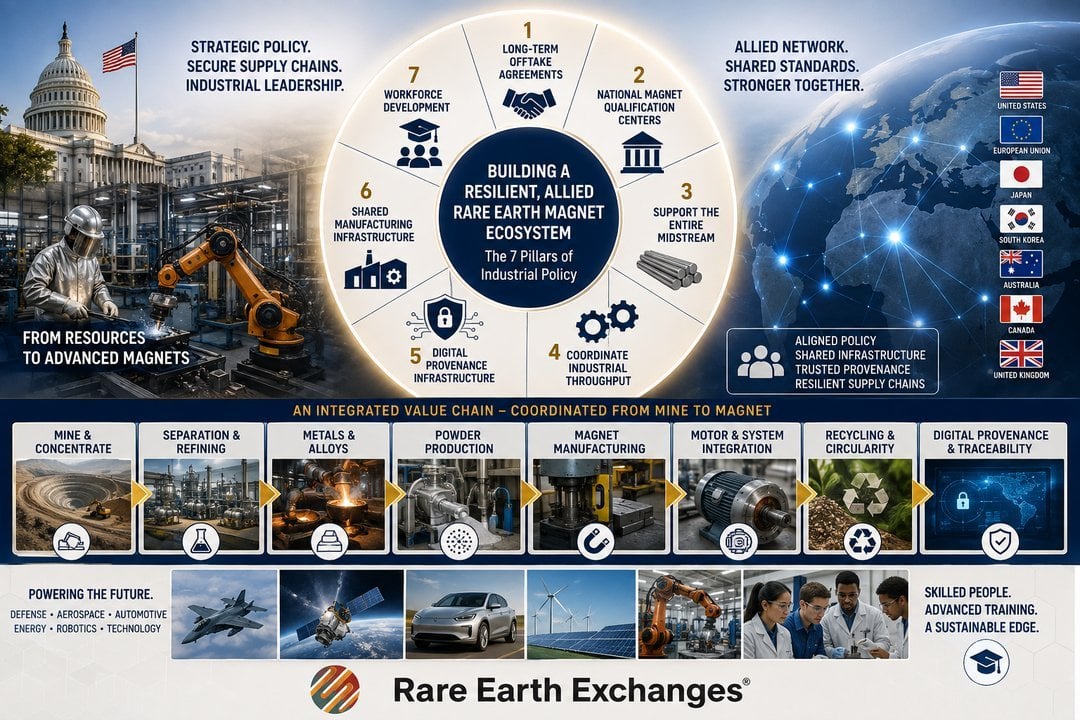
Rare Earth Exchanges® believes the next phase of Western industrial policy should focus on throughput orchestration—ensuring every stage of the supply chain grows together rather than independently.
First, governments should move beyond capital grants and establish 10- to 15-year defense and commercial offtake agreements. Investors finance predictable cash flows, not patriotic rhetoric. Guaranteed demand reduces financing costs, unlocks private capital, and allows manufacturers to optimize production rather than chase uncertain orders.
Second, the United States and allied governments should establish national piloting facilities—for mineral/element characterization, testing, and separation, as well as magnet qualification centers, jointly operated by the Department of Defense, Department of Energy, national laboratories, and qualified industrial partners. Today, each OEM frequently performs its own qualification process, duplicating time and cost. Shared qualification infrastructure, for example, could dramatically shorten commercialization timelines while maintaining rigorous performance standards.
Third, policy must support the entire midstream—not simply the final magnet plant. Metals, alloys, strip casting, hydrogen decrepitation, powder production, heavy rare earth diffusion technology, coatings, specialty furnaces, tooling, process equipment, analytical laboratories, and advanced metrology all deserve targeted support, in our opinion.
A magnet factory that imports alloy powder has simply relocated dependence further upstream.
Fourth, governments should actively coordinate industrial throughput across the value chain. Today, mines, separation plants, alloy producers, magnet manufacturers, motor companies, and defense contractors often announce projects independently, creating mismatches between feedstock availability and downstream demand. Strategic coordination—linking long-term feedstock contracts, processing capacity, customer commitments, logistics, and financing before facilities are commissioned—would materially reduce execution risk while improving capital efficiency.
Fifth, digital provenance should become strategic infrastructure. Standardized material passports, interoperable chain-of-custody systems, independent verification, and secure digital traceability platforms will likely become as important to defense procurement as coercivity, remanence, or energy product. Trusted provenance may ultimately command its own pricing premium.
Sixth, policymakers should support shared manufacturing infrastructure. Not every emerging company needs to independently purchase pilot-scale strip casters, hydrogen decrepitation systems, powder characterization equipment, vacuum sintering furnaces, or advanced microscopy laboratories. National shared-user manufacturing centers—similar to semiconductor foundries or national user facilities—could dramatically reduce development costs while accelerating learning across the industry.
Finally, as we continue to emphasize, workforce development deserves equal urgency. The West needs dedicated institutes for permanent magnet manufacturing that educate metallurgists, ceramic engineers, powder metallurgy specialists, furnace operators, coating experts, quality engineers, automation specialists, and process-control professionals. The semiconductor industry did not become globally competitive by constructing fabs alone—it built decades of educational infrastructure and apprenticeship.
Rare earth magnets require the same long-term commitment. Programs supporting MP Materials, eVAC, USA Rare Earth, Phoenix Tailings, Neo Performance Materials, and other emerging manufacturers, and even innovative alternatives such as Niron Magnetics, demonstrate that industrial policy is moving in the right direction. But the next competitive advantage will not come from announcing another factory. It will come from building an industrial ecosystem capable of learning, improving, qualifying, and scaling faster than its global competitors.
REEx Verdict
The West is no longer suffering from a shortage of announcements. It is still suffering from a shortage of qualified industrial throughput. Outside China, the competitive landscape is becoming clearer. VAC Group—with its German heritage, expanding U.S. manufacturing footprint through eVAC Magnetics, and pending acquisition by Energy Fuels—has emerged as the leading integrated Western producer of sintered rare earth magnets. Alongside (and more advanced than) VAC, the established Japanese manufacturers—Proterial, Shin-Etsu Chemical, and TDK—remain the technical benchmark outside China, possessing decades of manufacturing know-how, mature quality systems, and proven commercial production.
Behind that first tier in the REEx Insights Magnet Manufacturer Rankings, a second wave is rapidly taking shape. MP Materials, Neo Performance Materials, USA Rare Earth, Noveon Magnetics, JS Link, Vulcan Elements, and several other emerging manufacturers are making genuine progress and could become the foundation of a resilient Western magnet industry. Established defense suppliers such as Arnold Magnetic Technologies and Electron Energy Corporation (Permag) continue to play indispensable roles in defense qualification, specialty magnets, and secure supply, while innovators including Advanced Magnet Lab (Mitus Magnets) are exploring fundamentally new approaches to permanent magnet manufacturing.
Yet the industry's greatest challenge is no longer only proving the chemistry. It is, more importantly, compressing thirty years of industrial learning into three. That is why Rare Earth Exchanges believes the defining competition of Great Powers Era 2.0 is no longer over who discovers the next rare earth deposit (although heavy rare earth feedstock is badly needed). Nor is it simply about who builds the next separation plant or magnet factory. It is about who first assembles a fully integrated, commercially competitive, continuously improving magnet manufacturing ecosystem outside China—one that links mines, separation, metals, alloys, powder production, magnet manufacturing, motors, recycling, digital provenance, qualification, and workforce development into a single industrial system.
The January 1, 2027 DFARS deadline should therefore be viewed less as a finish line than as a forcing function. It will accelerate investment, expose remaining bottlenecks, and reward companies capable of delivering fully traceable, defense-qualified magnets—not merely production capacity on paper.
Factories can be financed. Equipment can be purchased. Even technology can be licensed.
Industrial ecosystems must be built, and American industrial policy—externalized to a global network of partners—becomes imperative. China spent more than three decades building its magnet manufacturing system. The West now has less than one. That final reality—not the opening of another plant—may be the single most important investment thesis in the rare earth sector for the remainder of this decade.


0 Comments
No replies yet
Loading new replies...
Moderator
Join the full discussion at the Rare Earth Exchanges Forum →