
Highlights
- Globalization is evolving from cost-driven efficiency to resilience-driven industrial strategy governed by geopolitical competition
- Control of refining, processing, and manufacturing layers—not just mining—defines strategic advantage in critical supply chains
- Corporate accounting must now quantify geopolitical exposure, country-of-origin risk, and multi-tier supplier dependencies
- Structural inflation is increasingly the permanent price of supply-chain resilience, not a temporary monetary phenomenon
- China's decades of deliberate industrial policy inadvertently catalyzed a global strategic response now reshaping capital allocation worldwide
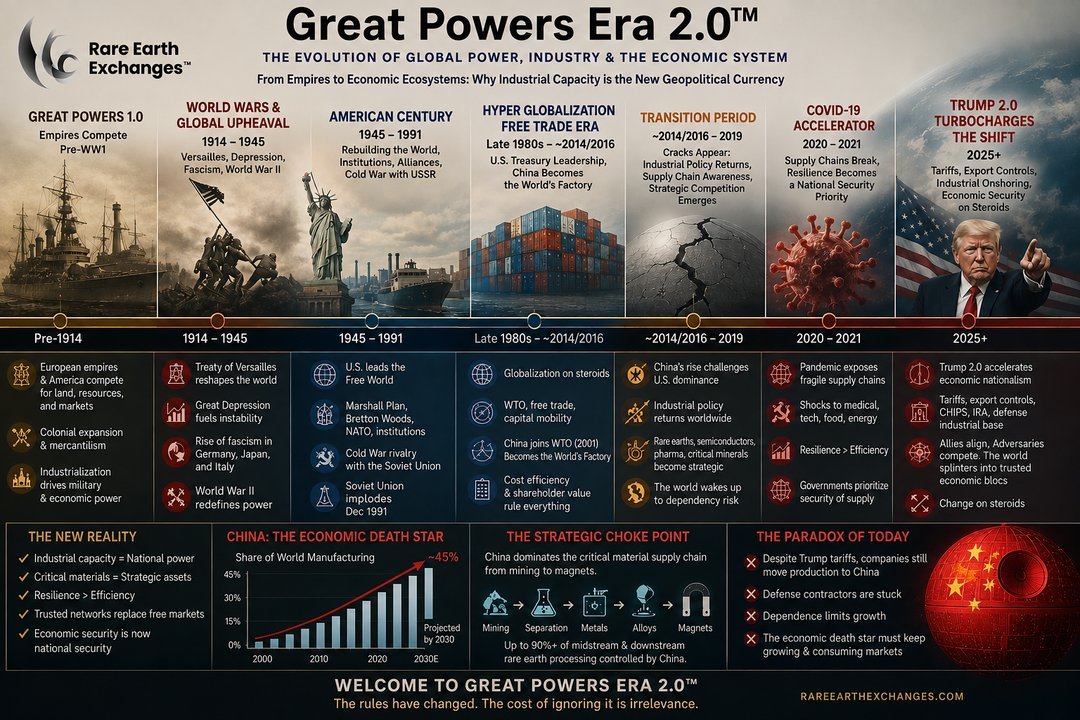
Globalization is not ending—it is evolving. Great Powers Era 2.0™, a strategic framework coined by Rare Earth Exchanges®, describes the transition from a world driven primarily by cost and efficiency to one governed by industrial capacity, supply-chain resilience, and geopolitical competition. While the underlying dynamics are not new, the framework organizes them into a coherent lens for investors, governments, and corporations seeking to understand why inflation, strategic redundancy, and industrial policy are becoming permanent features of the global economy.
REEx Insight
The value of Great Powers Era 2.0™ is not that it invents a new geopolitical reality. Rather, it provides the intellectual architecture to explain one already unfolding. Great powers have always competed. What's changed is where they compete. Military strength increasingly depends on industrial ecosystems, processing capacity, critical minerals, semiconductors, pharmaceuticals, AI infrastructure, and the invisible networks that connect them. The world's strategic contest has shifted from battlefields to supply chains.
That shift changes how capital should be allocated, how governments craft industrial policy, and how corporations manage risk.
Globalization Isn't Dead—It Has Been Rewritten
For decades, globalization rewarded one overriding objective: lower costs, along with greater productivity yields. Production migrated to wherever labor, energy, and regulation were cheapest. Lean inventories and just-in-time manufacturing maximized efficiency. That model is giving way to a new one.
Today, resilience often outweighs efficiency. Nations increasingly ask not simply Who can make it cheapest? but Who controls the refining? Who owns the processing? Can the supply survive a geopolitical shock?
Rare earths illustrate the transition perfectly. Mining alone provides little strategic advantage without separation, metals, alloys, and magnet manufacturing—the industrial layers where China established global dominance.
Ironically, China helped create Great Powers Era 2.0 through decades of deliberate industrial policy. U.S. tariffs, export controls, domestic investment, and the Trump administration's acceleration of economic security policies transformed that reality into a global response rather than a Chinese advantage alone.
The Accounting Revolution Few See Coming
Great Powers Era 2.0 also changes corporate accounting. Traditional ERP systems measure cost, inventory, and supplier relationships. Increasingly they must quantify geopolitical exposure, processing concentration, DFARS compliance, country-of-origin risk, and multi-tier supplier dependencies extending several layers beyond direct vendors. Enterprise platforms such as SAP, Oracle, and Microsoft will increasingly require strategic-risk intelligence alongside financial reporting. Supply chains are becoming balance-sheet assets—and liabilities.
The consequence is straightforward: greater redundancy, regional manufacturing, friend-shoring, and strategic inventories will almost certainly increase structural costs. Inflation becomes less a temporary monetary event than the price of resilience. Welcome to Great Powers Era 2.0.


0 Comments
No replies yet
Loading new replies...
Moderator
Join the full discussion at the Rare Earth Exchanges Forum →