
Highlights
- China Rare Earth Group and 30+ organizations convened in Ganzhou to implement national standards for NdFeB roasted recycled raw materials and zero-carbon manufacturing.
- Beijing treats standards as strategic infrastructure, using them to shape supplier qualification, testing methods, and certification across the global rare earth ecosystem.
- Experts warn the West risks building competitive mines while operating within an industrial framework increasingly defined by Chinese standards and institutions.
- The conference reflects China's dual-carbon strategy push, with case studies on enterprise standardization and pathways to zero-carbon rare earth factories.
- Standards create a network effect: as China's specifications gain global adoption, they reinforce domestic manufacturing leadership and raise barriers for foreign competitors.
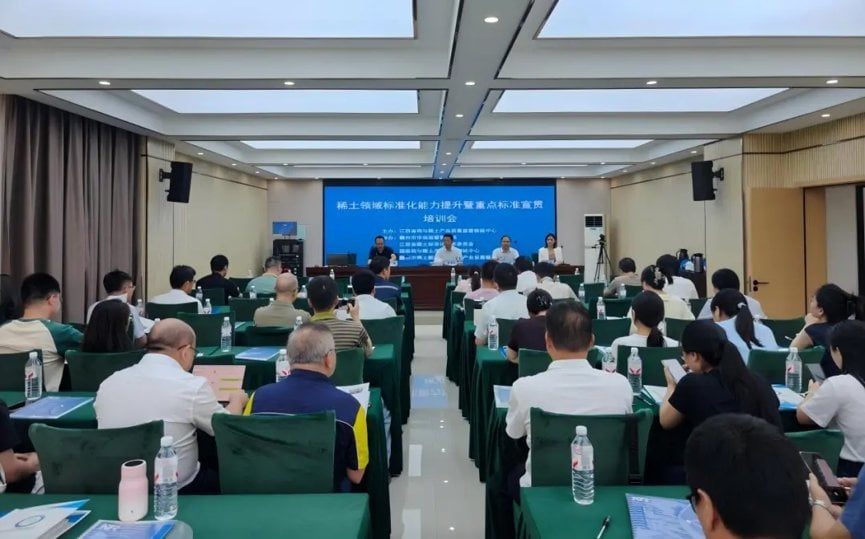
China's rare earth industry has taken another step toward strengthening its industrial foundation—not by opening another mine or processing plant, but by strengthening the standards that govern the industry itself. At a rare earth standards and training conference in Ganzhou, government agencies, China Rare Earth Group, industry experts, and more than 30 companies focused on implementing key national standards, including China's National Standard for Neodymium-Iron-Boron (NdFeB) Roasted Recycled Raw Materials, while advancing enterprise standardization and zero-carbon manufacturing. No new technology was unveiled. Yet the meeting highlights Beijing's broader strategy: build not only the world's largest rare earth industry, but also the institutional framework that defines how that industry operates.
Rare Earth Industry Standardization Capacity Building and Key Standards Promotion & Training Conference
REEx Insight
Western governments often measure progress by counting mines, processing plants, or magnet factories.
China measures success differently. It is investing simultaneously in research, commercialization, manufacturing, workforce development, standards, certification, recycling, environmental performance, and industrial governance—the invisible architecture that makes an industrial ecosystem increasingly difficult to displace.
Standards are far more than technical paperwork.
They determine how recycled materials are classified, how products are qualified, how quality is measured, how manufacturers certify suppliers, how laboratories test materials, and ultimately how companies compete.
In Great Powers Era 2.0™, the nation writing the standards frequently shapes the market itself.
Building the Industry's Operating System
Held in Ganzhou, Jiangxi Province, the conference brought together nearly 60 representatives from more than 30 organizations, including China Rare Earth Group and Jiangxi Rare Earth Co., Ltd.
Organized under the guidance of the Jiangxi Provincial Market Supervision Administration, the event focused on strengthening enterprise standardization capabilities and accelerating implementation of national rare earth standards. Among the most significant discussions was the implementation of China's national standard for NdFeB roasted recycled raw materials, reflecting growing emphasis on recovering valuable rare earths from manufacturing scrap and end-of-life magnets.
Experts also presented practical case studies covering enterprise standardization, implementation of the recycling standard, and pathways toward zero-carbon rare earth factories under China's dual-carbon strategy.
Why the West Should Pay Attention
This conference demonstrates that China views standards as strategic infrastructure. When a nation develops the specifications governing recycled feedstocks, testing methods, quality requirements, certification procedures, and manufacturing practices, it gains influence extending well beyond its own borders. Suppliers, equipment manufacturers, laboratories, and multinational companies often adapt to those standards because they represent the world's largest production ecosystem.
That creates a network effect.
As China's standards become more widely adopted, they reinforce China's manufacturing leadership, lower commercialization costs for domestic firms, and increase barriers for foreign competitors attempting to enter the market. Western policymakers often focus on replacing China's physical production capacity. Equally important is building the institutional capacity surrounding that production—standards organizations, testing laboratories, pilot-scale facilities, qualification protocols, engineering education, and industry-wide certification systems.
Otherwise, the West may eventually build competitive mines and processing plants while operating within an industrial framework increasingly shaped by China.
That is one of the defining characteristics of Great Powers Era 2.0™: competition is no longer limited to commodities or manufacturing. It increasingly extends to the rules, standards, institutions, and technical ecosystems that determine who captures long-term industrial leadership.
REEx Connect
Organizations: National Tungsten and Rare Earth Products Quality Inspection Center; Jiangxi Provincial Market Supervision Administration; Jiangxi Provincial Tungsten and Rare Earth Products Quality Supervision and Inspection Center; Ganzhou Municipal Market Supervision Administration; China Rare Earth Group; Jiangxi Rare Earth Co., Ltd.; Guangdong Zhizhonghe Holdings Co., Ltd.
Key Standard: National Standard for Neodymium-Iron-Boron (NdFeB) Roasted Recycled Raw Materials
Key Themes: Rare earth standardization; NdFeB magnet recycling; circular economy; zero-carbon manufacturing; quality systems; certification; workforce development; industrial governance; Great Powers Era 2.0™
Disclaimer: This report is based on information published by the National Tungsten and Rare Earth Products Quality Inspection Center, a Chinese state-affiliated organization. The information reflects official reporting and should be independently verified before being relied upon for investment, commercial, or policy decisions.
Editorial Note
This story may prove more strategically important than many announcements about new mines or production capacity. Physical assets can be built with sufficient capital. Institutions—standards bodies, testing protocols, certification systems, engineering expertise, and industrial governance—take decades to develop. China's continued investment in these less-visible foundations suggests it intends not only to remain the world's leading rare earth producer, but also to shape the rules under which the global rare earth industry operates. That is a strategic development Western governments, investors, and manufacturers ignore at their peril.


0 Comments
No replies yet
Loading new replies...
Moderator
Join the full discussion at the Rare Earth Exchanges Forum →