
Highlights
- India remains entirely dependent on imported high-performance permanent magnets despite possessing one of the world's largest rare earth resource bases.
- China's strategic advantage lies not in geology but in a decades-built integrated ecosystem spanning mining, separation, metallization, alloys, and magnet manufacturing.
- Defense-grade magnet qualification takes years of process validation and customer certification—timelines governments cannot legislate away with funding alone.
- India is expected to pursue measured domestic capability expansion while carefully managing its complex strategic and economic relationship with Beijing, not outright decoupling.
- Investors should focus on qualified magnet output leaving factories, not ore discoveries, as the true measure of rare earth strategic independence.
India possesses one of the world's largest rare earth resource bases, yet remains entirely dependent on imported high-performance permanent magnets—primarily from China. A thoughtful Financial Express analysis correctly argues that the strategic battle is no longer about mining but about mastering the industrial chain from separation to metals, alloys, and magnets. Rare Earth Exchanges' differentiator: this is not simply India's challenge—it is the defining industrial policy challenge facing every Western democracy attempting to reduce dependence on China's rare earth ecosystem. Investors should recognize that geology alone does not create strategic independence.
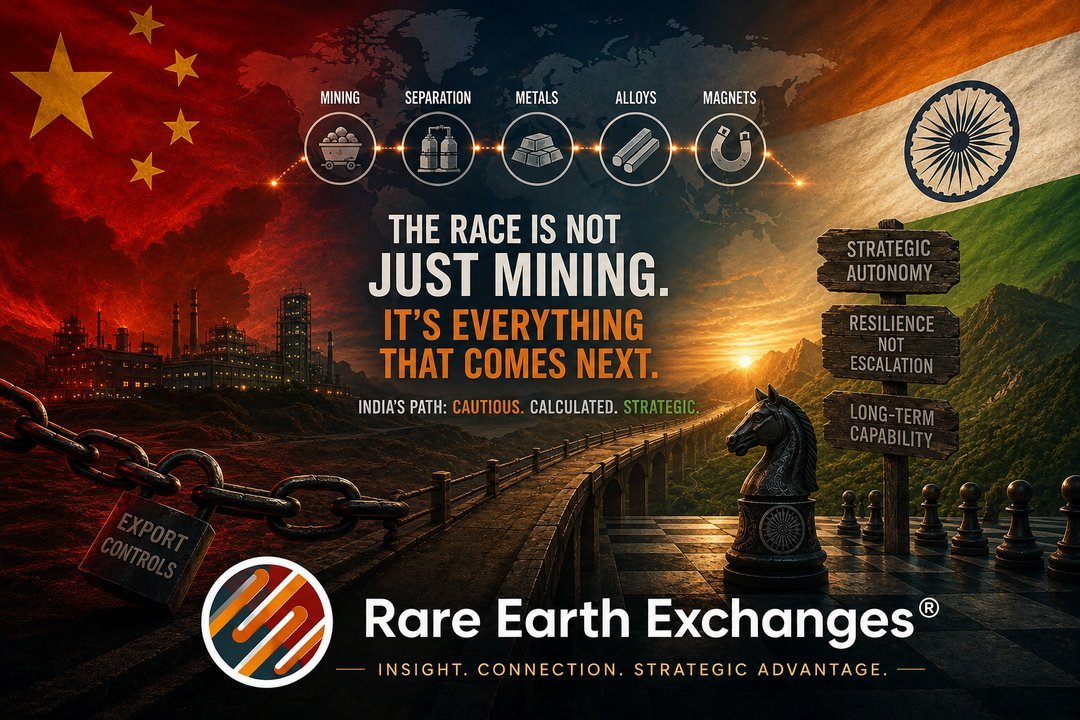
REEx Insight | The Ore Was Never the Prize
For years policymakers celebrated discoveries measured in tonnes beneath the ground. Investors should focus on something far rarer: tonnes of qualified magnets leaving factories.
China's enduring advantage was never simply its mineral endowment. It patiently constructed an industrial ecosystem over decades. Mines feed separation plants. Separation produces metals. Metals become alloys. Alloys become magnets. Magnet producers spend years qualifying products with defense, automotive, and industrial customers. That integrated system—not geology—is China's true strategic moat.
The Missing Industrial Middle
The Financial Express accurately identifies India's central challenge. Despite substantial rare earth resources and ambitious government incentives, India still lacks commercial-scale capability across the critical midstream: separation, metallization, alloy production, and high-performance NdFeB magnet manufacturing. The article also correctly highlights China's overwhelming dominance in refining and permanent magnet production and explains why Beijing's export licensing measures exposed vulnerabilities across global manufacturing.
Beyond the Headlines: The Industrial Clock vs. the Political Clock
One important dimension receives too little attention. Announced capacity is not the same as strategic capability. Defense-grade magnets require years of qualification, process validation, customer testing, and supply chain certification. Governments can fund factories, but they cannot legislate industrial experience or compress qualification cycles.
There is also a geopolitical reality. A Rare Earth Exchanges® source with longstanding ties to elements of the U.S. intelligence community, speaking on condition of anonymity because of the sensitivity of ongoing regional dynamics, believes New Delhi is unlikely to pursue a rare earth industrial strategy explicitly designed to confront or economically destabilize China. Instead, India is expected to carefully expand domestic capabilities while managing a complex strategic and economic relationship with Beijing.
If that assessment proves correct, India's strategy will emphasize resilience and optionality rather than outright economic decoupling. For investors, this distinction matters. Industrial policy rarely exists in a geopolitical vacuum.
Investor Takeaway: The Financial Express diagnosis is largely correct. India's challenge is not discovering rare earths—it is mastering the industrial ecosystem that transforms oxides into qualified permanent magnets. Rare Earth Exchanges would add one final observation: industrial capability develops on engineering timelines, while governments operate on political timelines. Those clocks rarely move together. If informed assessments prove correct, India will likely pursue a measured industrial buildout that strengthens domestic resilience while carefully managing its relationship with China. That balancing act—not simply additional mining—may ultimately determine whether India emerges as a credible mine-to-magnet power.
REEx Connect
Source Reviewed: Financial Express (India)
Organizations Cited: International Energy Agency (IEA); IREL (India) Limited; Ministry of Heavy Industries; Defence Metallurgical Research Laboratory; Bhabha Atomic Research Centre.
Author: Aritra Banerjee, Financial Express.


0 Comments
No replies yet
Loading new replies...
Moderator
Join the full discussion at the Rare Earth Exchanges Forum →