
Highlights
- China's 2025 export controls on rare earths proved that control over small volumes of obscure materials can create enormous leverage over trillion-dollar Western industries.
- America has capital but lacks decades of industrial capability—mines, separation, metallization, and magnet qualification cannot be built on a political timetable.
- The U.S. risks succeeding in light rare-earth production while remaining dangerously exposed in heavy rare earths like dysprosium and terbium.
- Phase II industrial policy must match capital to specific bottlenecks, not just fund large flagship projects, with some critical gaps solvable for $50 million rather than $5 billion.
- The true measure of success is not dollars announced but qualified material moving through the system and months of production that could continue if Chinese supply stopped.
America should recognize what happened in Washington on August 7 for what it was: an important mobilization—but not a victory. The Trump administration deserves substantial credit for forcing critical minerals, industrial capacity, and supply-chain security to the center of American national strategy. This effort has dovetailed with the existence of Rare Earth Exchanges®—our initial media and intelligence platform launched October 2024 with the formal company launch January 2025. Since returning to office, President Trump has accelerated the use of tariffs, executive authority, loans, grants, equity investments, and government-backed industrial policy. His April 15, 2025 order explicitly declared America's dependence on imported processed critical minerals a potential national-security threat. But America is confronting something much larger than a mineral shortage. We are entering Great Powers Era 2.0™.
What is Great Powers Era 2.0?
For roughly three decades after the Cold War, globalization was built around efficiency. With the Soviet Union gone and communism collapsing across Eastern Europe, America stood at the apex of global power—the unipolar superpower underwriting a system in which companies could chase the lowest cost, outsource production, and stretch just-in-time supply chains across the world. But beneath that prosperity, the balance of power was shifting. China's 2001 entry into the World Trade Organization (WTO) accelerated an extraordinary accumulation of manufacturing capacity, infrastructure, and technical know-how—not to mention wealth; the 2008 financial crisis weakened perceptions of Western economic invincibility; and by 2014–2016, the ethos of Great Powers Era 2.0™ was emerging. Made in China 2025 crystallized the change: China was no longer simply the factory inside an American-led global system—it intended to dominate industries that would determine future economic and military power.
Since then, the transformation has accelerated: the first Trump trade war, COVID supply shocks, semiconductor shortages, Russia's weaponization of energy (and invasion of Ukraine), Biden-era CHIPS and de-risking policies, and now Trump 2.0, which has dramatically expanded tariffs, industrial policy, and direct government intervention in strategic supply chains. There was no single starting gun; this is the cumulative result of China's ascent, Western deindustrialization, and the erosion of America's post-Cold War dominance. Globalization 1.0 asked: Where can we make it most efficiently? Great Powers Era 2.0 asks: Who controls the capacity to make it when we need it most? Defense systems, semiconductors, AI, energy, pharmaceuticals, shipping, critical minerals, rare earths, and magnets are no longer simply markets—they are instruments of state power. And increasingly, the defining question of this era is brutally simple: Who controls the bottlenecks?
By April 2025, the theory became reality.
China imposed export controls on seven medium and heavy rare-earth categories after Trump's escalating tariffs via the so-called Liberation Day. Beijing subsequently demonstrated something extraordinarily important: control over relatively tiny volumes of obscure materials could create enormous leverage over trillion-dollar Western industries. The broader October 2025 restrictions were later suspended until November 10, 2026. That date should be circled in every American industrial boardroom.
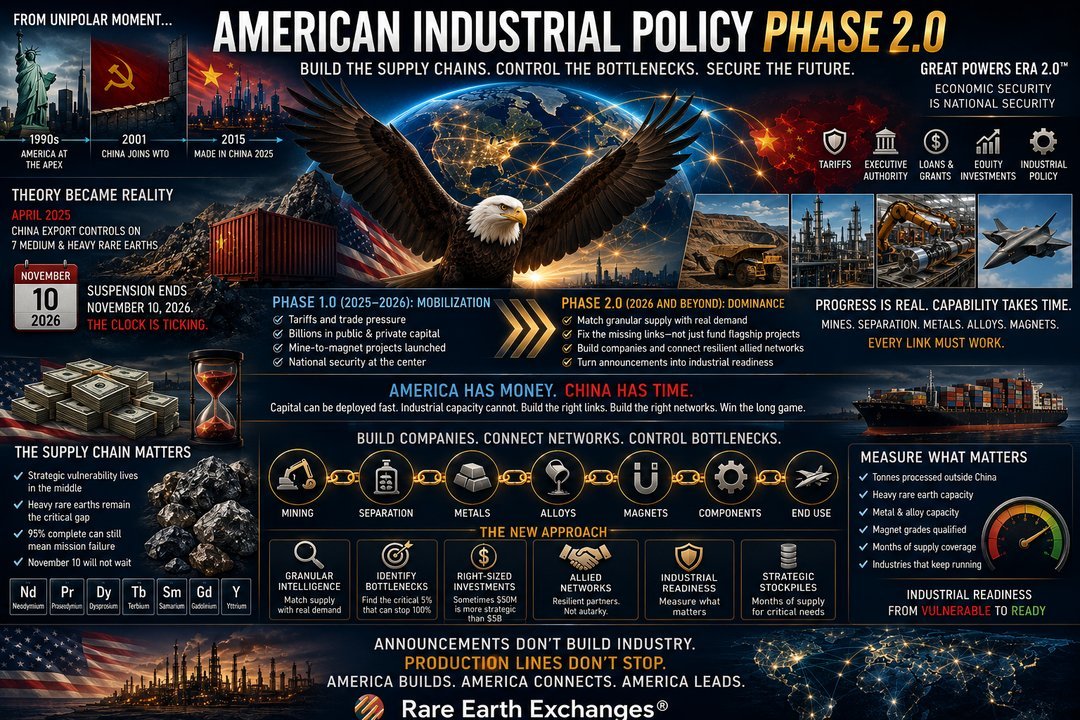
America Has Money. China Has Time.
Washington can announce billions of dollars on Friday. It cannot manufacture decades of industrial capability by Monday.
Political timelines are not industrial timelines. A mine requires geology, permitting, capital, and commissioning. Separation requires chemistry, feedstock, and operating expertise. Metals require specialized processing. Magnets require alloys, powder metallurgy, intellectual property, equipment, qualification, and customers.
And every link must work.
That is why celebrating individual projects risks confusing capital deployment with industrial capability.
Rare Earth Exchanges® has argued that meaningful ex-China mine-to-magnet production at scale remains years away. Meanwhile, the strategic problem may become increasingly asymmetric: the West could eventually create substantial light rare-earth capacity while remaining vulnerable in heavy rare earths, specialized processing, and certain magnet inputs.
Academic research increasingly supports the broader point: strategic vulnerability frequently lies not at the mine but in intermediate products and processing networks.
Progress Is Real—but Industrial Capacity Takes Time
The intense flurry of activity across 2025 and 2026 should not be minimized. The Trump administration has accelerated multiple mine-to-magnet initiatives, mobilized billions in public and private capital, and pushed miners, processors, metallurgists, magnet manufacturers, defense contractors, and investors to move with an urgency largely absent only a few years ago. Some of these projects may become pillars of a far more resilient Western supply chain approaching 2030 based on our forecasts; others will inevitably change ownership, technology, feedstock, partners, or strategy as industrial reality tests their original assumptions. That is not necessarily failure—it is how complex industrial ecosystems develop. Mines must be permitted and commissioned; separation processes proven and scaled; metals and alloys produced consistently; magnets qualified; customers secured; and every link connected economically to the next. This activity is essential and represents genuine progress. The problem is the dangerous gap between mobilization and capability: America has begun building the supply chains it should have started years ago, but those systems cannot be summoned into existence on a political timetable. Consequently, even as the foundations of greater resilience are being laid, the United States remains acutely vulnerable during the next several years—the very period in which great-power competition is accelerating fastest.
America Must Stop Building Companies and Start Building Networks
The answer is not autarky. America does not need every mine, separator, metallurgist, alloy producer, magnet factory, and component manufacturer inside the United States. Rather, it needs something more sophisticated:
a resilient allied industrial network that China cannot switch off.
That means industrial policy must extend beyond favored companies and flagship billion-dollar projects. Tax credits, financing, price floors, offtakes, stockpiles, and qualification support should follow strategically important supply chains, including trusted partners outside America's borders. Frankly, some of the most consequential investments may be $50 million, not $5 billion.
A missing heavy-rare-earth separation circuit, metallization facility, specialized furnace, or qualified magnet line can matter more than another celebrated mine or another planned magnet plant, for that matter. This is the defining lesson of Great Powers Era 2.0: Power increasingly belongs to the nations—and importantly, networks—that control the bottlenecks. Did we understand that in venturing into Venezuela and Iran to disrupt oil flows to China?
President Trump did not create this era. China did not create it alone. Decades of globalization, China's industrial rise, Western deindustrialization, technological competition, the COVID-19 pandemic, war and economic nationalism, plus growing socio-economic polarization in parts of the West brought us here. Trump 2.0 has dramatically accelerated America's confrontation with that reality. For that, his administration deserves serious credit.
But at the same time, confidence can become hubris. America has awakened. Now it must recognize the difference between announcing industrial power and actually possessing it. Because November 10 will not care how much money Washington announced. A production line either has the material it needs—or it stops.
The Next Step: American Industrial Policy 2.0
The extraordinary mobilization of 2025–2026 should be viewed as Phase I of a much longer, more enduring American industrial strategy. Phase I changed the psychology of Washington and corporate America: critical minerals became national security; government capital became acceptable; mines, separation plants, and magnet factories moved from the periphery toward the center of economic policy. President Trump deserves substantial credit for accelerating that transformation. But Phase II must now become more granular, more networked, and more enduring. The question can no longer simply be: Which companies and large projects should America fund? It must become: What exact materials, capabilities, volumes, and industrial relationships does America need—and where are the bottlenecks preventing them from reaching the factory floor?
This requires something closer to a national supply-chain intelligence architecture. Rare Earth Exchanges has approached the market this way through its research, rankings, and supply-chain analysis: begin with the actual industrial requirement and work backward. How many tonnes of which oxide, metal, alloy, or magnet specification will be required? Where will the feedstock originate? Who can separate it? Who can metallize it? Which magnet producer can qualify it? Which OEM actually needs it—and when? That level of granularity matters because a supply chain can be 95% complete and still be strategically useless if the missing 5% represents an irreplaceable bottleneck.
Match Capital to Bottlenecks—not Bottlenecks to Capital
Phase II therefore should not be defined by the size of government spending. It should be defined by the precision of government intervention. Some strategic problems may legitimately require multibillion-dollar investments. Others might be solved with a $50 million separation circuit, a specialized metallization facility, equipment financing, an offtake guarantee, a strategic inventory purchase, or assistance qualifying material with an American defense contractor or automaker. A $5 billion project addressing tomorrow's potential oversupply is not inherently more valuable than a $50 million project eliminating today's critical bottleneck.
That distinction becomes especially important as supply and demand diverge across the rare-earth complex. America could succeed in stimulating substantial new light rare-earth production while remaining dangerously exposed to heavy rare earths such as dysprosium and terbium, specialized metals and alloys, or particular magnet grades and component supply chains. Industrial policy must therefore match granular future demand against granular future supply—not simply count mines, factories, or dollars committed.
Build Companies. Connect Networks. Externalize Industrial Policy.
Phase II should continue building powerful American and allied companies—but deliberately connect those companies into resilient U.S.-anchored industrial networks. The answer is neither autarky nor indiscriminate globalization. America does not need every mine, separator, metallurgist, alloy producer, and magnet factory within its borders. It needs multiple reliable pathways from resource to finished component that no geopolitical competitor can unilaterally switch off.
That means selectively extending American industrial policy outward. Financing, tax incentives, price support, offtakes, stockpiling, and qualification assistance should be capable of following strategic supply chains into Canada, Australia, Europe, Japan, and other trusted jurisdictions, particularly emerging players in Africa and Asia, for example, when doing so strengthens the resilience of the American industrial base. The unit of analysis must increasingly become the supply chain—not merely the company or country.
And these networks must be economically durable. Government can catalyze them, absorb early risk, and protect strategically necessary capacity from predatory pricing. It cannot permanently manufacture commercial viability. Phase II therefore needs mechanisms that allow strategic companies to eventually compete, consolidate, specialize, pivot, or even fail without allowing the critical capability itself to disappear.
From Announcements to Industrial Readiness
That suggests a different national scoreboard. Stop measuring progress primarily by dollars announced, factories announced, or tonnes of theoretical capacity. Measure qualified material actually moving through the system: tonnes separated outside China; heavy rare-earth capacity commissioned; metal and alloy converted; magnet grades qualified; secondary suppliers established; inventories accumulated; embedded magnet dependencies identified; and months of industrial production that could continue if Chinese supply suddenly stopped.
That is the opportunity for Trump Industrial Policy 2.0: move from emergency mobilization to precision industrial strategy.
Phase I put billions of dollars on the table and awakened America to the threat. Phase II must map the bottlenecks, match supply to real demand, finance the missing links, and assemble companies into networks capable of surviving Great Powers Era 2.0.
Because the ultimate measure of industrial policy is not how much Washington spends. It is whether America's production lines keep running when an adversary decides they shouldn't.


0 Comments
No replies yet
Loading new replies...
Moderator
Join the full discussion at the Rare Earth Exchanges Forum →