
Highlights
- Baotou Research Institute is developing yttrium-modified zirconium metallic glass for foldable-phone hinges and humanoid-robot gears.
- Small yttrium additions improve glass-forming ability in zirconium alloys, reducing reliance on costly ultra-pure production conditions.
- China's strategy moves beyond selling rare earths to capturing downstream value through alloying knowledge, process IP, and finished components.
- Commercialization claims lack independently verified customers, production volumes, or attributed patents and should be treated with caution.
China is showing how rare-earth dominance can become something more valuable than selling rare earths. Baotou Research Institute of Rare Earths and university researchers are advancing yttrium-modified zirconium metallic glass from laboratory material toward foldable-phone hinges, humanoid-robot gears, and other precision components. The science behind yttrium improving zirconium-based metallic glass is independently supported; claims about commercialization scale are not yet independently established.
REEx Insight: Don't Sell the Yttrium—Sell What Yttrium Makes Possible
This is precisely how China can compound its rare-earth advantage. China already dominates much of the rare-earth separation and processing ecosystem, while the U.S. Geological Survey (USGS) says it produced most global yttrium supply in 2025. Instead of stopping at oxide or metal, Chinese laboratories can place those materials directly beside metallurgists, equipment makers, and enormous downstream manufacturing industries.
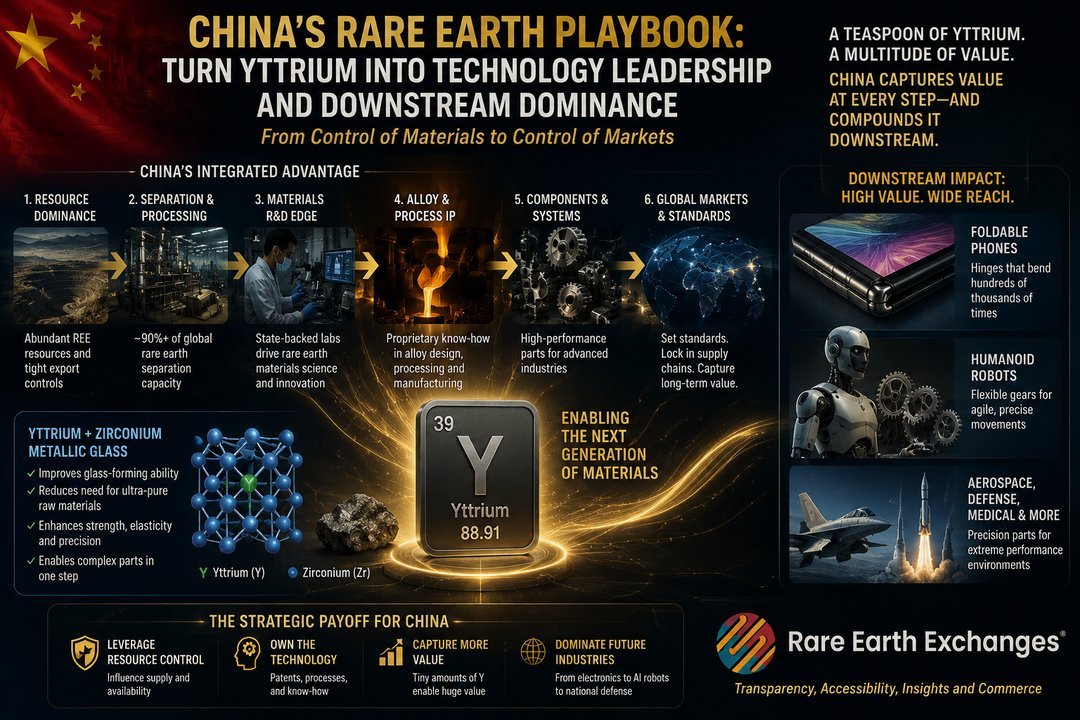
That creates a powerful feedback loop: control the material → experiment with the material → patent processes → commercialize components → capture substantially more value downstream. Metallic glass offers a revealing example. Peer-reviewed research confirms that very small yttrium additions can scavenge oxygen and substantially improve the glass-forming ability of zirconium alloys, potentially reducing reliance on costly ultra-pure production conditions. The rare earth therefore becomes an enabling ingredient, not necessarily the expensive part of the finished product.
That distinction matters strategically. China can monetize the same resource repeatedly—first through separation, then alloying knowledge, process IP, specialized equipment, components, and eventually finished products such as robots and electronics.
For the West, building another rare-earth mine does not reproduce this ecosystem. Supply-chain competition increasingly moves into the laboratories and factories where rare-earth properties are converted into defensible intellectual property and high-margin products.
A Little Yttrium Goes a Long Way
The Chinese report traces the team's work to 2000 and says it has developed capabilities spanning material design, processing, equipment, and industrial application. Foldable-phone hinge components are reportedly already using the material, with humanoid-robot flexible gears under trial.
But important blanks remain: no customers, production volumes, pricing, cost reduction, patents attributable to these applications, or independently verified commercial performance are disclosed. "Internationally leading" should be treated as a state-industry claim, not an independently established conclusion.
REEx Disclosure: The underlying news originates from media associated with a Chinese state-owned enterprise. Commercialization, market-leadership, and performance claims should be independently verified.


0 Comments
No replies yet
Loading new replies...
Moderator
Join the full discussion at the Rare Earth Exchanges Forum →