
Highlights
- Tiejie Logistics and Wuchan Zhongda signed a strategic pact targeting border hubs, cross-border corridors, shared warehousing, and multimodal freight for bulk commodities.
- No investment amounts or volume commitments were disclosed, but the agreement signals China's push to integrate mineral flows from mine to final delivery.
- The deal aligns with Beijing's broader strategy to make critical mineral movement more efficient, traceable, and potentially more controllable.
- Baogang's ties to China Northern Rare Earth make the logistics expansion strategically significant for rare earth supply chains beyond China's borders.
- Western policy analysts warn that China's leverage now extends beyond raw materials to the financial, storage, and transportation infrastructure surrounding them.
Baogang is building the arteries behind its materials business. Baogang-affiliated Tiejie Logistics has signed a strategic cooperation agreement with Wuchan Zhongda Logistics Investment Group, targeting border logistics hubs, cross-border transportation corridors, bulk-commodity supply chains, shared warehousing and freight capacity. The agreement contains no disclosed investment amount or firm volume commitments. But the strategic direction is notable: the companies intend to create more integrated door-to-door cross-border logistics for minerals and other bulk commodities, while combining Tiejie’s resource access with Wuchan Zhongda Logistics’ nationwide network and financial capabilities.
Wuchan Zhongda Logistics Investment Group is a corporate venture and investment subsidiary of Wuchan Zhongda Group (opens in a new tab), a major Chinese state-controlled conglomerate headquartered in Hangzhou, Zhejiang. The firm focuses on strategic investments, asset management, and infrastructure development within the logistics and supply chain sectors.
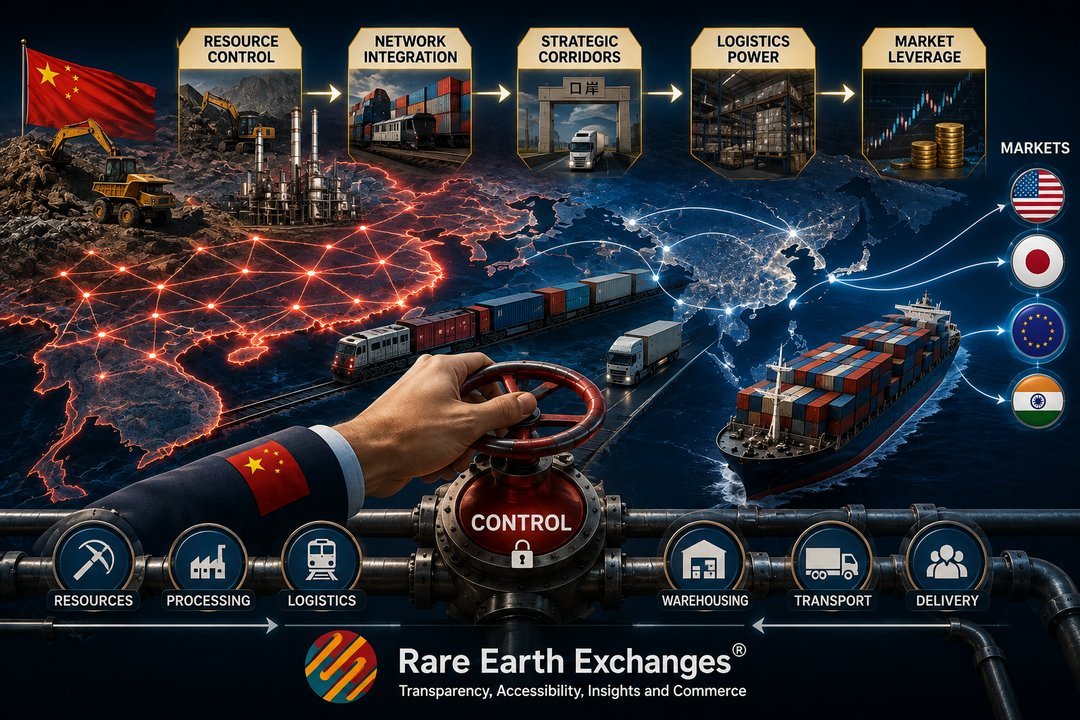
REEx Insight — China Tightens the Arteries of the Critical-Minerals System
The Tiejie–Wuchan Zhongda agreement appears consistent with a broader Chinese effort to tighten the physical organization, visibility and efficiency of critical-mineral flows—linking border hubs, regulated warehouses, transportation capacity, financing and final delivery into a more integrated system. It does not itself impose new controls on rare-earth shipments, and the announcement does not specify rare earths. But viewed alongside Beijing's existing export-licensing regime—which has already sharply constrained shipments of certain heavy rare earths to markets including Japan and the United States—the direction is strategically significant.
So what we are suggesting here is that China is not only strengthening its ability to produce and process critical minerals; it is building infrastructure that could make their movement more efficient, traceable and potentially more controllable. For Western markets, that raises the stakes: China's leverage drivers increasingly encompasses not just the material itself, but the industrial arteries through which strategic materials move.
From the Mine to the Customer's Door
The companies plan to jointly develop regulated warehouses for bulk commodities and integrated cross-border logistics capable of providing end-to-end, door-to-door service.
For minerals and other commodities, they intend to build more stable supply chains while dynamically sharing warehouse capacity and optimizing transportation resources.
They also plan to jointly develop multimodal transportation products, potentially combining rail, road and other freight channels to lower logistics costs.
Borders Become Strategic Infrastructure
The agreement specifically calls for expanding cross-border logistics corridors and port-of-entry logistics hubs, while cooperating on final delivery and expansion into emerging markets.
For Baogang's broader industrial ecosystem, better logistics could support movement of mineral feedstocks into China and manufactured or processed products outward—although the announcement does not identify specific commodities, countries, routes or customers.
The reference to mineral resources is nevertheless important given Baogang's central position in China's rare-earth industry through its relationship with China Northern Rare Earth.
The Western Takeaway — Build Networks, Not Islands
The significance is infrastructure, and potentially control. Western critical-mineral policy frequently evaluates mines, processing plants and magnet factories individually. China's model increasingly demonstrates the advantages of treating them as components of an integrated commercial system.
Control of materials becomes more powerful when paired with control of how those materials are financed, stored, transported, processed and delivered.
Source Disclaimer: This news item is based on a report published by Baogang Daily, the media outlet of state-owned Baogang Group. Statements concerning the partnership, capabilities and expected benefits originate from the state-owned enterprise's media and should be independently verified. No investment value, commodity volumes, specific international corridors or binding commercial commitments were disclosed.


0 Comments
No replies yet
Loading new replies...
Moderator
Join the full discussion at the Rare Earth Exchanges Forum →