
Contents
Rare earth minerals are ores containing the 17 rare earth elements — the 15 lanthanides on the periodic table plus scandium and yttrium. They are used in magnets, batteries, screens, lasers and defense systems. Despite the name, they are not rare in the ground. What is rare is the ability to separate them.
That last sentence is the part almost nobody explains, and it is why headlines about new discoveries keep failing to change anything. A country can hold enormous reserves, mine none of them, and still be nowhere near producing a usable kilogram of separated oxide. Reserves, production and separation capacity are three different things, and they sit in different countries.
This guide covers all 17 elements and what each one does, where the reserves actually are, who can process them, and what they cost — with every figure sourced and dated so you can check it.
Rare earth elements list: all 17
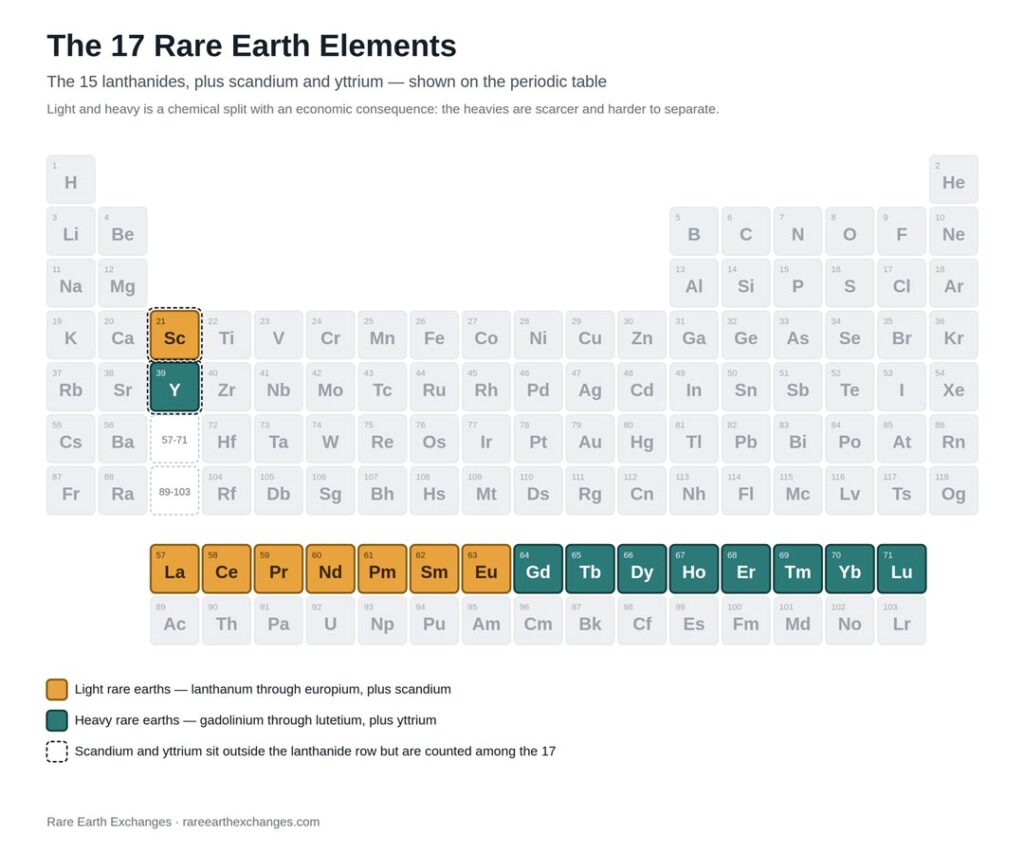
There are 17 rare earth elements: the 15 lanthanides plus scandium and yttrium. The lanthanides run from atomic number 57 through 71. Scandium and yttrium are included because they turn up in the same deposits and behave much like the lanthanides chemically, which is also why they are so hard to tell apart during processing.
Two words get mixed up constantly, so it is worth separating them. A rare earth element is the metal itself. A rare earth mineral is the rock it comes out of. Four ore types carry most of the world's supply: bastnäsite, monazite, xenotime and ion-adsorption clays. The clays matter more than their share of tonnage suggests, because they are unusually rich in the heavy rare earths.
| Element | Symbol | Atomic number | Light or heavy | Main use |
|---|---|---|---|---|
| Scandium | Sc | 21 | Light | Aluminum-scandium aerospace alloys, solid oxide fuel cells |
| Yttrium | Y | 39 | Heavy | Phosphors, high-temperature ceramics, superalloys |
| Lanthanum | La | 57 | Light | Refinery catalysts, optical glass, NiMH batteries |
| Cerium | Ce | 58 | Light | Glass polishing powders, catalytic converters |
| Praseodymium | Pr | 59 | Light | Magnet alloys, aircraft engine components |
| Neodymium | Nd | 60 | Light | Permanent magnets |
| Promethium | Pm | 61 | Light | Radioactive; research and specialist power cells only |
| Samarium | Sm | 62 | Light | Samarium-cobalt magnets that tolerate heat |
| Europium | Eu | 63 | Light | Red and blue phosphors in displays and lighting |
| Gadolinium | Gd | 64 | Heavy | MRI contrast agents, neutron shielding |
| Terbium | Tb | 65 | Heavy | Magnet additive, green phosphors |
| Dysprosium | Dy | 66 | Heavy | Magnet additive for heat resistance |
| Holmium | Ho | 67 | Heavy | Surgical and industrial lasers |
| Erbium | Er | 68 | Heavy | Fiber-optic signal amplifiers |
| Thulium | Tm | 69 | Heavy | Portable X-ray sources, lasers |
| Ytterbium | Yb | 70 | Heavy | Fiber lasers, alloy strengthening |
| Lutetium | Lu | 71 | Heavy | PET scanner detectors, catalysts |
Light vs heavy rare earths — and why the heavies are the problem
The split follows ionic radius and how the 4f electron shell fills, not atomic weight — which is why yttrium sits with the heavies despite being the lightest of the seventeen. Lanthanum through europium are the light rare earths; gadolinium through lutetium, plus yttrium, are the heavy rare earths. Conventions differ at the boundary: some classifications place europium with the heavies, and scandium is sometimes excluded from both groups. We follow the split used across our element pages.
The line is drawn on chemistry, but the consequence is economic. Heavy rare earths occur in fewer deposits, at lower grades, and they are harder to separate. Two of them do most of the work: dysprosium and terbium, both added in small quantities to magnets so they continue to work at high temperatures. A motor without them fails in the heat of an engine bay. That is why a supply problem measured in hundreds of tonnes can stall production measured in millions of vehicles.
Why "rare earth" is a misleading name
No — rare earth minerals are not rare. Cerium is more abundant in the Earth's crust than copper. Neodymium is more common than tin. Even the scarcer heavy rare earths are not unusual by the standards of metals nobody thinks of as exotic. The one genuine exception is promethium, which is radioactive and effectively absent from the crust.
The name is a holdover from 18th-century chemistry. "Earths" meant oxides, and these particular oxides were rare in the sense that chemists could barely obtain them in pure form — not because the material was scarce, but because nothing available could pull the elements apart from each other.
That is still the problem. The scarcity was never in the ground. It was, and remains, in the separation.
What rare earth minerals are used for
Lists of rare earth applications tend to be long and misleading. Yes, these elements appear in an enormous range of products. But the demand that moves markets is concentrated in a handful of uses, and magnets dominate them. Most of the value in a tonne of mixed rare earth oxide lies in a few elements; the rest is more of a by-product you have to find a home for.
| Application | Elements involved | Why substitution is hard |
|---|---|---|
| Permanent magnets | Neodymium, praseodymium, dysprosium, terbium, samarium | Alternatives are larger, heavier or weaker; motor and generator designs are built around the performance |
| Refinery and vehicle catalysts | Lanthanum, cerium | Substitutes exist but reduce yield or shorten catalyst life |
| Display and lighting phosphors | Europium, terbium, yttrium | Emission wavelengths are element-specific; color accuracy depends on them |
| Glass polishing | Cerium | Cheaper abrasives scratch precision optical surfaces |
| Rechargeable batteries | Lanthanum, cerium | Largely displaced by lithium chemistries; still used in hybrid vehicle packs |
| Medical imaging | Gadolinium, lutetium | Contrast and detector performance are tied to specific nuclear properties |
| Fiber-optic amplifiers | Erbium | Amplifies at the exact wavelength long-haul networks run on |
Magnets — where most of the demand actually is
Neodymium-iron-boron magnets are the reason rare earths are a strategic issue rather than an industrial curiosity. They deliver more magnetic force per unit of mass than anything else in commercial production. That single property is what allows an electric motor to be small enough to fit inside a wheel, a wind turbine to run without a gearbox, and a phone to vibrate without a bulky mechanism.
Neodymium and praseodymium do the main work, usually as a combined NdPr oxide. Dysprosium and terbium are added in smaller amounts to hold performance at temperature. Samarium-cobalt magnets handle the highest-temperature applications, which is why they persist in defense and aerospace despite costing more.
Substitution research is real and continuing, and some of it is promising. None of it has yet displaced NdFeB at scale in the applications that consume the most tonnage.
Defense systems
Fighter aircraft, submarines, radar arrays, precision guidance and targeting systems all contain rare earth magnets and phosphors. The quantities are small — defense consumes a minor fraction of world rare earth output — and that is exactly what makes it awkward. A small, specialised requirement with no substitute and a concentrated supply chain is harder to fix than a large one, because no commercial buyer has an incentive to build redundant capacity for it.
We covered the specific systems and their dependencies in more detail in rare earth elements in defense technology.
Where rare earth minerals are found — reserves by country
The table below puts reserves and production side by side, because reading either one alone produces a badly wrong picture of who controls what.
| Country | Mine production (t REO) | Share of world production | Reserves (t REO) | Share of reported reserves |
|---|---|---|---|---|
| China | 270,000 | 69.2% | 44,000,000 | 51.6% |
| United States | 51,000 | 13.1% | 1,900,000 | 2.2% |
| Australia | 29,000 | 7.4% | 6,300,000 | 7.4% |
| Burma | 22,000 | 5.6% | Not available | — |
| Thailand | 4,800 | 1.2% | Not available | — |
| India | 2,900 | 0.7% | Not available | — |
| Madagascar | 2,700 | 0.7% | Not available | — |
| Russia | 2,600 | 0.7% | 3,800,000 | 4.5% |
| Brazil | 2,000 | 0.5% | 21,000,000 | 24.6% |
| Nigeria | 1,500 | 0.4% | Not available | — |
| Vietnam | 150 | 0.0% | 3,500,000 | 4.1% |
| Malaysia | 110 | 0.0% | 710,000 | 0.8% |
| Canada | Zero | — | 830,000 | 1.0% |
| Greenland | Zero | — | 1,500,000 | 1.8% |
| South Africa | Zero | — | 860,000 | 1.0% |
| Tanzania | Zero | — | 890,000 | 1.0% |
| Other | 550 | 0.1% | Not available | — |
| World total | 390,000 | 100% | >85,000,000 | 100% of reported |
Three things in that table deserve more attention than they usually get.
Brazil's reserve share and its production share are not remotely the same number. Compare its two rows in the table: a large fraction of reported world reserves against a sliver of world output. Nothing about the geology explains that gap. It is a question of processing, capital and time.
China's production quota is a quota. USGS footnotes the Chinese figure as a production quota that does not include undocumented production, which means the real number is a floor rather than a measurement.
Several producers' output is estimated from Chinese import data. USGS says so directly, and the note covers Burma, Madagascar, Malaysia, Thailand and Vietnam. Burma is a major producer whose tonnage is measured by what crosses the Chinese border, which tells you something about where that material goes and who counts it.
Reserve figures also carry more definitional freight than they appear to. USGS footnotes Australia's reserves under the stricter JORC reporting standard at substantially less than the figure carried in its own main table. Same rock, different rulebook.
The United States
The United States is an unusually clean illustration of why reserves are the wrong thing to look at. It holds a small share of reported world reserves and accounts for a much larger share of world mine output, as the table above shows.
Read that as a reporting quirk before reading it as an achievement. Reserves are only booked where somebody has drilled and filed, and one operating mine does most of the booking here; USGS puts US measured and indicated resources well above the reserve figure it publishes. The mined tonnage is also reported as oxide contained in concentrate, not as separated product — the same unit slippage worth watching everywhere else in this market.
Mountain Pass in California is the mine doing that work. It extracts ore and produces concentrate, and it has been building out separation on site — but for years the concentrate crossed the Pacific to be separated, because that was where the capacity was. Domestic output of separated compounds and metals remains a fraction of domestic concentrate production, and the gap is widest for the heavy rare earths, where US separation of dysprosium and terbium at commercial scale is closer to an ambition than an industry.
Which is why the country still imports most of the processed material it consumes, and why the origins of those imports are worth looking at closely.
| Source of US imports | Share of rare earth compounds and metals |
|---|---|
| China (including Hong Kong) | 71% |
| Malaysia | 13% |
| Japan | 5% |
| Estonia | 5% |
| Other | 6% |
Malaysia, Japan and Estonia are not mining countries in any meaningful sense. They are places where separation happens. Read the table as a map of processing capacity rather than of geology, and the shape of the problem becomes obvious: what the United States is short of is not ore.
For the companies working on this, see our breakdown of the best rare earth mining companies in the USA, and our coverage of test mining at Halleck Creek in Wyoming.
China
China's position is usually described with a single percentage, which flattens three separate facts. Its share of reported reserves, its share of mined output, and its share of refining are three different numbers — and they get larger as you move downstream.
| Stage of the value chain | China's share |
|---|---|
| Mined production of magnet rare earths | 60% |
| Refined output of magnet rare earths | 91% |
| Sintered permanent magnet production | 94% |
That progression is the whole argument of this article in three rows. Mining is the stage where China's grip is loosest and the one that gets the coverage. Refining is where the grip tightens, and magnet-making tighter still. A country that broke China's mining share tomorrow would have changed the least important of the three numbers.
The trade data says the same thing from the demand side. A country that mines a large share of the world's rare earth ore still sourced most of its imported compounds and metals from China across the period in the table above. That is what a refining bottleneck looks like from the outside.
The position was built deliberately and over decades: process chemistry refined through long practice, a willingness to absorb the waste streams separation produces, and patience with payback periods that Western capital markets would not have funded. That combination is why it has not been unwound quickly, and why announcements alone do not unwind it.
Reserves are not production, and production is not separation
This is the distinction the rest of the coverage skips, and almost every confused rare earth headline traces back to it. There are three stages, and clearing one tells you very little about the next.
- Reserves in the ground. Rock that has been drilled and assayed and judged economic to extract under current conditions. This is a geological and accounting statement. It commits nobody to anything.
- Mining and concentration. Digging the ore and upgrading it into a concentrate. Capital-intensive, permit-heavy, and slow, but well understood. Plenty of countries can do this.
- Separation into individual high-purity oxides, and then into metals and alloys. This is where the bottleneck lives, and it is a different order of difficulty from the first two.
The reason stage three is so hard comes down to chemistry. Adjacent rare earths are nearly identical in the ways that matter for separating them. The standard method, solvent extraction, exploits a tiny difference in how each element partitions between two liquids — and for some neighboring pairs that ratio sits barely above one. So the process is repeated. A single high-purity split can take dozens of extraction stages plumbed in series; a full flowsheet separating the whole suite runs to hundreds, each stage a tank of churning liquid feeding the next.
A separation plant is therefore not a construction project with a ribbon-cutting. It is a chemistry program with a construction project attached, and the tuning takes years after the concrete has cured. Lynas built the reference case for this outside China, and the run from investment decision to reliable output took the better part of a decade. It is worth being precise about where that decade went, because a good deal of it went into licensing fights over what to do with the radioactive residue the process leaves behind. We list waste tolerance above as one of the advantages China built for itself. The Lynas timeline is what the same problem costs when a regulator and a public are asking questions — and that is a cost worth paying, not a reason the West cannot compete.
Which produces the outcome that ought to be the default frame for reading any rare earth announcement: a country can hold world-class reserves, open a mine, celebrate the milestone, and still ship its concentrate to China to be separated. Mountain Pass did exactly that for years — American ore, mined in America, sent across the Pacific and bought back as oxide.
The same standard has to apply to the projects the West is rooting for. A Western deposit with a large resource estimate and no separation route attached is in the same position as any other deposit with no separation route attached. Being on the right side of a supply chain argument does not separate neodymium from praseodymium. Ask of any project, in order: are there reserves, is anyone mining them, and can anyone separate what comes out. Most announcements answer the first question and let you assume the other two.
Our reporting keeps running into the same wall from different directions. Vietnam banned raw exports to force processing onshore and found that reserves alone do not deliver separation. The West collects feedstock it cannot refine. Researchers keep locating the value in the midstream rather than the mine. And a French company few people have heard of may matter more to Western supply than several far larger deposits, because it is building the stage everyone else skips.
What rare earth minerals cost — and why the price is hard to see
There is no exchange for rare earths. No ticker, no daily settlement, no public order book of the kind that exists for copper or aluminum. Prices come from assessment services that survey transactions and publish an estimate, and from contract terms that the parties usually do not disclose. Two credible sources can print different numbers for the same oxide in the same week, and both can be defensible.
| Oxide | Average price, US$ per kilogram |
|---|---|
| Lanthanum oxide, 99.5% minimum | $1.00 |
| Cerium oxide, 99.5% minimum | $1.71 |
| Samarium oxide, 99.5% minimum | $2.82 |
| Mischmetal, 65% cerium / 35% lanthanum | $5.62 |
| Europium oxide, 99.99% minimum | $27 |
| Gadolinium oxide, 99.99% minimum | $30 |
| Neodymium-praseodymium (NdPr) oxide, 99% minimum | $69 |
| Neodymium oxide, 99.5% minimum | $73 |
| Praseodymium oxide, 99.99% minimum | $74 |
The spread in that table is the most useful thing in it. The oxides at the top and bottom differ by orders of magnitude, not percentages. Talking about the price of "rare earths" as a category is close to meaningless — a producer's economics depend almost entirely on which elements its deposit is rich in, and a deposit loaded with cerium and lanthanum is a very different business from one loaded with neodymium and dysprosium.
It is also worth noticing where the figures above come from. A US government publication is the freely available source for rare earth prices, and it credits a commercial assessment service for the underlying data. The assessments that Western buyers actually contract against sit behind subscriptions. The public record is an annual average, published once a year, for a market that moves on export-control announcements. That is not a gap anyone created deliberately. It is what happens when a strategically important market has no exchange behind it.
Which is why prices here move on policy rather than on consumption. Quotas, export licensing, stockpile decisions and trade measures reprice this market faster than any change in how many motors the world is building. Anyone quoting a rare earth price without saying who assessed it, on what basis and as of when is not telling you enough to act on. We have written separately on the emergence of an ex-China pricing index, which is an attempt to fix exactly this.
Frequently asked questions
Does the United States have rare earth minerals?
Yes, and it mines a lot of them. The United States holds a small share of reported world reserves but accounts for a much larger share of world mine production — see the reserves and production table above, sourced from USGS. The gap is downstream: US mines produce far more concentrate than the country turns into separated compounds and metals, and most of the processed material it consumes is imported. Having the rock and having the supply chain are different things.
Which country has the most rare earth minerals?
China holds the largest reported reserves, and Brazil also holds a very large share. But reserves and output do not track each other — Brazil holds a substantial fraction of reported world reserves and produces a tiny fraction of world output. Read the reserves column and the production column in the table above as two separate questions, because that is what they are.
Is gold considered a rare earth mineral?
No. Gold is a precious metal and is not part of the rare earth group. The 17 rare earths are the 15 lanthanides plus scandium and yttrium, defined by where they sit on the periodic table and how they behave chemically, not by how valuable they are.
What is so special about rare earth metals?
Their magnetic and optical properties. A neodymium magnet delivers far more magnetic force per unit of mass than the alternatives, which is why small, powerful motors depend on it. Several rare earths also emit light at very specific wavelengths, which is what makes them useful in displays, lasers and medical imaging. In most of these roles there is no drop-in substitute that performs as well.
Where do most rare earth minerals come from?
It depends which question you are asking. For mined ore, China is the largest producer by a wide margin, followed by the United States and Australia. For refined output the concentration is far higher, and higher again for finished magnets — see the value chain table above, sourced from the IEA. Most US imports of processed compounds and metals come from China, with Malaysia, Japan and Estonia supplying much of the remainder. Those three are separation and processing locations, not major mining countries.
Are rare earth minerals actually rare?
No. Cerium is more abundant in the Earth's crust than copper, and several other rare earths are more common than metals nobody calls rare. They are difficult to find in concentrations worth mining, and much harder to separate from one another once mined. The name describes an 18th-century chemistry problem, not present-day geology.
How do I invest in rare earths?
Most retail exposure runs through mining equities or sector funds, and the funds vary widely in what they actually hold. Our breakdown of the main options is here: Best Rare Earth ETFs. This is analysis, not investment advice.
The short version
Rare earth minerals are neither rare nor exotic. There are 17 elements embedded in ordinary rock across dozens of countries, and finding them has never been the hard part.
The hard part is separation — pulling 17 chemically similar metals apart into pure oxides, at scale, at a price somebody will pay. That capacity is concentrated in one country, and no volume of new mining announcements changes it until somebody builds the back end.
So when the next major discovery makes the news, ask the three questions in order: are there reserves, is anyone mining them, and can anyone separate them? The third answer is the one that matters, and it is the one the press release usually leaves out.
A good place to start is the element you care about most. Each of the 17 has its own profile with production, supply risk, and application data; browse the rare earth element pages.
Rare Earth Exchanges publishes independent analysis. This article is not investment advice. We receive no compensation from any company, fund or issuer named here. Prices, production figures and reserve estimates change; verify current figures with the primary sources linked above and speak with a licensed financial adviser before making any investment decision.
