
Highlights
- China's industrial output rose 4.5% YoY in July while retail sales grew just 0.6%, exposing a deep supply-demand imbalance.
- High-tech manufacturing surged 16.9% and industrial robot output jumped 30.2%, intensifying pressure to find export markets.
- Rare earth diplomacy may become a key bargaining chip in a broader Trump-Xi deal linking mineral access to U.S. market entry for Chinese goods.
- Resource-rich nations are demanding technology transfer and value-chain stakes, making commodity access costlier for Beijing in Great Powers Era 2.0.
- Neither the U.S. nor China can fully achieve its economic goals alone—rare earth markets are now at the center of great-power competition.
A striking Chinese financial op-ed identifies perhaps the most important contradiction in China’s economy: “strong supply, weak demand.” China has built extraordinary manufacturing capacity, particularly in electric vehicles (EVs), electronics, artificial intelligence (AI), robotics, and advanced equipment, but Chinese households and private businesses are not generating enough demand to absorb it. Rare Earth Exchanges® (REEx) sees the consequence extending directly into Great Powers Era 2.0™: Beijing must stimulate consumption at home while finding larger markets abroad. That makes access to the United States—and the rare earth leverage surrounding U.S.-China negotiations—economically more important than commonly appreciated. China has become extraordinarily good at making things. Its emerging problem is finding enough people willing—or able—to buy them.
REEx Insight: The Factory Has to Sell Somewhere
Writing in Sina Finance (opens in a new tab), Yuekai Securities chief economist Luo Zhiheng (opens in a new tab), with Ma Jiajin, calls China's condition “—strong supply, weak demand.” The numbers support the diagnosis: July industrial output rose 4.5% year over year, while retail sales increased only 0.6%; fixed-asset investment fell 6.7% during January-July. China's own National Bureau of Statistics confirms those figures.
Yet underneath the weakness, China's technological machine is accelerating. High-tech manufacturing grew 16.9%, digital-product manufacturing 17.3%, and industrial robot output 30.2%.
Luo Zhiheng, Yuekai Securities

Source: Sina Finance
And here lies the contradiction. Years of ferocious domestic competition—“involution” on an industrial scale—have forced Chinese manufacturers to cut costs, improve products, and fight for survival. The winners emerge extraordinarily competitive. But when domestic demand cannot absorb their production, that competitive machine turns outward, to the world. EVs are the obvious example. Rare earth magnets, robotics, batteries, solar, electronics, and increasingly AI-enabled industrial equipment may follow.
Beijing's Two-Pump Strategy
China's 15th Five-Year Plan attacks the problem partly by creating new domestic demand as Rare Earth Exchanges® has continued to analyze: modern metropolitan areas, green infrastructure, digitally transformed cities, AI applications, robotics, intelligent manufacturing, and emerging industries. It explicitly calls for modern metropolitan development, greener cities, and economy-wide “AI+” deployment.
But Beijing is simultaneously emphasizing external demand. Premier Li Qiang this week called for stabilizing foreign demand and expanding international trade cooperation. REEx believes investors should connect this directly to rare earth diplomacy.
A future Trump-Xi bargain (possibly this September) could involve more than China's loosening of rare earth and magnet restrictions and America's concessions on technology or tariffs. Beijing has a powerful incentive to secure greater U.S. purchases of Chinese goods. Rare earth leverage could therefore become one bargaining chip in a much larger negotiation over market access. Recent U.S.-China talks already link rare earth commitments with Chinese purchases of American goods.
The Contradiction Inside the Miracle
There is another side. China's increasingly top-down political economy may mobilize capital spectacularly—but excessive state direction can also weaken entrepreneurial confidence, discourage risk-taking, and perpetuate investment where political priorities outrun market demand.
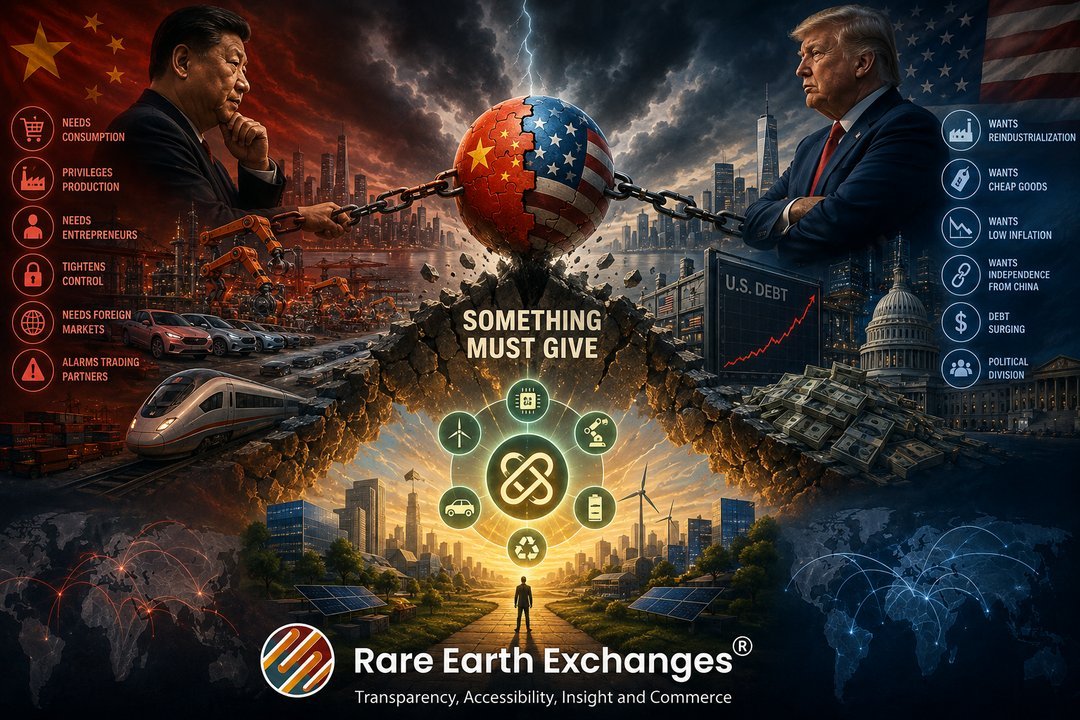
That is the dialectic Communist Party leaders may be reluctant to acknowledge: China needs entrepreneurs willing to challenge convention even as political control tightens; it needs consumers to spend while the system continues to privilege production; and it needs foreign markets more than ever just as its industrial power increasingly alarms the countries expected to absorb its exports. Great Powers Era 2.0 adds another contradiction. REEx predicts that China will increasingly discover that securing the commodities feeding its industrial machine is no longer simply a matter of writing checks, financing infrastructure, and signing long-term contracts.
Resource-rich nations are awakening to the strategic value beneath their soil. They want processing, technology transfer, skilled jobs, intellectual property, and a larger share of the value chain (the same model China followed more or less)—while the United States, Japan, Europe, and other powers arrive with competing capital and security partnerships. The old game was access to commodities. The new game is a contest over who controls what those commodities become. For Beijing, accustomed to turning mineral access into industrial dominance, Great Powers Era 2.0™ could make the world a considerably more expensive—and contested—place to feed the Chinese factory. Inflationary pressures are certainly real.
America carries its own bundle of contradictions. It wants to reindustrialize without paying substantially more for what it consumes; break dependence on Chinese supply chains while keeping inflation subdued; spend strategically at home while an already immense federal debt continues climbing under Trump 2.0; and confront Beijing without severing the commercial arteries connecting the world's two largest economies. As Britain's Rolling Stones famously reminded us, “You can't always get what you want.” Washington, however, intends to try—and try hard. Tariffs, industrial policy, strategic capital, mineral diplomacy, and the sheer gravitational pull of the American consumer will all be deployed in the contest.
And be careful betting against America. Tocqueville recognized nearly two centuries ago the country's unusual “inventive power of mind.” The names and technologies change, but the underlying American impulse—to build, trade, gamble on an idea, fail, finance another one, and build again—has proved remarkably difficult to extinguish, leading to the most notable experiment in world history.
China's extraordinary rise, paradoxically, was itself made possible to a considerable degree by the American-led post-World War II order—open sea lanes, expanding global trade, Western capital and technology, and eventually access to the enormous American consumer market. Beijing mastered that system, exploited its opportunities, and ultimately became powerful enough to challenge parts of the architecture that helped enable its ascent.
Unprecedented Times Ahead
Great Powers Era 2.0 marks the transition away from that comparatively frictionless age. Commodities become strategic assets; supply chains become instruments of statecraft; factories become national-security infrastructure; and access to minerals, technology, and markets increasingly carries a geopolitical price.
Yet investors should be equally careful about extrapolating American decline. The United States enters this new era burdened by debt, political division, and decades of industrial erosion—but also possessing deep capital markets, world-leading universities and technology companies, enormous energy and resource endowments, powerful alliances, and something more difficult to quantify: an unusually restless and relentless entrepreneurial culture.
And therein lies the defining tension of Great Powers Era 2.0. Beijing cannot indefinitely manufacture its way around weak domestic demand; Washington cannot effortlessly borrow, tariff, and subsidize its way back to industrial supremacy. China needs America's consumers even as it challenges American power. America needs pieces of China's industrial ecosystem even as it races to escape them. Neither system is likely to get everything it wants. Something will have to give, somewhere. For rare earth investors, this is no longer geopolitical scenery painted behind the market. It is the market.


0 Comments
No replies yet
Loading new replies...
Moderator
Join the full discussion at the Rare Earth Exchanges Forum →