
Highlights
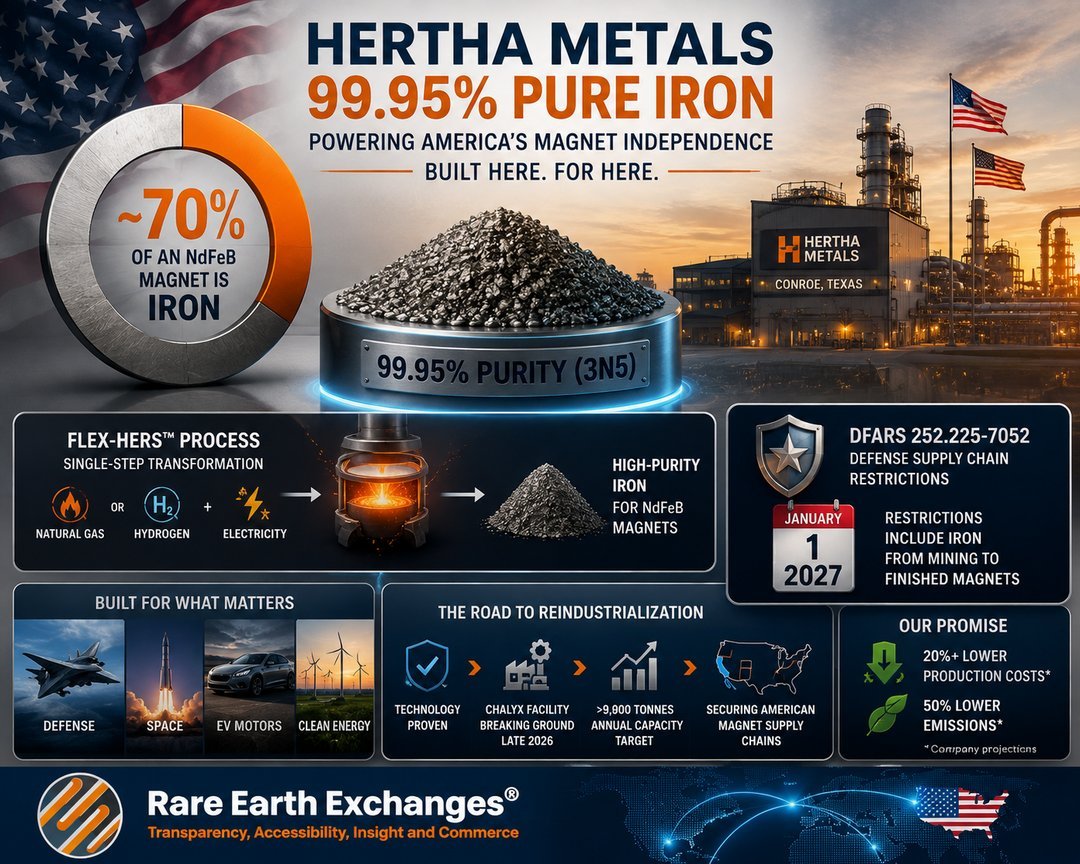
- Hertha Metals achieved 99.95% pure (3N5) iron from domestic inputs at its Conroe, Texas demonstration facility using its coal-free Flex-HERS process.
- Roughly 70% of an NdFeB magnet by mass is iron, yet domestic high-purity iron supply has been largely overlooked in U.S. rare-earth magnet policy.
- DFARS 252.225-7052 mandates that from January 2027, defense NdFeB magnets must trace their entire supply chain—including iron—back to compliant sources.
- Hertha's planned Chalyx facility targets over 9,000 tonnes of high-purity iron annually, though groundbreaking, customer qualification, and financing milestones remain ahead.
- The company claims its process cuts production costs by 20% and emissions by 50%, but these figures are unvalidated projections until proven at commercial scale.
America’s rare-earth magnet problem contains an unlikely bottleneck: iron. Texas-based Hertha Metals (opens in a new tab) says it has produced 99.95% pure iron (3N5) from domestic inputs at its Conroe demonstration facility, targeting the high-purity feedstock required by neodymium-iron-boron (NdFeB) magnet manufacturers. The timing matters. Beginning January 1, 2027, U.S. defense procurement restrictions reach deep into the NdFeB supply chain—including the mining and processing provenance of iron itself.
REEx Insight: Rare Earths Aren’t the Whole Magnet
The irony is hiding in plain sight: roughly 70% of an NdFeB magnet by mass is iron.
Washington is spending billions securing neodymium, praseodymium, and magnet manufacturing, but compliant iron matters too. DFARS 252.225-7052 specifies that from January 2027, restrictions for NdFeB magnets encompass the supply chain from mining of neodymium, iron, and boron through finished magnets, subject to specified exceptions.
Hertha therefore targets an overlooked piece of the Western magnet puzzle.
Its Flex-HERS™ process (opens in a new tab) uses natural gas or hydrogen plus electricity to convert iron feedstock into iron or steel in a single process. Hertha has separately demonstrated continuous one-tonne-per-day operation at Conroe—important evidence of process scale, although not proof that 3N5 iron has yet been continuously produced at that rate.
Leading the Reindustrialization of America—CEO Dr. Laureen Meroueh

3N5 Clears One Gate—Several Remain
Achieving 99.95% purity is meaningful. It is not the same as commercial qualification.
Hertha says its planned Chalyx facility will supply high-purity iron to magnet producers and break ground later in 2026. Earlier company disclosures envisioned more than 9,000 tonnes annually, although the project timeline has shifted from an earlier January 2026 groundbreaking target. Now come the milestones investors should watch: customer qualification, binding offtakes, financing, construction, sustained purity at commercial scale, yields, and costs.
Hertha also claims its technology can reduce production costs by more than 20% and emissions by 50%. Those are compelling numbers—but until validated at commercial scale, they remain company projections rather than proven Chalyx economics. The obscure ingredient may be iron. The strategic question is whether Hertha can industrialize it.
Profile
Hertha Metals is a Texas-based industrial technology startup founded in 2022 by MIT-trained engineer Dr. Laureen Meroueh, who serves as CEO. The company is developing Flex-HERS™, a coal-free pyrometallurgical process designed to convert iron ore directly into high-purity iron or steel in a single production step, using electricity with natural gas or hydrogen.
Based in Conroe, Texas, Hertha has raised approximately $17–20 million in early-stage capital, with backing reported from major climate and deep-tech investors including Khosla Ventures, Breakthrough Energy Ventures, Pear VC, and Clean Energy Ventures. Its strategy reaches beyond lower-carbon steel: by producing high-purity iron domestically, Hertha is positioning itself within the emerging U.S. neodymium-iron-boron (NdFeB) permanent-magnet supply chain, an increasingly important intersection of advanced manufacturing, defense, and American reindustrialization.


0 Comments
No replies yet
Loading new replies...
Moderator
Join the full discussion at the Rare Earth Exchanges Forum →