
Highlights
- China's MIIT and NDRC elevated pilot-scale testing into national industrial policy in 2024, targeting 300 local and 20 higher-level platforms by 2027.
- Baotou and Ganzhou operate as city-scale rare earth laboratories, with dozens of pilot lines linking universities, state firms, and capital to accelerate commercialization.
- The model extends beyond rare earths to lithium, tungsten, and germanium, with science funding now explicitly tied to pilot-scale targets.
- China's 2025 export controls on rare earth production-line knowledge signal that pilot infrastructure itself is now a protected strategic asset.
- Chinese agencies acknowledge real friction: funding gaps, approval bottlenecks, talent shortages, and inconsistent disclosure of commercial economics.
China's critical-minerals advantage is usually described as vertical integration: mine, separate, refine, make metals, manufacture magnets and feed them into enormous downstream industries. That is true—but incomplete. Rare Earth Exchanges® research points to another layer hiding between laboratory and factory: a growing network of pilot-scale facilities, demonstration lines and commercialization platforms where processes can fail cheaply, improve quickly and then move toward industrial production. China is increasingly institutionalizing that middle ground.
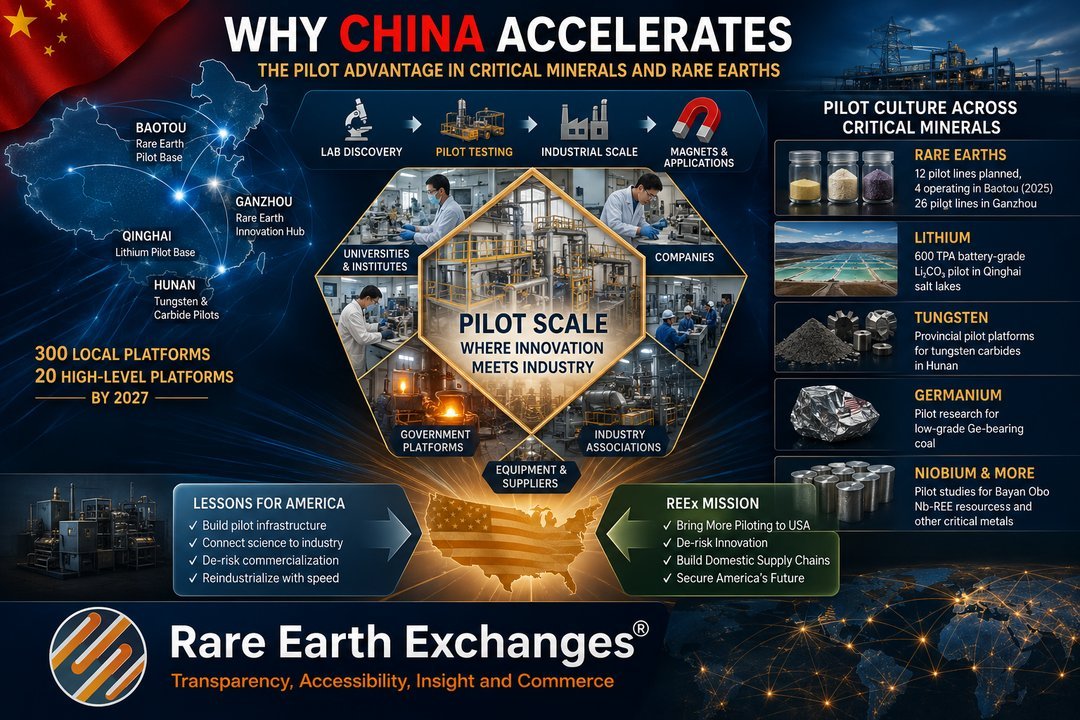
REEx Insight: The Industrialization Layer
China's system is centralized in strategic direction but federated in execution. Beijing sets priorities; provinces and municipalities build platforms; state-owned and private companies supply industrial sites; universities and institutes supply science; innovation centers and industry organizations connect them.
In 2024, the Ministry of Industry and Information Technology and National Development and Reform Commission explicitly elevated zhongshi—or intermediate/pilot testing—into national industrial policy. Their new-materials guide says pilot facilities should solve the problems that appear when laboratory chemistry meets industrial reality: process compatibility, batch stability and cost economics. China's target is roughly 300 local new-material pilot platforms and about 20 higher-level platforms by 2027, with professional construction, market-oriented operation and open services. That is not merely R&D spending. It is infrastructure for learning-by-manufacturing.
Baotou and Ganzhou Become City-Scale Laboratories
Baotou offers perhaps the clearest rare-earth example. In 2025, its Rare Earth New Materials Technology Innovation Center reported 44 research projects across seven fields, 12 pilot demonstration lines planned and four already operating. A Tsinghua University–Northern Rare Earth collaboration built a 10-tonne-per-year rare-earth-tailings biomining demonstration line, with plans to validate thousand-tonne processing.
By 2026, Baotou authorities were calling for Northern Rare Earth to build China's largest rare-earth pilot base, add more than eight pilot lines and publish a citywide directory of pilot resources so facilities could be shared.
Ganzhou shows the southern version. Municipal reporting says its National Rare Earth Functional Materials Innovation Center had initiated 26 patent-based pilot lines; 14 had reached industrialization and 13 high-tech companies had been incubated. The city explicitly describes its model as "technology research → pilot incubation → industrial application," linking the Chinese Academy of Sciences, Jiangxi University of Science and Technology, companies and capital.
Academic work reflects the same engineering culture. A Chinese study by Xiahou Bin and colleagues modeled pilot-scale in-situ leaching of ion-adsorption rare-earth ore using a plant-derived leachant; subsequent English-language reviews and extraction research continue to cite that pilot work in the search for cleaner leaching systems.
Beyond Rare Earths: Lithium, Tungsten and Germanium
The pattern extends across critical minerals. At Qinghai's salt lakes, a 173,400-square-meter pilot base established in 2021 had hosted 11 projects by 2025 and completed nine, including a 600-tonne-per-year battery-grade lithium-carbonate pilot targeting difficult high-magnesium brines. The platform combines corporate infrastructure with universities and the Chinese Academy of Sciences' Qinghai Institute of Salt Lakes.
Hunan has created provincial pilot platforms around tungsten-based cemented carbides, combining Zhuzhou companies, universities and government support. More revealing still, China's National Natural Science Foundation's 2026 critical-metals program explicitly calls for research that leads into pilot tests for weathered tungsten-molybdenum ores, Bayan Obo niobium-rare-earth resources and low-grade germanium-bearing coal, with specified recovery and purity targets. Science funding is being connected directly to scale-up.
The Machine Still Has Friction
This should not be romanticized. China's own agencies acknowledge problems. Qinghai officials report that pilot projects can become trapped in conventional construction approvals, while facilities struggle with high operating costs, limited project flow and shortages of specialized talent. Ganzhou disclosed in 2026 that its National Rare Earth Functional Materials Innovation Center faced an approximately RMB 80 million funding gap and that university-industry coordination remained imperfect.
Nor do announcements of pilot lines prove commercial economics. Capacity, recovery, yield, product qualification and operating cost remain inconsistently disclosed—a caveat Rare Earth Exchanges repeatedly applies when assessing Chinese commercialization claims.
Why China Accelerates
The strategic lesson is larger than any individual pilot plant. China does not wait for a technology to become "commercial" before constructing the ecosystem around it. It builds places where commercialization can be learned. Pilot lines connect scientists to operators, equipment suppliers, feedstock, customers and regulators. Failed approaches generate manufacturing knowledge; successful ones can move immediately into an already-dense supply chain.
And that accumulated know-how is becoming more protected. In October 2025, China imposed export controls covering technologies related to rare-earth mining, separation, metallization, magnet manufacturing and recycling, including production-line assembly and commissioning knowledge.
For Western policymakers and investors, that may be the uncomfortable answer to Why China Accelerates: the competition is not simply over mines or factories. It is over the experimental industrial infrastructure between them—the place where chemistry becomes manufacturing and manufacturing becomes dominance.
Sources and Citations
- MIIT/NDRC, New Materials Pilot Platform Construction Guide, 2024–2027 and official interpretation.
- Baotou Municipal Government / Science and Technology Bureau, rare-earth pilot-platform planning and resource sharing.
- China News Service, Baotou rare-earth innovation center, Tsinghua collaboration and demonstration lines.
- Ganzhou Municipal Government, rare-earth pilot lines and "research–pilot incubation–industrial application" model.
- China National Intellectual Property Administration, Jiangxi University of Science and Technology rare-earth/critical-mineral pilot-line commercialization.
- Xiahou et al., Nonferrous Metals Engineering, pilot experimental research on ion-adsorption rare-earth leaching; Minerals review.
- Golmud Municipal Government, Qinghai salt-lake pilot base and lithium demonstration projects.
- Hunan Department of Industry and Information Technology, tungsten/cemented-carbide pilot platforms.
- National Natural Science Foundation of China, 2026 Critical Metals Metallurgy program.
- China Ministry of Commerce, 2025 rare-earth technology export controls.
- Rare Earth Exchanges, reporting on China's bio-metallurgy base, magnet pilot infrastructure, commercialization platforms and refining ecosystem.


0 Comments
No replies yet
Loading new replies...
Moderator
Join the full discussion at the Rare Earth Exchanges Forum →