
Highlights
- China Northern Rare Earth alone budgeted ~45,000 tonnes of NdPr and Nd metal production in 2025, illustrating the scale gap facing Western competitors.
- Ex-China metallizers like LCM, ASM, MP Materials, and Phoenix Tailings are real but collectively represent only a fraction of global capacity.
- The IEA counts just ~18,000 tonnes of announced ex-China metals and alloys capacity, calling metallization one of diversification's most acute constraints.
- Fluoride-based molten-salt electrolysis at ~1,050°C dominates the process, creating environmental challenges and high barriers to entry for new operators.
- Financing furnaces is achievable; building the metallurgical know-how to run them at production scale must be earned on the industrial clock.
The West is finally building rare-earth mines and the beginning of separation plants (although we have a ways to go), yet another stubborn midstream bottleneck remains: metallization—the conversion of separated rare-earth oxides into metals and alloys suitable for magnets. China produced 91% of refined magnet rare earths in 2024; Rare Earth Exchanges® suggests China also controls roughly 90% of global rare-earth smelting/separation and metal processing. The exact oxide-to-metal share is not independently published, but the concentration is unmistakable.
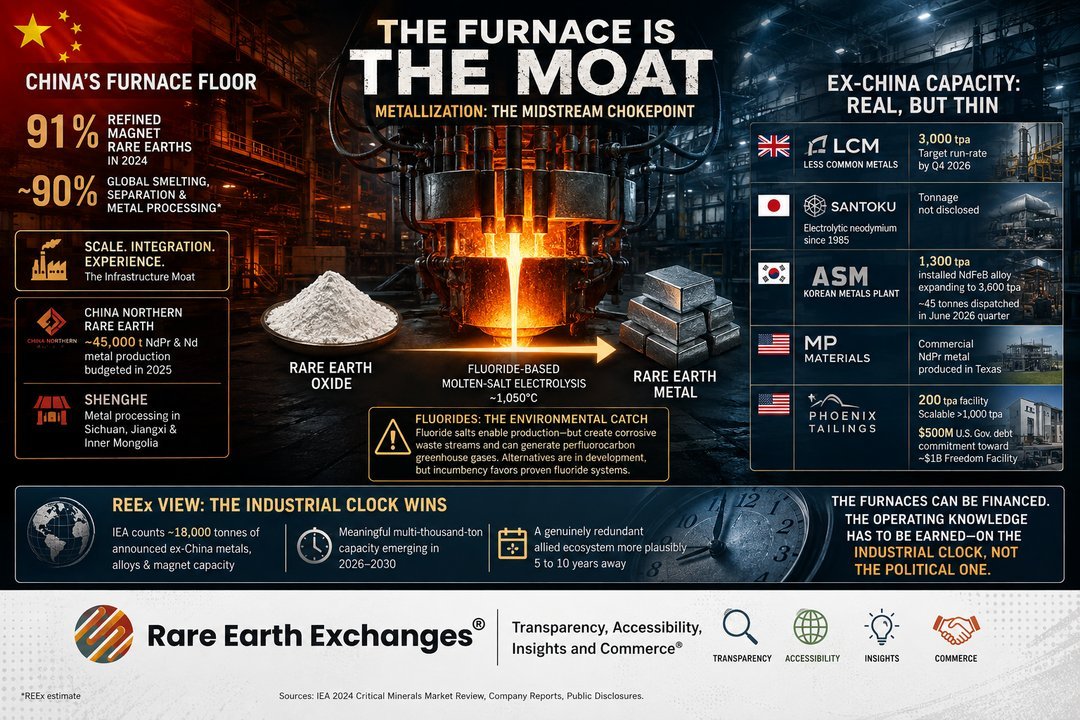
REEx Insight: The Furnace Is the Moat
Metallization is where white oxide powder becomes industrial metal. NdPr oxide is commonly reduced through fluoride-based molten-salt electrolysis at roughly 1,050°C; other rare earths can require metallothermic reduction. Plants need high-current electrolysis cells, refractory systems, carbon anodes, specialty cathodes, furnaces, casting or strip-casting equipment—and metallurgists capable of controlling oxygen and impurities at production scale. REEx has identified electrolysis cells, specialized equipment, and operating know-how as ex-China bottlenecks.
China’s Furnace Floor
Scale explains the moat. China Northern Rare Earth alone budgeted approximately 45,000 tonnes of NdPr and Nd metal production in 2025. Shenghe operates rare-earth metal processing in Sichuan, Jiangxi, and Inner Mongolia. These facilities sit beside equipment suppliers, experienced operators, and enormous domestic magnet demand.
Fluorides: The Environmental Catch
Conventional Nd/Pr electrolysis depends on fluoride-containing molten salts. They introduce corrosive process streams and waste-management requirements; carbon-anode fluoride electrolysis can also generate perfluorocarbon greenhouse gases. Alternative chloride chemistry and inert-anode technologies are being developed, but incumbency still favors proven fluoride systems.
Ex-China Capacity: Real, but Thin
USA Rare Earth’s Less Common Metals (LCM) in Britain is a proven commercial metallizer targeting 3,000 tonnes per year of metal-and-alloy run-rate capacity by Q4 2026, although actual current metal tonnage is not separately disclosed. Japan’s Santoku has made electrolytic neodymium since 1985, but likewise publishes no current tonnage.
Australia Strategic Materials (ASM—not a party of Energy Fuels) Korean Metals Plant has 1,300 tpa installed NdFeB-alloy capacity and is expanding toward 3,600 tpa, yet dispatched only about 45 tonnes of NdFeB alloy and NdPr metal in the June 2026 quarter. Energy Fuels’ acquisition remains scheduled for implementation August 28. Meanwhile, MP Materials already produces commercial NdPr metal in Texas.
Phoenix Tailings opened a 200-tpa New Hampshire metallization facility scalable beyond 1,000 tpa and secured a conditional $500 million U.S. government debt commitment toward its roughly $1 billion Freedom Facility.
REEx View: The Industrial Clock Wins
The IEA counts only about 18,000 tonnes of announced ex-China metals, alloys, and finished-magnet capacity, measured by rare-earth content, and calls metallization one of diversification’s most acute constraints.
REEx estimate: meaningful multi-thousand-ton capacity is emerging through 2026–2030; a genuinely redundant allied ecosystem is more plausibly five to ten years away. The furnaces can be financed. The operating knowledge has to be earned—on the industrial clock, not the political one.


0 Comments
No replies yet
Loading new replies...
Moderator
Join the full discussion at the Rare Earth Exchanges Forum →