
Highlights
- China's Vice Minister Ke Jixin proposed BRICS cooperation on 6G, satellite internet, and submarine cables at the August 21 Pune ministerial meeting.
- 6G networks, satellites, and subsea cables rely on rare earths, copper, and specialty metals, giving China a potential multi-layered monetization advantage.
- No BRICS infrastructure program was approved; the only concrete outcome was an India-Brazil ICT cooperation MoU.
- China's strategy aims to embed its rare-earth and manufacturing dominance into downstream telecom equipment, satellites, and technical standards across BRICS markets.
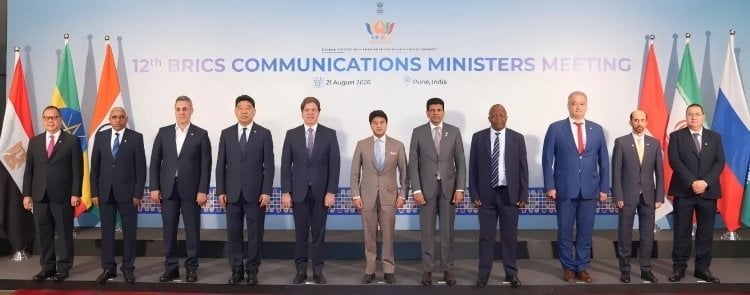
China wants BRICS cooperation to reach beneath the digital economy into the infrastructure carrying it. At the August 21 BRICS Communications Ministers' Meeting in Pune, Chinese Vice Minister of Industry and Information Technology Ke Jixin proposed cooperation on 6G, satellite internet, and a BRICS submarine-cable network, alongside artificial intelligence, next-generation communications, training, and digital-policy coordination. China's proposal stops well short of an approved infrastructure program—but it offers a glimpse of how BRICS could evolve in the Great Powers Era 2.0™.
REEx Insight: The Digital World Still Has to Be Built From Something
The strategic intelligence sits beneath the bandwidth. 6G networks, satellites, subsea cables, data centers, and AI systems may look digital, but their foundations are stubbornly physical. They consume semiconductors, optical materials, copper, specialty metals, power electronics, permanent magnets, and rare earths.
That creates an intriguing intersection between BRICS expansion and China's industrial power.
BRICS now brings together 11 countries stretching across enormous mineral resources, manufacturing capacity, energy production, and emerging-market demand. It is not a Chinese bloc—India, Brazil, and others retain distinct strategic interests—but it gives Beijing another platform for connecting resources → infrastructure → technology → standards → markets.
That matters in Great Powers Era 2.0
China's rare-earth advantage becomes more valuable when it is embedded inside Chinese telecom equipment, satellites, robotics, power systems, and other downstream technologies. If future BRICS cooperation eventually extends into procurement and shared infrastructure, China could potentially monetize its materials and manufacturing dominance several times over: supply the inputs, manufacture components, provide equipment, participate in infrastructure, and influence technical standards. The commodity is only the first sale. The ecosystem is the prize.
For Western investors and policymakers, this is why critical-mineral security cannot end at the mine gate—or even the separation plant. The geopolitical contest increasingly concerns who converts strategic materials into the infrastructure on which other economies depend.
Blueprint, Not Bulldozers
Ke proposed four areas: infrastructure connectivity encompassing 6G, satellite internet, and subsea cables; AI and communications R&D; digital-skills development; and policy coordination. China's MIIT explicitly describes these as Chinese proposals.
India independently confirms discussions covering resilient ICT ecosystems, cybersecurity, digital skills, and innovation. But there is no announced BRICS cable project, financing package, mineral agreement, or 6G deployment.
One concrete deal did emerge: India and Brazil signed an ICT cooperation MoU covering emerging technologies, infrastructure, cybersecurity, and connectivity.
REEx Disclosure: The underlying Chinese report was published by China's Ministry of Industry and Information Technology. Chinese proposals should be independently verified and should not be interpreted as collectively approved BRICS projects.


0 Comments
No replies yet
Loading new replies...
Moderator
Join the full discussion at the Rare Earth Exchanges Forum →