
Highlights
- MIIT's 2026–2030 strategy prioritizes efficient mining, low-grade ore utilization, and recycling to extract more value from China's strategic resources.
- China plans a digital identity system for EV batteries and targets over one million tonnes of retired power-battery recycling annually by 2030.
- Beijing is shifting from raw resource control to downstream value capture, intensifying competition in metallurgy, materials science, and industrial commercialization.
- Western mine development alone will not close the supply-chain gap if China simultaneously advances recovery, recycling, and advanced materials manufacturing.
China’s Ministry of Industry and Information Technology (MIIT) has laid out a broad 2026–2030 industrial strategy that directly touches critical minerals, advanced materials, recycling, and supply-chain security. At an August 26 State Council Information Office briefing, Vice Minister Xin Guobin and other MIIT officials said Beijing will prioritize advanced manufacturing, strengthen weak points in strategic supply chains, and raise the value captured from China’s “advantaged resources.”
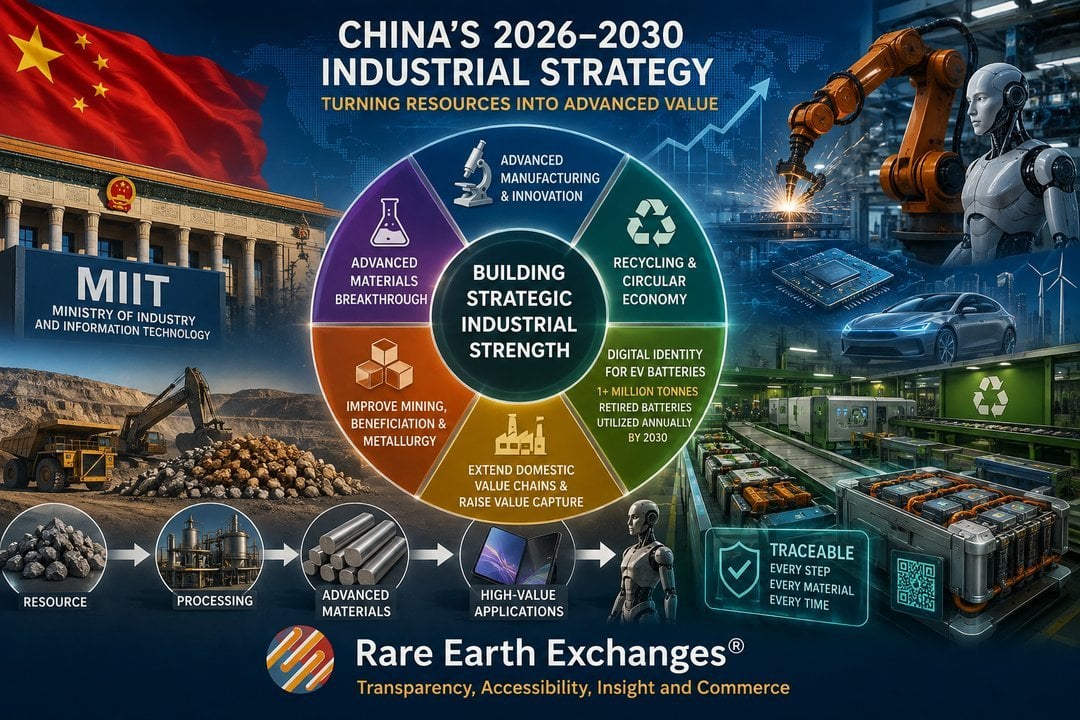
For rare-earth and critical-mineral markets, the most consequential language came from MIIT Planning Director Yao Jun: China intends to improve technologies for efficient mining, beneficiation, and metallurgy of scarce resources, expand utilization of low-grade and complex ores and industrial waste, strengthen recycling, and extend domestic value chains rather than simply sell primary resources.
REEx Insight: Beijing Is Moving From Resource Control to Value Capture
The message for Western policymakers is subtle but important. China is not merely defending access to minerals. It is seeking to extract more economic and strategic value from every tonne. That means recovering materials previously considered uneconomic, processing increasingly difficult feedstocks, recycling industrial waste, applying AI to materials development, and pushing advanced materials rapidly from laboratory validation into manufacturing.
For REEx, this reinforces a central supply-chain thesis: the strategic battleground is shifting downstream. Western mine development alone will not close the gap if China simultaneously improves recovery, metallurgy, recycling, materials science, and industrial commercialization.
MIIT explicitly calls for advanced materials to become a new industrial “growth pole,” supported by company-led R&D, national technology programs, pilot-scale infrastructure, and policies designed to overcome the difficult “last mile” from research to mass production.
Recycling Becomes Industrial Policy
China also plans a stronger circular-materials system. MIIT said it will introduce a digital identity system for EV batteries, allowing their origin and destination to be traced, while targeting more than one million tonnes of retired power-battery utilization annually by 2030. This matters beyond lithium. The policy architecture—traceability, recycling, process innovation, and domestic recovery—could become a template for other strategic materials.
Source Disclaimer: The attached source is an official Chinese government press-conference transcript distributed by China.com.cn, the State Council Information Office and MIIT-related media, not Baogang Daily. It represents state-source reporting and policy messaging; statistics, technological claims and projected outcomes should be independently verified before forming business or investment conclusions.


0 Comments
No replies yet
Loading new replies...
Moderator
Join the full discussion at the Rare Earth Exchanges Forum →