
Highlights
- USGS 2025 data ranks lutetium's GDP disruption impact at $2.06B—higher than terbium or dysprosium—yet it receives far less policy attention.
- Industrial solvent extraction achieves separation factors of only 1–2 between neighboring rare earths, requiring hundreds of stages to reach commercial purity.
- Private equity faces an impossible equation: tiny markets, opaque prices, and plants that must separate all co-produced elements whether customers want them or not.
- The U.S. DoD has loaned MP Materials $150M for heavy-REE separation and taken an equity stake, signaling a shift toward state-capitalist industrial policy.
- Western 'mine-to-magnet independence' claims are dangerously simplistic without dedicated separation capacity for the full suite of heavy rare earths.
As Rare Earth Exchanges® has continued to emphasize, separation represents one of the biggest chokepoints in the rare earth supply chain. Rare earths are notoriously difficult to separate because neighboring lanthanides are chemically almost identical. In the aqueous chemistry used industrially, most exist predominantly as trivalent (+3) ions, while their ionic radii decrease only slightly across the series—a phenomenon known as the lanthanide contraction. Industrial solvent extraction therefore often achieves separation factors of only 1–2 between neighboring rare earths, meaning one extraction step provides very little separation. Producers must compensate with repeated extraction, scrubbing, and stripping operations, sometimes involving tens to hundreds of stages across multiple circuits, to reach high-purity products. Producing terbium and dysprosium consistently is difficult enough. Producing the entire suite of neighboring heavy rare earths—including yttrium, gadolinium, holmium, erbium, ytterbium, and lutetium—to multiple customer-specific purity levels, economically and continuously, is considerably harder. This is where Western claims of “mine-to-magnet independence” can become dangerously simplistic.
A text communication with Rare Earth Observer (opens in a new tab) (REO) was inspirational for this article.
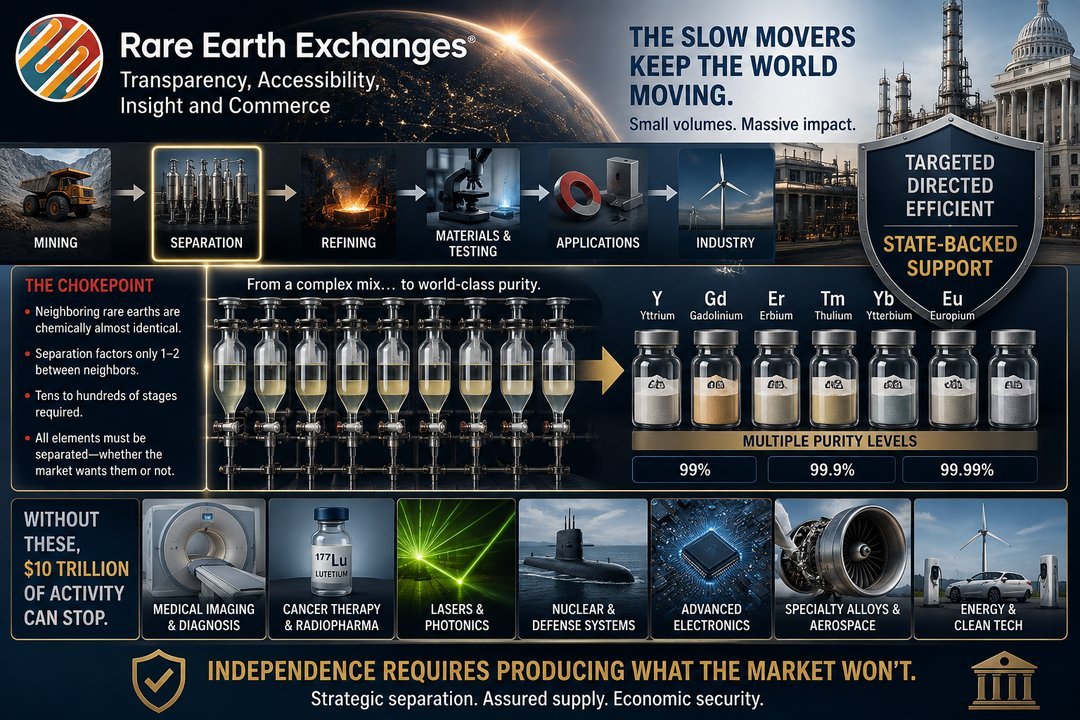
REEx Insight: The “Slow Movers” Can Stop Fast Industries
Western attention is concentrated on NdPr magnets and Dy/Tb. That risks missing yttrium, gadolinium, holmium, lutetium, and europium—plus Er, Tm, and Yb. Classification varies: Y is not a lanthanide and Eu/Gd are sometimes called middle rare earths, but commercially they sit inside the same separation problem.
The surprise is lutetium. USGS's 2025 economic model ranked Lu's probability-weighted U.S. GDP impact from disruption at about $2.06 billion—higher than Tb ($1.81 billion) or Dy ($1.62 billion). Gd was $758 million and Y $295 million; Ho remains on the U.S. critical-minerals list. These elements serve medical imaging, cancer treatment, lasers, nuclear systems, electronics, and specialized alloys.
Estimates of $10 trillion impact downstream should be understood as downstream economic activity potentially exposed to critical-mineral disruption—and not as $10 trillion of predicted economic losses. USGS confirms that critical minerals underpin U.S. industries worth trillions of dollars, while its disruption model shows that even tiny-volume rare earths can create outsized economic consequences because they sit inside much larger industrial systems. The distinction is critical: the value of a strategic rare earth is not measured by the size of its commodity market, but by the economic activity that cannot function without it.
Industrial Policy Becomes Industrial Insurance
Here conventional private equity faces an ugly equation: tiny markets, opaque prices, difficult chemistry, uncertain feedstocks, multiple purity requirements, and plants that must separate all co-produced elements, whether customers currently want them or not—the industry's “balance problem.” REEx would treat 99%, 99.9%, and 99.99% grades as separate strategic capabilities, with exact specifications determined by customers.
The U.S. is already moving toward state-capitalist industrial policy, not laissez-faire mining: the Department of Defense loaned MP Materials $150 million for heavy-REE separation, while also taking an equity position in the national champion. While its agreement provides a roughly decade-long NdPr price floor, the Department of Energy separately offered $134 million for integrated separation-and-refining demonstration capacity.
Several other financing deals have emerged involving USA Rare Earth, Energy Fuels, Phoenix Tailings, and others.
The Investment Conclusion
The West needs strategic separation plants that are allowed to be economically inefficient. Government should finance excess capacity, maintain inventories of low-volume elements, guarantee minimum offtake and price floors (where strategic), fund qualification laboratories, and accept returns below normal private-equity hurdles.
China's own rare-earth research agenda explicitly integrates separation, purification, high-purity metallurgy, recycling, testing, and downstream applications. That is the benchmark. Private capital can participate—but unsubsidized private equity trying to earn normal commodity returns from every individual heavy rare earth could lose badly. Independence requires producing some materials precisely because the market is too small to justify producing them.
In Great Powers Era 2.0™, redundancy is not wasted capital. It is strategic insurance.
See REO (opens in a new tab) as well for ongoing insights.


0 Comments
No replies yet
Loading new replies...
Moderator
Join the full discussion at the Rare Earth Exchanges Forum →