
Highlights
- Researchers analyzed 71 offtake agreements involving nine Australian rare earth producers and at least 46 buyers, revealing a clear post-2020 shift away from Chinese counterparties.
- Midstream companies—chemical, metal, and magnet producers—account for 31 of 63 agreements with identifiable customers, making them the key battleground in Western supply chains.
- At least 12 Chinese-linked agreements expired or were cancelled before product delivery, underscoring the fragility of earlier supply relationships.
- Government financing conditions in Australia and allied nations are effectively steering projects toward friendly buyers, narrowing an already small customer pool.
- The study warns that without expanded separation and magnet industries outside China, new Australian projects risk competing for the same limited pool of Western buyers.
Australian rare earth companies are increasingly building supply chains away from China—but finding enough Western customers remains the harder problem. Neil M. Coe of the University of Sydney, with Lian Sinclair and Eli Hayes, analyzed 71 publicly reported offtake agreements (opens in a new tab) involving nine Australian rare earth producers and at least 46 buyers. Their study finds a clear post-2020 shift from Chinese counterparties toward Western midstream and downstream companies. Yet the researchers conclude that, apart from Lynas Rare Earths, Australian projects have struggled to secure enough customers to support financing and large-scale production.
REEx Insight
The study exposes a critical weakness in Western rare earth strategy: building mines does not automatically build supply chains. An offtake agreement—a buyer’s commitment to purchase future production—can determine whether a project gets financed at all. The researchers find that midstream companies, including chemical, metal, and magnet producers, account for 31 of 63 agreements with identifiable customers. In other words, the emerging battle may be decided less by who owns the ore than by who can separate, metallize, and turn it into magnets—and commit to buying feedstock years in advance.
Study Methods and Findings
The researchers built a dataset covering agreements from 2002 through August 2025, using company reports and stock-exchange filings. Of 71 agreements, 37 were classified as binding offtakes or heads of agreement and 34 as less-binding MOUs or letters of intent.
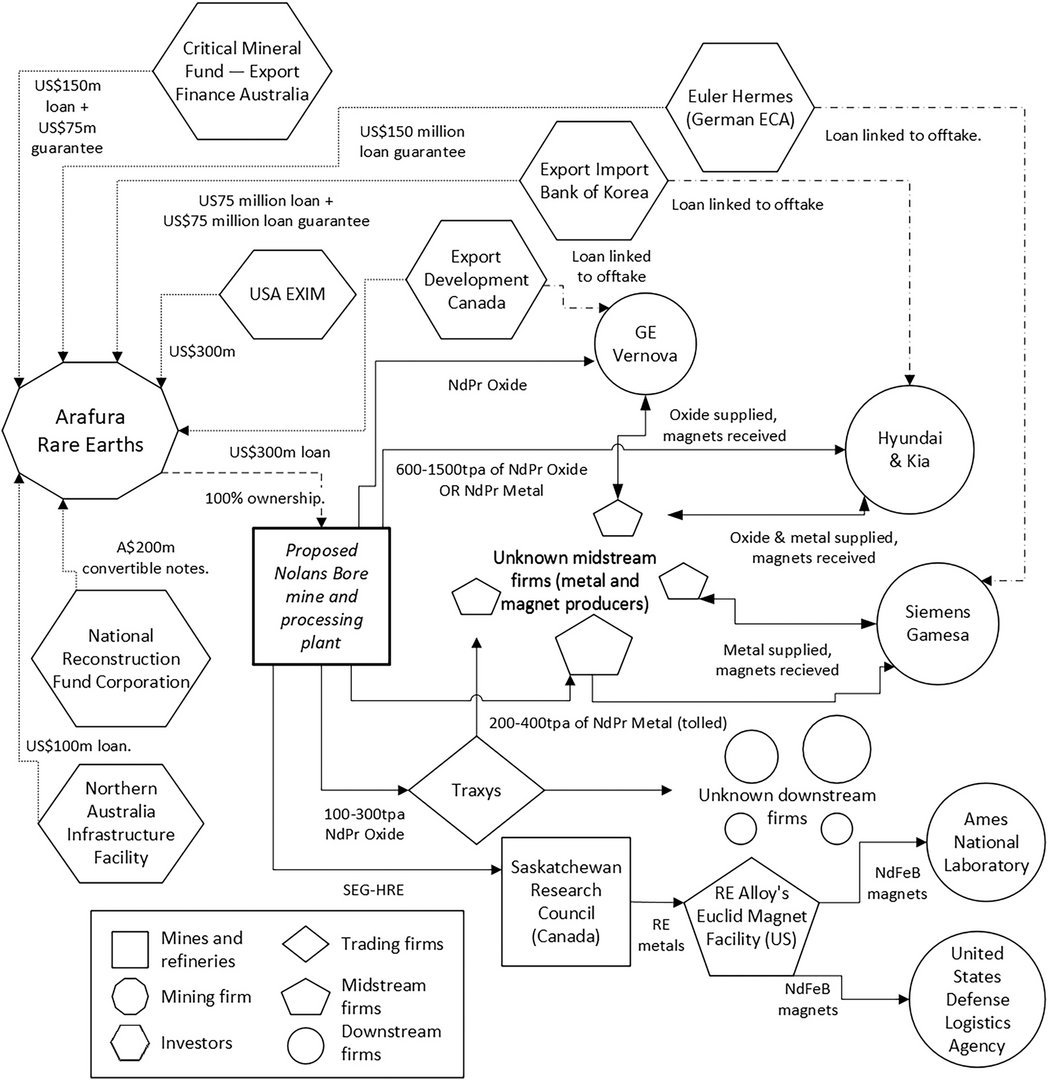
The geopolitical shift is striking: Chinese firms historically represented the largest group of counterparties, but Australian producers increasingly switched toward Western buyers after 2020. At least 12 Chinese-linked agreements expired or were cancelled before product delivery.
The controversial implication is that government finance is not neutral. Australian and allied financing conditions can effectively steer projects toward “friendly” buyers and away from China. That may improve supply security, but it also narrows the customer pool in an already small market.
Limitations and Conclusion
The analysis relies mainly on publicly disclosed agreements; some customers and commercial terms remain confidential, and Lynas has unidentified sales. Social and environmental impacts were largely outside scope, and the authors do not share the underlying research dataset.
The takeaway: the West may be financing mines faster than it is creating customers. Without larger separation, metals, alloy, and magnet industries outside China, multiple new Australian projects could end up competing for the same limited pool of buyers.
Citation: Coe, N.M., Sinclair, L. & Hayes, E. (2026). Mapping nascent rare earth global production networks in a time of geopolitical contestation. ZFW – Advances in Economic Geography. Published August 24, 2026. DOI: 10.1515/zfw-2025-0096.


0 Comments
No replies yet
Loading new replies...
Moderator
Join the full discussion at the Rare Earth Exchanges Forum →