
Highlights
- Ganfeng Lithium and the Chinese Academy of Sciences have started the world's first 500-tonne-per-year continuous tower-extraction line for rubidium and cesium carbonates.
- Seventeen extraction towers replace over 70 conventional mixer-settlers, cutting extractant consumption by 40% and plant footprint by 50%.
- Cesium recovery exceeds 98% and rubidium exceeds 95%, with products surpassing 99.9% purity already entering commercial sales.
- China converts a geological weakness—no independently mineable pollucite deposits—into a processing advantage through resource intensification.
- No capital costs, operating costs, or independently audited economics were disclosed, leaving commercial competitiveness unverified.
China is learning to mine a second time—inside the processing plant. Ganfeng Lithium (opens in a new tab) and the Chinese Academy of Sciences (opens in a new tab) have started stable operation of what they describe as the world's first 500-tonne-per-year continuous tower-extraction line for rubidium and cesium carbonates from low-grade material associated with lithium mica. Products exceed 99.9% purity and are already being sold.
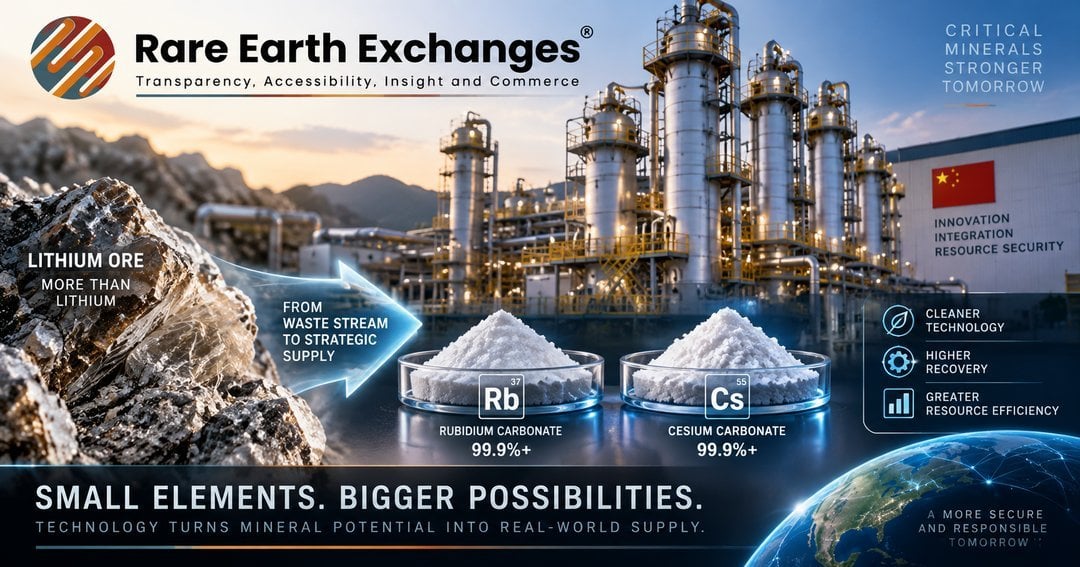
REEx Insight — China's Orebody Is Getting Bigger Without Mining More Ore
The breakthrough is not simply another separation machine. It demonstrates resource intensification: extracting additional strategic commodities from material already moving through an established lithium supply chain.
The plant processes 25,000 tonnes annually of lithium-mica leachate. Seventeen towers replace more than 70 conventional mixer-settlers, reportedly cutting extractant consumption 40% and footprint 50%. Cesium recovery exceeds 98%; rubidium exceeds 95%.
This matters because China says it no longer has independently mineable pollucite deposits, the principal conventional cesium ore. Technology is therefore converting a geological weakness into a processing advantage.
REEx sees a broader strategic lesson: supply-chain strength should be measured not merely by reserves, but by value recovered per tonne of material processed. China's dense processing ecosystem creates opportunities to recover minor metals that standalone Western projects may discard as uneconomic. The same logic applies across rare-earth circuits: recover more elements, share infrastructure, and spread fixed costs across more saleable products.
But investors need discipline. No product split, feed grade, capital cost, operating cost, or independently audited economics were disclosed. Engineering success is established; commercial competitiveness is not.
Waste Stream Becomes Feedstock
The reported achievement is credible because CAS itself provides detailed operating metrics, not merely Global Times. Rubidium and cesium are rare metals, not rare earth elements, but the strategic processing lesson travels directly across both industries.
REEx Connect
| Organization | Role |
|---|---|
| Ganfeng Lithium (opens in a new tab) | Industrial partner |
| Chinese Academy of Sciences | Program sponsor |
| Institute of Process Engineering (opens in a new tab) | Technology developer |
| Jiuling Lithium | Development collaborator |
Source disclaimer: This article responds to reporting by Global Times, a Chinese state-affiliated publication. REEx independently cross-checked the principal technical claims against the Chinese Academy of Sciences' Institute of Process Engineering. Performance and “world's first” claims remain developer/institution-reported and have not been independently audited.


0 Comments
No replies yet
Loading new replies...
Moderator
Join the full discussion at the Rare Earth Exchanges Forum →