
Highlights
- A September 10 fire at Qingdao Beihai Shipbuilding killed 25 people and triggered personal instructions from Xi Jinping and Premier Li Qiang, raising questions about China's governance structure.
- China's bureaucracy appears to respond upward before outward, with local officials prioritizing blame avoidance over problem-solving—a pattern repeated after a deadly Fujian factory fire just two months earlier.
- China's export machine is surging—August exports jumped 25% year-over-year with a $119B trade surplus—but domestic demand remains weak, creating a 'strong supply, weak demand' contradiction.
- China's rare earth dominance illustrates the broader paradox: exercising export leverage today accelerates rival nations' efforts to build alternative supply chains tomorrow.
- An omnipresent state that supervises every lever of industry may have worked during industrial catch-up but risks suffocating the entrepreneurship needed for China's next economic phase.
A deadly September 10 fire aboard a cargo ship undergoing repairs at Qingdao Beihai Shipbuilding triggered instructions from the very top of China’s political hierarchy. President Xi Jinping ordered rescue efforts, investigation, accountability, and a sweeping review of fire hazards. Premier Li Qiang issued his own instructions. The Ministry of Emergency Management then dispatched a working group.
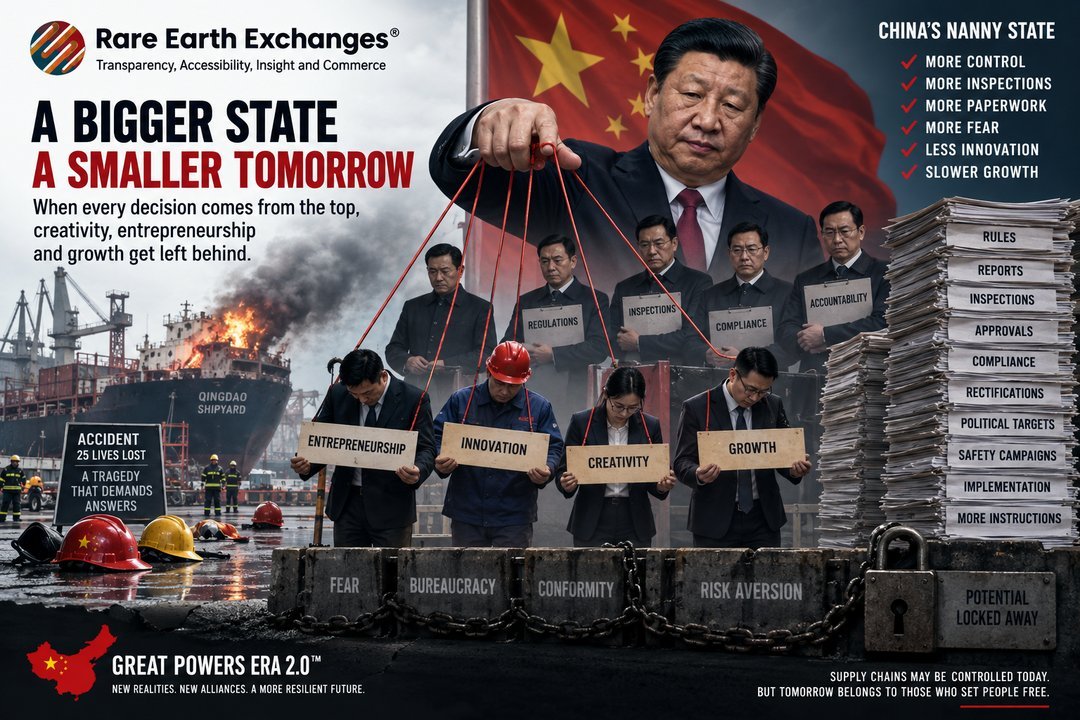
The human tragedy is serious: 25 people were reported killed. But the political response raises a different question. Why does the leader of the world’s second-most-populous country and second-largest nominal economy need to personally instruct local officials to investigate a shipyard fire, enforce existing safety rules, and prevent another one?
The episode illustrates something larger than accident management. China’s extraordinary state capacity is increasingly accompanied by extraordinary state reach. In Great Powers Era 2.0™, that may eventually become an economic liability.
REEx Insight — The Control Machine Is Becoming the Management Machine
China's centralized system helped build one of history's great industrial transformations. Beijing could identify strategic sectors, mobilize capital, build infrastructure, coordinate state enterprises, and tolerate investment horizons that Western corporations often could not.
That system helped China dominate critical supply chains.
But the same machine can become too large.
After the Qingdao fire, Xi did not merely express condolences. According to the official account, he instructed authorities to accelerate rescue efforts, handle the aftermath, determine the cause, punish responsible parties, investigate fire hazards across regions and departments, refine preventive measures, and prevent major accidents. Li Qiang separately ordered rescue, treatment, prevention of secondary disasters, and strengthened safety responsibilities.
The State Council apparatus and Ministry of Emergency Management then moved into action.
Much of this is perfectly sensible. That is precisely what makes the episode interesting.
Why does any of it need to come from Xi Jinping?
A functioning industrial safety system should already require rescue, investigation, accountability, hazard inspection, and prevention after a fatal industrial accident. These are operational responsibilities of shipyard management, local authorities, regulators, and emergency agencies.
When the general secretary of the Chinese Communist Party, president of China, and chairman of the Central Military Commission must publicly instruct the bureaucracy to perform those basic functions, the message is not simply that Beijing cares.
The implicit message is that the bureaucracy responds upward before it responds outward.
And this is hardly unprecedented. After a deadly Fujian factory fire just two months earlier, Xi similarly instructed officials nationwide to learn “profound lessons,” eliminate safety hazards, and prevent serious accidents. China had already issued a national policy in March strengthening grassroots fire governance, followed in June by a 2026–2030 emergency-management modernization plan emphasizing preventive safety and “whole-chain” rectification.
So Beijing already had the rules, the bureaucracy, the plans, and the inspections.
Then another disaster required another instruction. That is where governance starts looking less like decisive leadership and more like administrative recursion.
The Nanny State Meets the Factory Floor
China increasingly wants the state everywhere: financing strategic industries, directing technology, supervising data, managing supply chains, controlling strategic mineral exports, steering industrial consolidation, inspecting factories, and instructing local governments how to implement instructions about previous instructions.
Centralization can produce astonishing coordination.
It can also produce fear, paperwork, and institutional paralysis.
Managers who believe every serious failure can ultimately become a political matter rationally devote more resources to satisfying regulators, documenting compliance, and demonstrating alignment. Local officials learn that avoiding blame can matter almost as much as solving problems. Businesses learn to watch Beijing's priorities because policy can reshape entire industries.
The danger is subtle: the entrepreneur gradually becomes an implementer.
That matters because China's next economic challenge is almost the opposite of the challenge it mastered over the previous generation. China does not primarily need another factory. It needs demand.
China Has Built a Production Machine That Must Keep Selling
The imbalance is becoming difficult to ignore. China's own August data showed manufacturing production recovering, yet the broader composite Purchasing Managers' Index remained at 49.5, while small manufacturers registered just 47.9. Non-manufacturing activity was 49.0, and its employment index stood at only 45.4.
Yet exports are roaring. China's August exports jumped 25% year over year, producing a roughly $119 billion monthly trade surplus. Chinese passenger-vehicle exports during the first eight months of 2026 already exceeded their total for all of 2025, while domestic auto sales fell sharply in August.
This is the contradiction REEx recently described as “strong supply, weak demand.” In China’s Factories Outrun Its Consumers as Beijing Searches for Demand at Home—and Markets Abroad, we argued that China's extraordinary industrial machine increasingly needs either stronger Chinese consumption or larger foreign markets.
The problem is that Great Powers Era 2.0 is making those foreign markets less welcoming.
Great Powers Era 2.0 Changes the Equation
Rare Earth Exchanges® has argued that China brilliantly exploited the economic architecture of the previous era. Scale mattered. Cost mattered. Efficiency mattered. Western companies happily concentrated production in China because the economics worked.
That world is fragmenting. As REEx outlined in Great Powers Era 2.0: The Industrial Alliances That Will Decide the Rare Earth Race, economic security, redundancy, and supply-chain resilience are increasingly being valued alongside price.
China therefore faces a dangerous contradiction.
It needs the world to keep buying from the Chinese industrial machine at precisely the moment much of the world is trying to become less dependent upon that machine.
Rare earths demonstrate the problem perfectly. China's extraordinary control over separation, metals, alloys, and magnets creates enormous leverage today. But exercising that leverage encourages customers to finance alternatives tomorrow. REEx documented that paradox in China Exports Less Rare Earth—But Earns Far More: The Market Is Sending a Clear Signal: China's ability to monetize scarcity strengthens its near-term position while simultaneously giving the United States, Europe, Japan, South Korea, Australia, and others stronger incentives to diversify.
And in Great Powers Era 2.0 Accelerates the Erosion of China’s Rare-Earth Monopoly, REEx argued that the emerging competitor to China is not another China. It is a network of allied mines, separators, metal producers, magnet manufacturers, capital markets, and customers.
That distinction becomes increasingly important.
The State That Built the Machine May Be Squeezing It Too Hard
There is an important counterpoint. Foreign businesses in China are not universally collapsing under the pressure. A September American Chamber of Commerce in Shanghai survey actually showed improving sentiment: 58% of surveyed U.S. companies reported optimism about their five-year outlook, up sharply from the previous year's record low, while 78% reported profits. But domestic competition was the leading challenge, cited by 68%.
So the evidence does not support the simplistic claim that Chinese business is universally broken. The more defensible conclusion is more troubling.
China has created a spectacular manufacturing ecosystem while simultaneously creating a governance system that increasingly seeks to supervise, coordinate, inspect, direct, and correct that ecosystem from above. That worked remarkably well during industrial catch-up.
It may work less well when the challenge becomes entrepreneurship, consumer confidence, capital efficiency, and adaptation to hostile foreign markets.
The Qingdao tragedy therefore deserves to be viewed on two levels. Twenty-five tragic deaths demand investigation and accountability. Nothing about questioning Beijing's political response diminishes that fact.
But a country of roughly 1.4 billion people should not require Xi Jinping to remind a shipyard bureaucracy that fires must be investigated and hazards corrected. A powerful state can build factories. An omnipresent state can eventually suffocate the people running them.
That may become one of China's great tests in Great Powers Era 2.0. Beijing spent decades constructing perhaps the world's most formidable industrial machine. Now it must resist the temptation to place a political supervisor beside every lever. Because when every problem requires instructions from the top, the real problem may no longer be at the bottom.


0 Comments
No replies yet
Loading new replies...
Moderator
Join the full discussion at the Rare Earth Exchanges Forum →