
Highlights
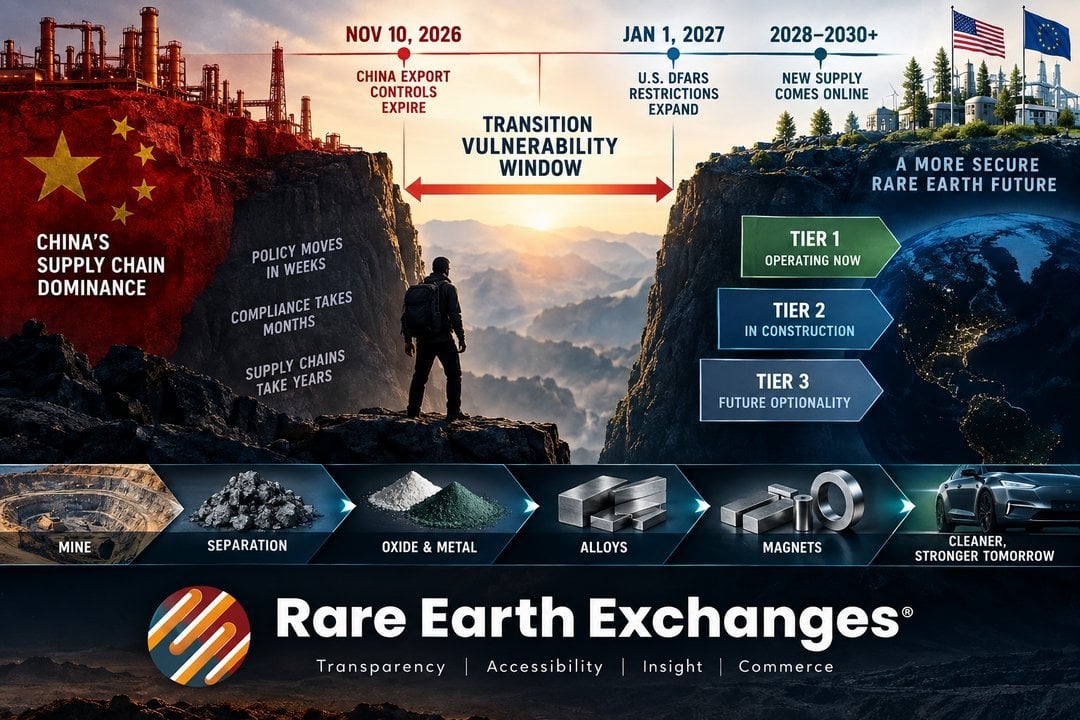
- China's export-control deadline and U.S. DFARS restrictions create a critical supply gap REEx calls the Transition Vulnerability Window, spanning roughly 2025–2030.
- REEx ranks rare earth equities in three tiers based on Time-to-Qualified-Molecule, favoring Lynas, MP Materials, Neo Performance, and Energy Fuels as Tier 1 operators with proven separation or magnet capacity.
- The Missing Molecules Problem warns investors that aggregate TREO tonnage misleads: cerium cannot replace terbium, and oxide is not a qualified magnet alloy.
- A new valuation equation weights resource quality, metallurgy, separation, downstream reach, qualification, provenance, and scale—all divided by time-to-market.
- Companies racing toward 2028–2030 commissioning targets face a merciless clock, as strategic value accrues to whoever eliminates midstream bottlenecks first.
Rare earth equities are entering a period when time may matter almost as much as geology. China's November 10 export-control deadline sits just 52 days before expanded U.S. DFARS restrictions take effect January 1, 2027. Yet much of the West's replacement separation, metallization and magnet capacity arrives in 2028–2030 or even later. Rare Earth Exchanges® calls this mismatch the Transition Vulnerability Window. For investors, it creates a new valuation lens: Who can deliver the right molecule, in the right form and jurisdiction, before the window closes?
REEx Insight — Stop Valuing Rocks. Start Valuing Time.
The rare earth market has traditionally rewarded tonnes, grade, NPV and projected mine life.
Those metrics still matter. But Great Powers Era 2.0™ introduces another variable: Time-to-Qualified-Molecule. China's leverage clock moves in weeks. Western compliance moves in months. Mines, separation plants, metallization facilities, magnet factories and customer qualification move in years.
That mismatch creates a Transition Premium, meaning a kilogram of qualified dysprosium available outside China in 2027 has greater strategic utility during a supply disruption than the same theoretical kilogram buried inside a deposit scheduled for 2031. This changes how REEx views the equity universe.
Tier 1 — The Clock Works For Them
Lynas Rare Earths [ASX: LYC; OTC: LYSCF] (opens in a new tab) may have the cleanest Transition Vulnerability Window argument. It already operates the largest ex-China rare-earth mining and separation system and has now commenced separated dysprosium production in Malaysia, with terbium following—an extraordinarily scarce Western capability. MP Materials [NYSE: MP] (opens in a new tab) combines Mountain Pass mining, U.S. NdPr separation and emerging magnet production. Its DoD agreement adds something competitors lack: a $110/kg NdPr price floor with the Department of Defense, materially insulating economics from Chinese price pressure. MP's weaknesses remain HREE depth, metallization and proving magnets at scale.
Neo Performance Materials [TSX: NEO; OTCQX: NOPMF] (opens in a new tab) deserves considerably more attention under this framework. Silmet has commissioned continuous small-scale Dy/Tb separation, while Neo's new Estonian magnet plant has moved beyond qualification into commercial sintered-magnet shipments to a Tier-1 traction-motor customer. Few Western equities span both ends of that equation. Energy Fuels [NYSE American: UUUU; TSX: EFR] (opens in a new tab) is the Tier-1 disruptor. White Mesa supplies genuine separation capability, while its proposed $1.9 billion VAC acquisition would bolt on established metal, alloy and magnet expertise—including an operating 2,000-tpa South Carolina magnet facility. But its planned 288-tpa Dy and 80-tpa Tb separation expansion is targeted only by mid-2029.
REEx interpretation: Tier 1 deserves a scarcity premium valuation because these companies increasingly own industrial proof, not merely industrial plans. But we remind all—these assets carry serious risks as well. Track Rare Earth Exchanges to understand risks across tier one mine-to-magnet ecosystems.
Tier 2 — Racing the Clock
This group may offer greater upside—but also greater execution risk. Iluka Resources [ASX: ILU] (opens in a new tab) is building something strategically exceptional at Eneabba: an Australian refinery designed to produce Nd, Pr, Dy and Tb oxides and accept third-party feed. Commissioning is expected in 2027, backed by substantial Australian government financing. If commissioning and qualification proceed successfully, Iluka could migrate toward Tier 1 rapidly. USA Rare Earth [NASDAQ: USAR] (opens in a new tab) has assembled perhaps the sector's most ambitious emerging ecosystem: Serra Verde feedstock exposure, Less Common Metals metallization, Carester separation exposure (via investment) and a planned South Carolina magnet complex targeting 6,400 tpa of NdFeB magnets. Construction has begun, but commissioning is targeted for 2028. The valuation question is therefore brutal but simple: how much should investors pay today for tomorrow's integration? And frankly, how much is this asset discounted due to the myriad risks present?
Aclara Resources [TSX: ARA] (opens in a new tab) deserves particular attention because its strategy directly attacks the Missing Molecules Problem: ionic-clay HREE resources plus planned U.S. separation. Penco targets 2027 operations, while its Louisiana separation project has attracted potential EXIM financing.
Viridis Mining & Minerals [ASX: VMM] (opens in a new tab) is emerging rapidly. Colossus has a 200.1 Mt reserve containing approximately 579 kt TREO and has operated a continuous semi-industrial demonstration plant; engineering and equipment procurement are advancing toward a targeted 2028 start. That makes Viridis more than another Brazilian clay story—but 2028 remains 2028.
Brazilian Rare Earths [ASX: BRE; OTCQX: BRELY] (opens in a new tab) offers remarkable geology: Monte Alto's reported resource grade is approximately 11.3% TREO, with a development concept targeting separated NdPr plus an HREE concentrate. But its hydrometallurgical separation pilot remains ahead of it. Enormous geological potential should not yet be priced as operating separation.
American Resources [NASDAQ: AREC], through its minority privately held ReElement Technologies (opens in a new tab) holding, adds additional optionality and remains in construction. Privately held ReElement is especially worth monitoring because chromatography-based separation could attack the midstream bottleneck, but investors should distinguish ReElement's potential from the economic interest actually represented by AREC shares. Meaning ReElement could become a very valuable separation company without every dollar of that value translating into a dollar of AREC market value.
Tier 3 — Great Resources, Merciless Clock
Here the Transition Vulnerability Window becomes a discount factor. Meteoric Resources [ASX: MEI] (opens in a new tab) controls the enormous Caldeira ionic-clay system; Northern Minerals [ASX: NTU] (opens in a new tab) owns strategically important Dy/Tb-rich Browns Range; and Arafura Rare Earths [ASX: ARU] (opens in a new tab) has finally moved Nolans into construction—but production is targeted around 2029. Mkango Resources [TSXV/AIM: MKA] (opens in a new tab) has an intellectually compelling mine-separation-recycling strategy, but its Polish separation project currently points toward a 2029 ramp-up and Songwe remains unfunded for construction.
Ionic Rare Earths [ASX: IXR] (opens in a new tab) combines Makuutu HREE exposure with Belfast magnet-recycling technology, but Makuutu is under strategic review and the proposed U.S. recycling JV remains non-binding. Ucore Rare Metals [TSXV: UCU; OTCQX: UURAF] (opens in a new tab) is particularly interesting because RapidSX attacks separation rather than another mine. More than 7,400 hours of demonstration runtime is meaningful; a proposed 9,600-tpa Louisiana complex could become strategically valuable. But commercial commissioning and qualification still separate demonstration from bankable supply. ReAlloys Inc (opens in a new tab). (Nasdaq: ALOY) remains dependent on Canadian and other sourced feedstock, Saskatchewan Research Council (opens in a new tab) for separation, unproven metallization at scale, and a complex integration with little time to spare.
Pensana [LSE: PRE] (opens in a new tab) (although historical issues with the resource), Hastings Technology Metals [ASX: HAS] (opens in a new tab) and there are others---see REEx Insights™ Rankings for upstream, midstream and downstream assets.
There are other private concerns on our radar including Caldera Holdings (opens in a new tab) and the Pea Ridge mine (opens in a new tab), which can be mined expeditiously for heavy rare earths. They are in financing discussions. A public venture in tier 3 to watch is Rare Element Resources (opens in a new tab) ([OTCQB: REEMF) majority owned by General Atomics (opens in a new tab) affiliate Synchron (opens in a new tab).
Southern Alliance Mining (opens in a new tab) (QNS. SGX) owns 40% of heavy rare earth rich MCRE Resources Sdn. Bhd in Malaysia. Currently all of the offtake goes to the China Rare Earth Group ecosystem. As Rare Earth Exchanges has chronicled in Great Powers Era 2.0, both China, the USA and Europe all converge in Malaysia.
The Equity Equation Changes
REEx's Missing Molecules Problem explains why aggregate TREO can mislead investors. A mountain of cerium cannot replace missing terbium; mixed carbonate is not separated oxide; oxide is not metal; and metal is not a qualified magnet. Hence our working equation becomes: Strategic Equity Potential ∝ Resource Quality × Metallurgy × Separation × Downstream Reach × Qualification × Provenance × Scale ÷ Time-to-Market. And time is becoming viciously expensive.
China still possesses the dominant industrial ecosystem even after enormous Western investment. Meanwhile: Funding ≠ construction ≠ commissioning ≠ specification ≠ qualification ≠ scale ≠ auditable commercial supply. That hierarchy separates a rare-earth stock story from a rare-earth supply chain. The Transition Vulnerability Window therefore does not necessarily reward the company with the biggest deposit or the loudest press release. It disproportionately increases the strategic relevance of companies that can eliminate bottlenecks before everyone else eliminates them too.
For the remainder of this decade, perhaps the most revealing question in rare earth investing is no longer:
How much rare earth does the company own? It is: How many industrial steps—and how many years—stand between that company and a customer's qualified magnet? That answer may increasingly determine what the equity is actually worth.


0 Comments
No replies yet
Loading new replies...
Moderator
Join the full discussion at the Rare Earth Exchanges Forum →