
Highlights
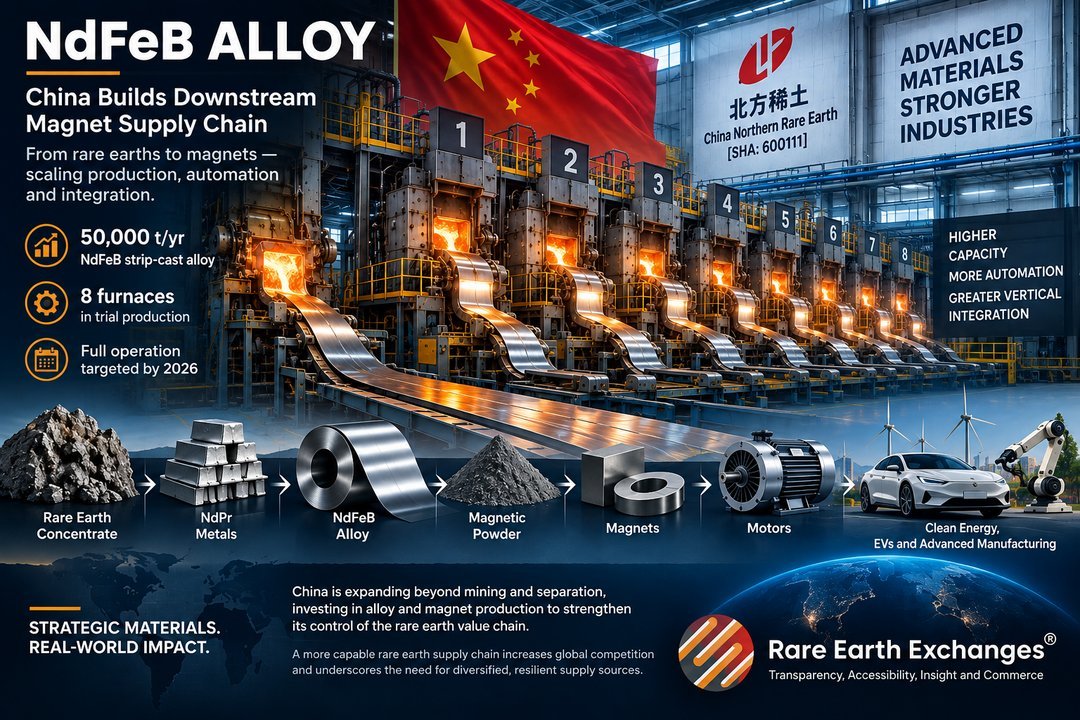
- China Northern Rare Earth has started trial production at its new NdFeB strip-cast alloy facility in Baotou, with eight melting furnaces now online.
- The project is designed for 50,000 metric tons of NdFeB alloy annually, with Phase I covering 30,000 tons and Phase II adding 20,000 tons.
- The plant features automated dosing, vacuum induction melting, and MES digital controls capable of producing low-, medium-, and high-end NdFeB alloys.
- Northern Rare Earth is simultaneously expanding into finished magnets via 5,000 t/year and 3,000 t/year magnet projects, deepening vertical integration.
- Western magnet supply chain independence requires metallization and alloy-making capacity, not just mines and separation plants.
China Northern Rare Earth Group High-Tech [SHA: 600111] says its new high-performance neodymium-iron-boron (NdFeB) strip-cast alloy project in Baotou has entered trial production, with eight melting furnaces now connected across the production line. Full operation is targeted by year-end 2026. The larger project is designed for 50,000 metric tons of NdFeB strip-cast alloy annually, plus 10,000 tons of hydrogen-decrepitated material. Phase I covers 30,000 tons of alloy, while Phase II adds another 20,000 tons.
REEx Insight — China Moves Another Step Beyond the Oxide
For the West, the important word here is alloy. Mining rare earths and separating NdPr oxide do not produce a magnet. Nd and Pr must move through oxide → metal → alloy → magnetic powder → finished magnet, with tight control over chemistry and manufacturing. Northern Rare Earth is strengthening that middle section. The new factory combines automated raw-material dosing, vacuum induction melting, automated material handling, and MES digital production controls. Management says it can alter metal recipes according to customer orders and produce low-, medium-, and high-end NdFeB alloys.
That matters in Great Powers Era 2.0™. China is not merely defending its mining and separation position; it continues investing downstream where separated elements become engineered materials. Northern Rare Earth is simultaneously expanding alloy production while participating in 5,000 t/year and 3,000 t/year finished-magnet projects. The strategic lesson is straightforward: Western magnet independence requires metallization and alloy-making capacity, not simply mines and separation plants. A shortage at any intermediate step can stop the chain.
Baotou Builds the Cluster
The plant sits inside Baotou's magnet-material manufacturing cluster. Northern Rare Earth describes an increasingly connected regional chain linking PrNd metal → strip-cast alloy → magnets → motors. The company says the plant will become China's largest single-site rare-earth magnetic-alloy facility when fully operational. That remains a company claim, but the project's 50,000-ton design capacity is independently supported by environmental and project documentation. There is no new magnet chemistry breakthrough reported. The breakthrough is industrial scale, automation, and vertical integration.
REEx Connect
| Organization | Key Contact | Strategic Role |
|---|---|---|
| China Northern Rare Earth [SHA: 600111] | Wang Chen | Parent rare-earth group |
| Northern Rare Earth Magnetic Materials | Rong Lijun | Project deputy commander |
| Baogang Group | Meng Fan-ying | Controlling industrial group |
| Antai Northern Technology | — | 5,000 t/year magnet project |
| Northern Zhaobao Magnetics | — | 3,000 t/year high-performance NdFeB project |
| Antai Technology [SHE: 000969] | — | Magnet-sector JV partner |
Source Disclaimer: This news originates from Baogang Group media. Baogang is a Chinese state-owned enterprise and the controlling shareholder of China Northern Rare Earth. Claims regarding technology leadership, cost competitiveness, product quality, and future performance should be independently verified before use in investment or commercial decisions.


0 Comments
No replies yet
Loading new replies...
Moderator
Join the full discussion at the Rare Earth Exchanges Forum →