
Highlights
- Malaysia supplied approximately 348,400 micro and small UAS to the U.S. in 2024, capturing 84% of micro-drone imports and 57% of small-drone imports.
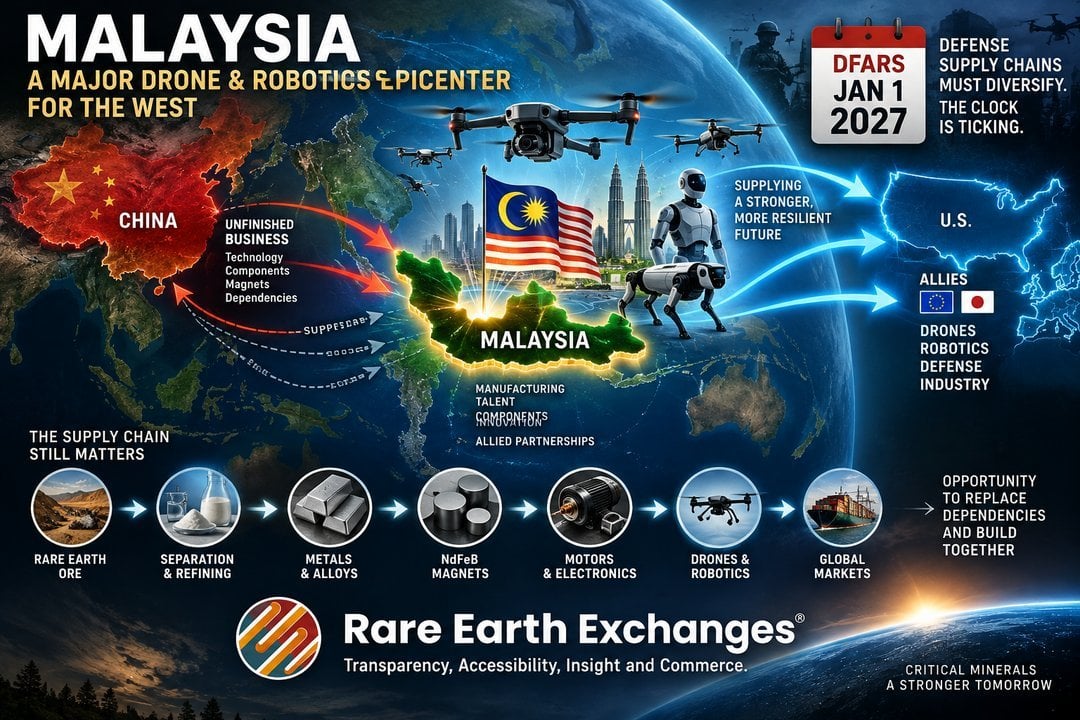
- The global drone market may be bifurcating into a China-centered ecosystem and an emerging U.S.-allied alternative, with Malaysia positioned as a key bridge.
- Malaysian companies like Shah Ehsan/Edge Technology produce UAV motors and ESCs, but upstream rare earth magnet dependencies on China remain unresolved.
- The Anzu Robotics case—U.S.-owned, Malaysia-manufactured, DJI-licensed—illustrates the complexity of transitioning away from Chinese drone supply chains.
- REEx aims to map the full supply chain from drone OEM to NdFeB magnet to rare earth mine, connecting Malaysian manufacturers with ex-China suppliers.
Something extraordinary is happening in the global drone supply chain—and Malaysia may be emerging as one of the most important countries in the nascent ex-China drone and robotics ecosystem. In 2024, Malaysia supplied approximately 348,400 micro and small unmanned aircraft to the United States. That included 260,200 micro-UAS weighing less than 250 grams, representing an extraordinary 84% of U.S. imports in that category, and approximately 88,200 small UAS between 250 grams and 25 kilograms, representing 57% of imports. China's direct shares fell to 11% and 28%, respectively. Those numbers should get the attention of U.S. industry and policymakers for a reason that goes well beyond trade statistics.
As Washington attempts to reduce strategic dependence on China across drones, robotics, permanent magnets and other critical technologies, Malaysia increasingly looks like a country the United States and allied industry should be working with—not merely investigating.
Malaysia combines an established electronics and precision-manufacturing base with a growing domestic drone industry, motor and electronics capabilities, local engineering talent and an explicit national strategy to develop DroneTech through 2030. Its ambitions extend across agriculture, logistics and industrial applications into security, defense and maritime applications.
The result could be strategically significant: Malaysia has an opportunity to become an important bridge between today's China-dominated drone supply chain and tomorrow's more diversified global market.
But building that market requires understanding exactly where today's dependencies remain.
REEx Insight: The Beginning of a Bifurcated Drone Market
The global drone industry may be entering a structural transition. For more than a decade, China built an extraordinary competitive position across commercial drones and many of the components beneath them. Now national-security restrictions, procurement requirements, trade tensions and customer demand for supply-chain resilience are encouraging development of an alternative ecosystem.
That does not mean the Chinese ecosystem simply disappears. A more plausible near-term outcome is an increasingly bifurcated market: a highly competitive China-centered drone and robotics supply chain on one side and an emerging U.S.-allied or ex-China ecosystem on the other.
Malaysia could occupy an unusually important position in that transition.
It already has electronics manufacturing, precision engineering, contract manufacturing and an emerging indigenous drone industry. The country is geographically embedded within Asia's manufacturing ecosystem while maintaining extensive commercial relationships with the United States, Europe, Japan and other major economies.
That makes Malaysia potentially more valuable than simply another location for final assembly.
It could become one of the places where the alternative supply chain is actually built.
For REEx, therefore, the objective is not to prove that Malaysian drones secretly remain Chinese. It is to determine which layers have already diversified, which remain dependent on China, and where Malaysian and allied companies can economically replace those dependencies.
That requires going much deeper than customs statistics. Rare-earth ore → concentrate → separation → NdPr/Dy/Tb oxides → metals → NdFeB alloy → sintered magnet → rotor/motor → ESC → propulsion system → drone OEM/ODM → U.S. importer → end user. Every step represents both a potential dependency and a commercial opportunity.
Malaysia Is More Than an Assembly Platform
Malaysia should not be viewed simply as an offshore assembly location.
The country has spent years developing a domestic DroneTech ecosystem. Its Malaysia Drone Technology Action Plan 2022–2030 is intended to accelerate development of the sector, cultivate internationally competitive domestic companies and expand drone applications across agriculture, logistics, infrastructure, security, defense and maritime activities.
And REEx's company-level investigation is beginning to show what that industrial base looks like.
Shah Ehsan Sdn Bhd / Edge Technology (opens in a new tab) in Selangor is particularly interesting because it operates below the finished-aircraft level. The company describes capabilities encompassing UAV brushless motors, stators, propellers, electronic speed controls, motor development and complete motor assembly.
That is precisely the type of company an ex-China ecosystem needs. But it also raises the next question: Where do the permanent magnets come from? Who manufactures them? Where is the NdFeB alloy produced? Where were the NdPr—and potentially Dy and Tb—separated and refined?
Those are not accusations. They are the questions that any serious effort to create a resilient alternative supply chain eventually has to answer.
And answering them creates an opportunity for collaboration. If a Malaysian motor manufacturer currently buys Chinese magnets, for example, REEx can help identify emerging magnet suppliers in the United States, Japan, Europe, Australia or elsewhere. If the magnet itself is produced outside China but relies on Chinese alloy, the investigation moves another level upstream.
The objective is not simply to identify dependencies. It is to help replace them where replacement makes commercial and strategic sense.
Anzu Shows How Complicated the Transition Can Be
Anzu Robotics (opens in a new tab) provides a useful case study of this transitional market.
Anzu's Raptor-series aircraft are manufactured in Malaysia, and the company has licensed technology associated with China's DJI. Anzu has also acknowledged Chinese-origin components in its supply chain.
Meanwhile, Texas Attorney General Ken Paxton sued Anzu in February 2026 and subsequently opened an investigation into Drone Nerds concerning its relationship with Anzu, alleging deceptive representations and China/CCP-related security concerns. These remain allegations by the Texas Attorney General rather than adjudicated findings.
The corporate picture has also changed substantially. In November 2025, U.S.-based XTI Aerospace, through its drone subsidiary, acquired 100% of the equity interests of both Drone Nerds and Anzu Robotics. SEC filings confirm the transactions and show XTI subsequently reorganizing its strategy around UAS and advanced defense systems.
That combination—U.S. ownership, Malaysian manufacturing, licensed Chinese technology and continuing questions about Chinese-origin components—is almost a perfect illustration of the transitional global drone market. It should therefore be investigated carefully without allowing one company's controversy to obscure the larger Malaysian opportunity.
The 348,400-Drone Opportunity
The biggest unanswered question remains remarkably simple. Who actually manufactured those 348,400 Malaysian-origin aircraft imported by the United States in 2024? The publicly visible Malaysian companies identified by REEx cannot yet be demonstrated to account for that volume.
That suggests another layer of the ecosystem remains to be mapped: contract manufacturers, ODMs, foreign brands manufacturing in Malaysia and component suppliers operating beneath the consumer-facing brands. This is where the investigation becomes particularly valuable. Instead of asking whether Malaysia is really replacing China, REEx proposes a more useful set of questions: How much of the supply chain has already migrated? What capabilities does Malaysia already possess? Where does China remain indispensable? And where could Malaysian, American and allied companies collaborate to close those remaining gaps?
Those answers matter far beyond commercial drones. Autonomous systems increasingly blur traditional boundaries between commercial robotics, industrial automation, public-safety systems and defense applications. Motors, permanent magnets, sensors, electronics, batteries and control systems can therefore become strategically important across multiple markets.
Malaysia's emergence deserves attention precisely because the country already possesses pieces of this industrial puzzle. The next stage is connecting them. And the emerging Rare Earth Exchanges® suite of solutions supports that effort.
| REEx Solution | Core Function | What REEx Does | Malaysia Drone Example | Value to Industry |
|---|---|---|---|---|
| REEx Insights™ | DISCOVER | Maps dependencies, bottlenecks, companies, materials and emerging supply-chain risks | Trace Malaysian drone production from OEM → motor → NdFeB magnet → alloy → separated rare earths → mine | Know where the dependency really is |
| REEx Connect™ | CONNECT | Identifies and directly connects relevant buyers, suppliers, manufacturers, investors and strategic partners | Connect Malaysian drone and motor manufacturers with ex-China magnet, alloy and rare-earth suppliers | Turn intelligence into relationships |
| REEx Marketplace™ | TRANSACT | Creates a structured marketplace where qualified supply and demand can find each other | Malaysian manufacturer seeking NdFeB magnets can discover and engage alternative allied suppliers | Turn relationships into commerce |
| REEx Qualify™ | VALIDATE | Supports technical and provenance evaluation of materials and emerging supply pathways | Evaluate whether proposed magnet/material sources meet specification, performance and provenance requirements |
The Malaysia investigation therefore should not end with a story about where America's drones come from. It should begin a conversation with Malaysian industry.
The message is straightforward:
Malaysia is already becoming important to America's drone supply chain. Now there is an opportunity to work together to make that supply chain deeper, more transparent and more resilient.
That means collaborating with Malaysian drone manufacturers, motor companies, electronics producers, contract manufacturers and policymakers—and connecting them with emerging ex-China producers of magnets, alloys, metals and separated rare earths.
The global drone market may be bifurcating.
If it is, Malaysia has an opportunity to become one of the industrial anchors of the emerging alternative ecosystem. And Rare Earth Exchanges intends to follow that supply chain all the way from the drone to the motor, to the magnet, to the mine.
Sources & References
- Federal Aviation Administration (FAA), FAA Aerospace Forecast FY 2025–2045: UAS and AAM Full Document. Primary source for the 2024 U.S. drone-import statistics used throughout the report, including Malaysia's 260,200 micro-UAS imports, 88,200 small-UAS imports, market shares and import values. FAA — UAS and AAM Forecast (opens in a new tab)
- Malaysia Ministry of Science, Technology and Innovation (MOSTI), Malaysia Drone Technology Action Plan 2022–2030 (MDTAP30). Government source establishing Malaysia's national strategy to develop its domestic drone technology ecosystem and expand drone applications. MSTI Portal (opens in a new tab) MOSTI — Malaysia Drone Technology Action Plan 2022–2030 (opens in a new tab)
- Shah Ehsan Sdn Bhd / Edge Technology. Primary company source for Malaysian capabilities involving UAV brushless motors, motor development, stators, propellers, ESCs and motor assembly. Edge Technology / Shah Ehsan (opens in a new tab)
- Anzu Robotics — FAQ and corporate materials. Primary source for Anzu's description of Raptor manufacturing in Malaysia, its relationship with DJI technology, manufacturing arrangements and product supply-chain disclosures. Anzu Robotics (opens in a new tab)
- Aonic Group — Corporate History. Documents the Malaysian company's evolution from Poladrone, its DJI Enterprise relationship, 2021 agricultural-drone production facility and September 2025 introduction of the Mist Tec 50, described by Aonic as Malaysia's first fully locally engineered 50-liter heavy-duty agricultural drone. Aonic Group (opens in a new tab) Aonic — Our Story (opens in a new tab)
- Meraque Group. Primary company source covering Malaysian UAV, autonomous-systems and manufacturing capabilities. Meraque Group (opens in a new tab)
- MATA Aerotech Sdn Bhd. Primary company source for its Malaysian UAS R&D, manufacturing and assembly operations and aircraft platforms. MATA Aerotech (opens in a new tab)
- Eagle Eida Electronics Technology Sdn Bhd. Primary company source for BLDC motor-control electronics, engineering and UAV/drone applications. Eagle Eida Electronics Technology (opens in a new tab)
- Texas Office of the Attorney General — Anzu Robotics / Drone Nerds actions. Primary government source for Attorney General Ken Paxton's allegations and investigation. The article should continue making clear that these are Texas AG allegations, not adjudicated findings. Texas Attorney General (opens in a new tab)
- U.S. Securities and Exchange Commission — XTI Aerospace Form 8-K, November 2025. Confirms that XTI Drones Holdings acquired 100% of the equity interests of Drone Nerds and Anzu Robotics on November 10, 2025. SEC (opens in a new tab) SEC — XTI Aerospace 8-K (opens in a new tab)
- XTI Aerospace 2025 Form 10-K. Important for the more precise current ownership description: XTI reported an approximately 83.4% controlling interest in XTI Drones Holdings, with the remainder held by noncontrolling Class B unitholders. It also describes the acquisition as part of a strategic shift toward enterprise and public-sector UAS solutions. SEC (opens in a new tab) SEC — XTI Aerospace 10-K (opens in a new tab)
- Rare Earth Exchanges — Malaysia Drone Supply-Chain Research Database. REEx's working investigation identifies Shah Ehsan, Anzu, Aonic, Meraque, MATA Aerotech, Eagle Eida and ESCATEC as companies warranting further supply-chain investigation, while explicitly cautioning that these companies have not yet been established as collectively responsible for the FAA's approximately 348,400 Malaysian-origin UAS imports.


0 Comments
No replies yet
Loading new replies...
Moderator
Join the full discussion at the Rare Earth Exchanges Forum →